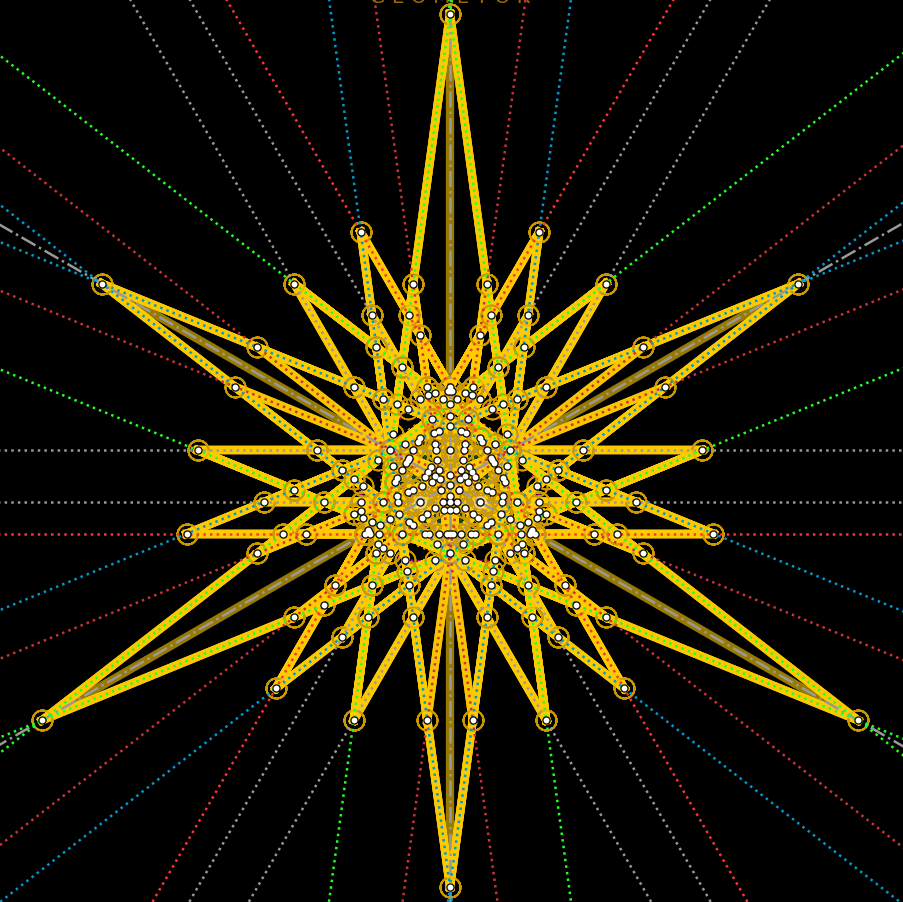
Learned Ignorance, Polygon Exhaustion & the Coincidence of Maximum and Minimum — Critical Commentary & Notes¶
Exact Symbolic Reconstruction, Latin Philology & Canon Reception · DI Ded., I.1–4, Ep. (1440)
I. Exact Symbolic Analysis of Polygon Exhaustion (DI I.3)¶
In DI I.3 §2, Nicholas of Cusa elevates Archimedes' method of exhaustion (archimedes:dimensio) into the foundational epistemological theorem of learned ignorance. For a regular \(n\)-gon inscribed in the unit circle \(x^2 + y^2 = 1\):
Across the constructible tower \(n \in \{3, 4, 6, 8, 12\}\) modeled in
geometor.cusa.polygon_exhaustion_and_complementa, every vertex, apothem, and sagitta lies in
an exact nested quadratic radical field over \(\mathbb{Q}\):
\(n = 3\): \(r_3 = \frac{1}{2}\), \(s_3 = \frac{1}{2}\), \(Q_{\text{side}} = 3\).
\(n = 4\): \(r_4 = \frac{\sqrt{2}}{2}\), \(s_4 = 1 - \frac{\sqrt{2}}{2}\), \(Q_{\text{side}} = 2\).
\(n = 6\): \(r_6 = \frac{\sqrt{3}}{2}\), \(s_6 = 1 - \frac{\sqrt{3}}{2}\), \(Q_{\text{side}} = 1\).
\(n = 8\): \(r_8 = \frac{\sqrt{2+\sqrt{2}}}{2}\), \(s_8 = 1 - \frac{\sqrt{2+\sqrt{2}}}{2}\), \(Q_{\text{side}} = 2 - \sqrt{2}\).
\(n = 12\): \(r_{12} = \frac{\sqrt{6}+\sqrt{2}}{4}\), \(s_{12} = 1 - \frac{\sqrt{6}+\sqrt{2}}{4}\), \(Q_{\text{side}} = 2 - \sqrt{3}\).
Because \(r_n < 1\) strictly for every finite \(n\), the gap between polygon and circle never closes in the finite domain: discursive reason can multiply angles indefinitely without ever reaching identity with the curved continuum.
II. Classical & Scholastic Reception¶
Aristotle & the Bat/Night-Owl Simile (`DI I.1 §3`): Cusa cites Aristotle's Metaphysics II.1 (993b9–11): just as the eyes of bats are to the blaze of day, so is the intellect of our soul to things which are by nature the most evident of all.
The Incommensurable Ratio of Infinite to Finite (`DI I.1 §1`): Cusa invokes the Euclidean principle that ratio exists only between homogeneous magnitudes (Euclid Elements V, Def. 4–5). Because the infinite exceeds every finite quantity beyond any assignable ratio, the infinite qua infinite cannot be grasped through discursive comparison.
Anselmian Maximum (`DI I.2 §1`): Cusa’s definition of the Absolute Maximum draws upon St. Anselm of Canterbury's formula in the Proslogion (Cap. II): aliquid quo maius nihil cogitari potest.
IV. Executable Symbolic Verification¶
In accordance with GEOMETOR’s strict content/code separation for historical editions, executable geometor.model SymPy constructions, Rational Trigonometry proofs, and series-error audits for Learned Ignorance, Polygon Exhaustion & the Coincidence of Maximum and Minimum live in src/geometor/cusa/ and the companion walkthrough Demos.