Content of type 'part'

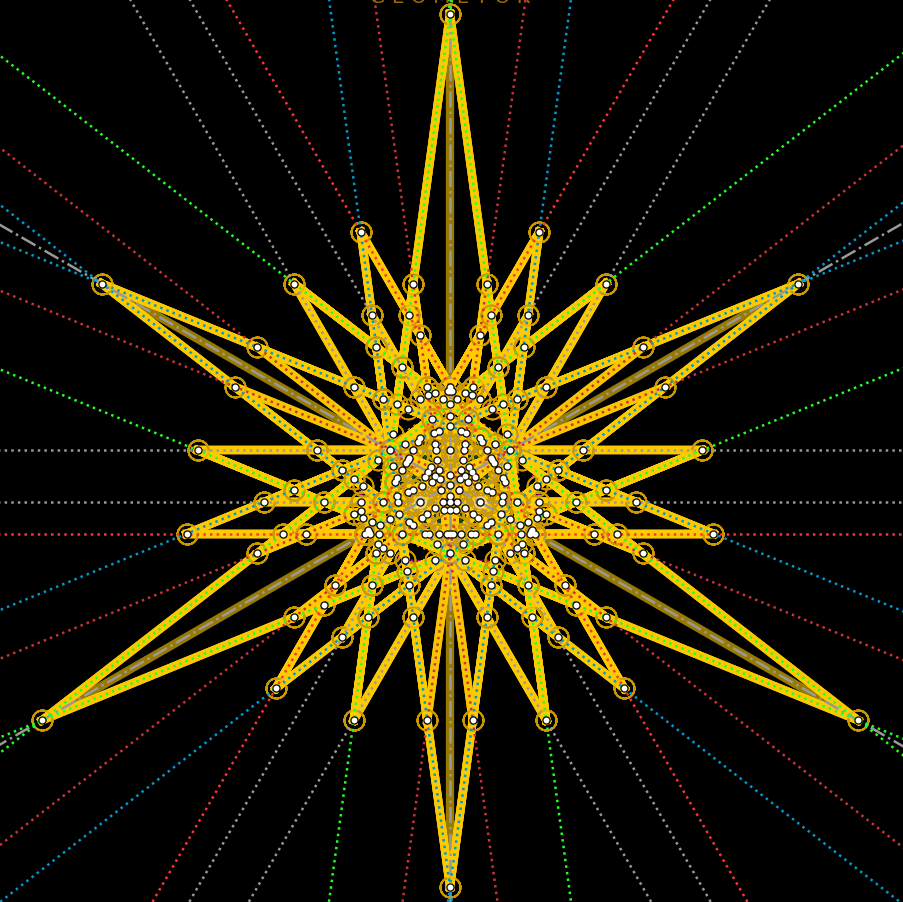
De Docta Ignorantia I.3 — Polygon Exhaustion & Incommensurability of the Circle ( O V0 ): (x - (0))^2 + (y - (0))^2 - (1) = 0 [ W1 W2 ]: (0)*x + (1)*y + (-1) = 0 [ W2 W3 ]: (1)*x + (0)*y + (1) = 0 [ W3 W4 ]: (0)*x + (1)*y + (1) = 0 [ W4 W1 ]: (1)*x + (0)*y + (-1) = 0 [ O S4 ]: (0)*x + (1)*y + (0) = 0 [ T1 T2 ]: (3/2)*x + (-sqrt(3)/2)*y + (sqrt(3)/2) = 0 [ T2 T3 ]: (0)*x + (1)*y + (1/2) = 0 [ T3 T1 ]: (-3/2)*x + (-sqrt(3)/2)*y + (sqrt(3)/2) = 0 [ S1 S2 ]: (1)*x + (-1)*y + (1) = 0 [ S2 S3 ]: (1)*x + (1)*y + (1) = 0 [ S3 S4 ]: (-1)*x + (1)*y + (1) = 0 [ S4 S1 ]: (-1)*x + (-1)*y + (1) = 0 [ H1 H2 ]: (1/2)*x + (-sqrt(3)/2)*y + (sqrt(3)/2) = 0 [ H2 H3 ]: (1)*x + (0)*y + (sqrt(3)/2) = 0 [ H3 H4 ]: (1/2)*x + (sqrt(3)/2)*y + (sqrt(3)/2) = 0 [ H4 H5 ]: (-1/2)*x + (sqrt(3)/2)*y + (sqrt(3)/2) = 0 [ H5 H6 ]: (1)*x + (0)*y + (-sqrt(3)/2) = 0 [ H6 H1 ]: (-1/2)*x + (-sqrt(3)/2)*y + (sqrt(3)/2) = 0 [ O F ]: (1)*x + (0)*y + (0) = 0 W1 = (1, 1) W2 = (-1, 1) W3 = (-1, -1) W4 = (1, -1) O = (0, 0) S4 = (1, 0) H1 = (0, 1) H3 = (-sqrt(3)/2, -1/2) H5 = (sqrt(3)/2, -1/2) S2 = (-1, 0) H4 = (0, -1) H2 = (-sqrt(3)/2, 1/2) H6 = (sqrt(3)/2, 1/2) F = (0, -1/2) O S4 H1 H3 H5 S2 H4 H2 H6 F

Liber I — De Maximo Absoluto

Book I investigates the Absolute Maximum—that than which nothing can be greater—which transcends all comparative proportion and in which the superlative Minimum coincides. Through the mathematical transsumption of the straight line, triangle, circle, and sphere, Cusa demonstrates how geometric symbols serve as an incorruptible ladder to intellectual vision.

Nicholas of Cusa
De Docta Ignorantia II.11–12 — Perspectival Relativity (Undique Centrum, Nullibi Circumferentia) ( T H1 ): (x - (0))^2 + (y - (0))^2 - (4) = 0 ( S H2 ): (x - (3/2))^2 + (y - (1/2))^2 - (4) = 0 ( P H3 ): (x - (-1))^2 + (y - (3/2))^2 - (4) = 0 [ T L ]: (1/2)*x + (-3/4)*y + (0) = 0 [ S M ]: (7/4)*x + (-1)*y + (-17/8) = 0 [ T S ]: (-1/2)*x + (3/2)*y + (0) = 0 [ T P ]: (-3/2)*x + (-1)*y + (0) = 0 [ S P ]: (-1)*x + (-5/2)*y + (11/4) = 0 H1 = (2, 0) H2 = (7/2, 1/2) H3 = (1, 3/2) T = (0, 0) P = (-1, 3/2) L = (-3/4, -1/2) M = (1/2, -5/4) S = (3/2, 1/2) T P L M S

Liber II — De Universo et Cosmologia

Book II develops the cosmology of the contracted universe. Because exact physical equidistance never occurs in nature, no celestial body can occupy an immobile geometric center, nor do fixed celestial poles exist. The universe is as though having its center everywhere and its circumference nowhere (quasi habens undique centrum et nullibi circumferentiam).

Nicholas of Cusa