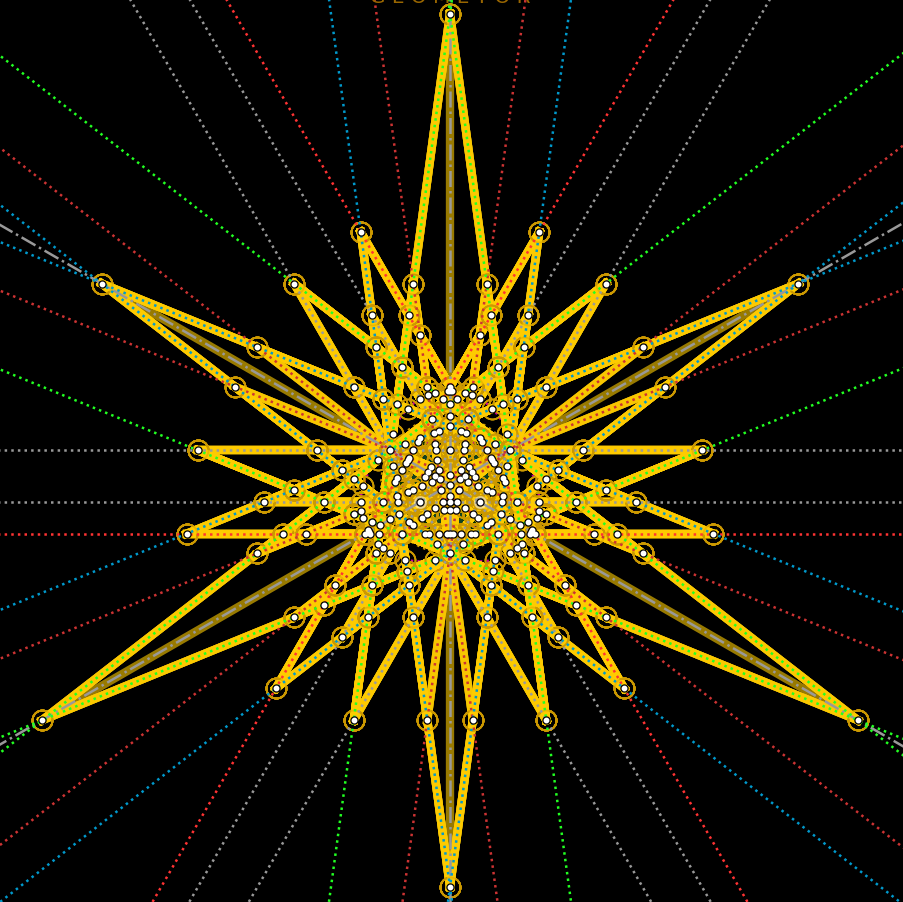
Book III: The Transversal Theorem, Sines & Harmonic Pencils¶
Menelai Alexandrini Sphaericorum Liber Tertius — Edmond Halley (1758, pp. 80–112) & Claudius Ptolemy (1898, pp. 68–75)
Book III is the mathematical pinnacle of the Sphaerica and the foundational cornerstone of spherical trigonometry in world mathematics. Where Books I and II establish the synthetic geometry of spherical triangles and rising-time inequalities, Book III develops the exact quantitative chord/sine metric:
The Menelaus Transversal Theorem (*Theorema Menelai* / *Figura Catha*, Prop. III.1, Halley pp. 80–82): Transfers the six-segment complete quadrilateral ratio across great circles via central gnomonic projection from the sphere center to planar chord triangles.
Foundations of Trigonometry (Lemmata I–II & Props. III.2–III.5): Establishes the Planar Menelaus Theorem, the Chord-Sine projection lemma, the right-spherical-triangle canon, the Spherical Law of Sines, and the Rule of Four Quantities and Tangents.
Harmonic Pencils & Concurrencies (Props. III.6–III.10): Proves the internal and external angle-bisector theorem in sines, spherical harmonic division and 4-ray cross-ratio pencil invariance, the concurrence of angle bisectors (incenter), and the crowning three-transversal proof of the concurrency of spherical altitudes (orthocenter) fifteen centuries before Ceva and Poncelet.
Astronomical Rising Times (Props. III.11–III.25): Concludes with exact arc-difference ratio bounds governing ancient and medieval spherical astronomy.
Sections & Propositions¶
Proposition III.1 — The Spherical Menelaus Transversal Theorem
On the unit sphere S², great-circle transversal DF cuts the sides of spherical triangle A, B, C (AB, BC, CA) at D (external on BC), E, and F, satisfying:
Halley’s Historical Scholion — Chords, Sines & Figura Catha
[§3.3 · Halley 1758, p. 82]
Lemmata I & II — Planar Transversal & Chord-Sine Projection
In geometor.menelaus.planar_transversal, transversal DF cuts the sides of △ABC at D (external on BC), E (on CA), and F (on AB), while auxiliary segment CH drawn parallel to DF transfers both ratios onto AB via Euclid VI.4.
Ptolemy’s Almagest I.13 — The Surviving Greek Witness
Because Menelaus’s original Greek text of the Sphaerica was lost in antiquity, the sole surviving Greek mathematical witness to the transversal theorems is Chapter 13 of Book I of Claudius Ptolemy’s Syntaxis Mathematica (Almagest, c. 140 CE; ed. Heiberg, 1898).
Propositions III.2 & III.3 — Spherical Law of Sines & Rule of Tangents
When \(\mathrm{\Gamma}\) is the pole of \(\mathrm{AB}\) and \(\mathrm{B}\) is the pole of \(\mathrm{A\Gamma}\), angles \(\mathrm{A}, \mathrm{E}, \mathrm{\Delta}\) are right angles and all four arcs \(\widehat{\mathrm{AB}}, \widehat{\mathrm{A\Gamma}}, \widehat{\mathrm{BE}}, \widehat{\mathrm{\Gamma\Delta}}\) are quadrants. Triangles \(\triangle \mathrm{\Gamma EZ}\) and \(\triangle \mathrm{B\Delta Z}\) are right-angled spherical triangles whose angles at \(\mathrm{\Gamma}\) and \(\mathrm{B}\) are measured by arcs \(\widehat{\mathrm{AE}}\) and \(\widehat{\mathrm{A\Delta}}\) respectively. From this corollary, Halley notes, the canons for resolving almost all cases of spherical trigonometry may be deduced without difficulty by dropping perpendiculars to resolve oblique triangles into right-angled ones.
Proposition III.6 — Spherical Internal & External Angle Bisectors
[§4.1 · Internal & External Bisectors, Halley p. 91] Let \(\triangle \mathrm{AB\Gamma}\) be a spherical triangle, and let arc \(\mathrm{B\Delta}\) bisect angle \(\angle \mathrm{AB\Gamma}\): I say that \(\sin \widehat{\mathrm{AB}} : \sin \widehat{\mathrm{A\Delta}} = \sin \widehat{\mathrm{B\Gamma}} : \sin \widehat{\mathrm{\Delta\Gamma}}\) (and alternando, \(\sin \widehat{\mathrm{AB}} : \sin \widehat{\mathrm{B\Gamma}} = \sin \widehat{\mathrm{A\Delta}} : \sin \widehat{\mathrm{\Delta\Gamma}}\)).
Proposition III.8 — Spherical Harmonic Division & Pencils
In verify_spherical_cross_ratio_invariance() (generalizing Sphaerica Prop. III.8 and Pappus’s Synagoge VI/VII), four great circles concurrent at vertex V cut great circles X1X4 and Y1Y4 in four-tuples (X1, X2, X3, X4) and (Y1, Y2, Y3, Y4) having identical spherical sine cross-ratio \(-2\) (and \(-1\) in the harmonic right-angle bisector case of Prop. III.8).
Proposition III.9 — Concurrency of Spherical Angle Bisectors
[§4.3 · Demonstration, Halley p. 95] In \(\triangle \mathrm{AB\Gamma}\), let the angle bisectors \(\mathrm{A\Delta}\) and \(\mathrm{\Gamma\Delta}\) of \(\angle \mathrm{A}\) and \(\angle \mathrm{\Gamma}\) meet at \(\mathrm{\Delta}\), and join \(\mathrm{B\Delta}\) produced to meet base \(\mathrm{A\Gamma}\) at \(\mathrm{E}\).
Proposition III.10 — Concurrency of Spherical Altitudes
[§4.4 · Menelaus’s Masterpiece Proof via Triple Menelaus & Orthic Harmonic Polarity, pp. 95–97] Let \(\triangle \mathrm{AB\Gamma}\) be a spherical triangle, and from vertices \(\mathrm{A}\) and \(\mathrm{\Gamma}\) drop perpendicular arcs \(\mathrm{A\Delta} \perp \mathrm{B\Gamma}\) and \(\mathrm{\Gamma E} \perp \mathrm{AB}\) meeting at \(\mathrm{Z}\); join \(\mathrm{BZ}\) and produce it to meet \(\mathrm{A\Gamma}\) at \(\mathrm{H}\) (crossing \(\mathrm{E\Delta}\) at \(\mathrm{K}\)). Menelaus claims \(\mathrm{BH} \perp \mathrm{A\Gamma}\):
Propositions III.11–III.25 — Astronomical Rising Times & Closing Horizon
Following the triumph of Proposition III.10 (concurrency of altitudes), the remainder of Book III (Propositions III.11–III.25, Halley pp. 97–112) shifts from triangle center configurations to quantitative spherical difference-ratio bounds and rising-time proportion laws: