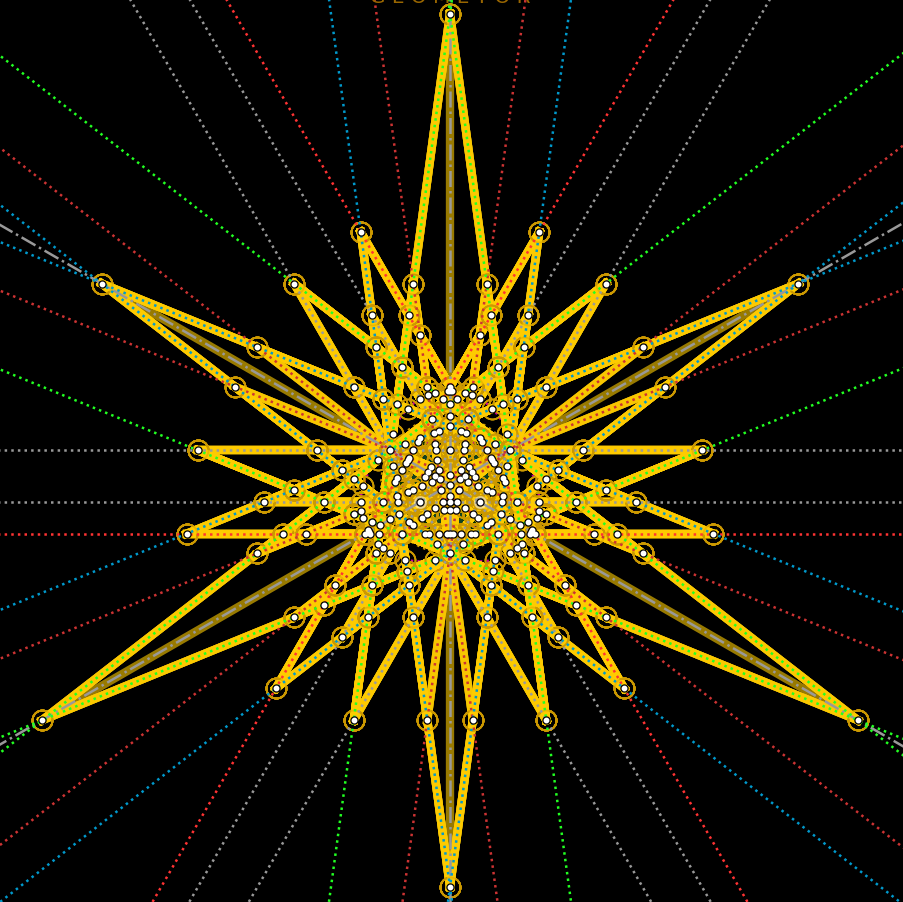
Analytical Summary: Spherical Harmonic Division & Projective Invariance
Modern Elements-2.0 Decomposition of Proposition III.8
1. Geometric Architecture of Harmonic Division on S²
Direct Theorem: - Right-angled spherical triangle \(\triangle AB\Gamma\) (\(\angle B = 90^\circ\)). - Two rays \(B\Delta, BE\) making equal angles with leg \(BA\) (\(\angle AB\Delta = \angle ABE\)). - By Prop. III.6 applied to internal and external bisectors, the base points \(\Gamma, E, \Delta, A\) satisfy:
\[\frac{\sin\widehat{\Gamma E}}{\sin\widehat{EA}} \;=\; \frac{\sin\widehat{\Gamma\Delta}}{\sin\widehat{\Delta A}}.\]First Converse (Characterization of Right Angles): - If the sine cross-ratio is harmonic and \(\angle EBA = \angle AB\Delta\), then \(\angle AB\Gamma = 90^\circ\).
Second Converse (Characterization of Bisectors): - If the sine cross-ratio is harmonic and \(\angle AB\Gamma = 90^\circ\), then \(\angle EBA = \angle AB\Delta\).
2. The Bridge to Projective Geometry
Proposition III.8 is the exact spherical predecessor of harmonic bundles and the cross-ratio invariance of 4-ray pencils. Menelaus establishes that harmonic division on the sphere is purely angular: whether measured along the base arc \(A\Gamma\) or projected via great circles, the cross-ratio in sines remains invariant.