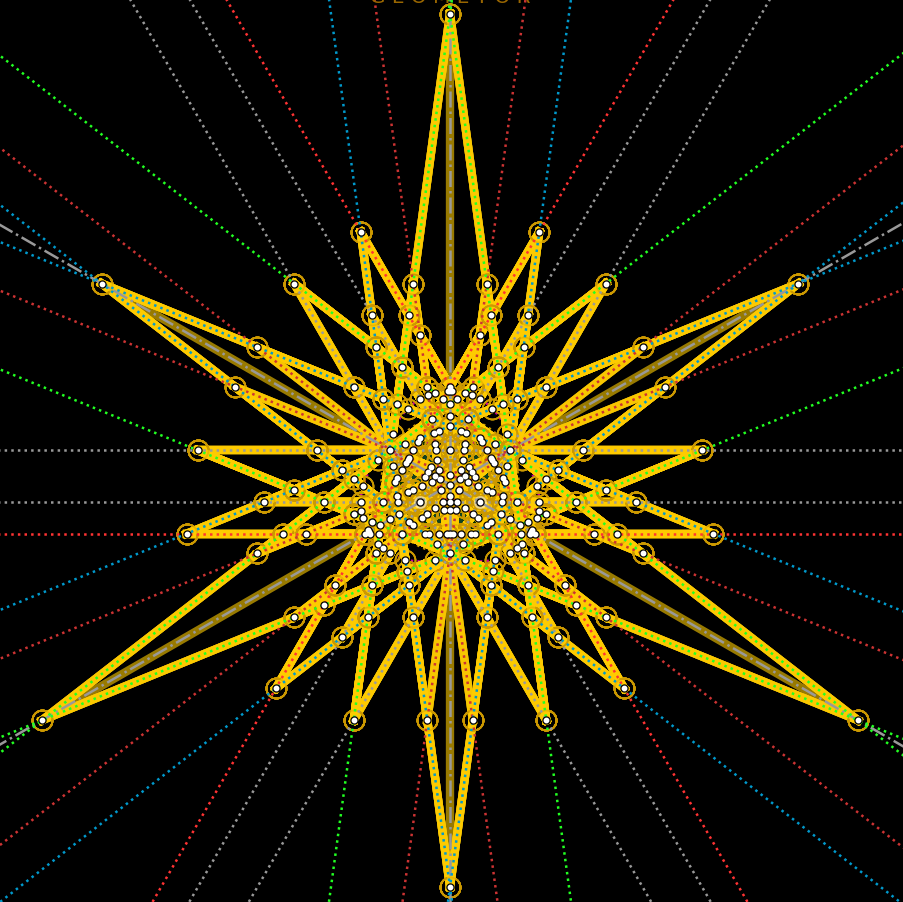
Analytical Summary: The Philological Arc from Chord to Sine & Figura Catha
Deductive & Terminological Evolution of Proposition III.1
1. Chords of Double Arcs vs. Sines
Greek Antiquity: Ptolemy and Menelaus operated with the chord subtending double the arc, \(\operatorname{crd}(2\theta) = 2R \sin \theta\). All compound ratios involved ratios of chords.
Medieval Arabic: Translators rendered the Sanskrit jīvā as Arabic
جيب(jayb, pocket / fold / sinus), standardizing the half-chord function \(R \sin \theta\).Medieval Hebrew: Jacob ben Machir used
נכחות(nekhōḥōth).Early Modern Latin: Edmond Halley deliberately chose Sinus over subtensa dupli arcus because the ratios of half-chords are identical to ratios of full chords:
\[\frac{\operatorname{crd}(2\alpha)}{\operatorname{crd}(2\beta)} \;=\; \frac{2R \sin \alpha}{2R \sin \beta} \;=\; \frac{\sin \alpha}{\sin \beta}.\]
2. Transmission Path: Alexandria -> Baghdad -> Toledo -> Oxford
Halley highlights the direct transmission vector:
Menelaus (Alexandria, c. 100 CE) -> Ptolemy (Syntaxis I.13, c. 140 CE).
Arabic redactions by Ishāq ibn Hunayn and Thābit ibn Qurra (9th c. CE), naming the transversal figure al-Qaṭṭāʿ (the sector / intersection).
Latin reception in Toledo and medieval England: Figura Catha, studied extensively by 14th-century Oxford Mertonian Simon Bredon.
Edmond Halley’s 1758 Oxford reconstruction synthesizing Bodleian Hebrew and Arabic manuscripts.