Commentary & Notes — On the Origin of Science from Sensible Things, Turning to Phantasms, and Threefold Abstraction
Aristotelian Sources, Euclidean Counterparts, Hoenen’s Noetics, and GEOMETOR Significance
Aristotelian & Scholastic Foundations
Written at the height of Aquinas’s maturity (c. 1267–1268, contemporary with his Sentencia libri De anima in Part III of this Codex), Questions 84 and 85 orchestrate a grand historical dialectic among Democritus (De Somno, De Generatione I.8), Plato, Augustine (83 Different Questions, De Genesi ad litteram XII), Avicenna, and Aristotle (De Anima III.4–8, Metaphysics Z.10–11, Posterior Analytics II.19). By grounding human cognition in the substantial unity of the rational soul as forma corporis, Aquinas explains why our intellect occupies the exact ontological midpoint between bodily sense (bound to individual corporeal matter) and angelic intelligence (proportioned to separate forms): its proper object is the quiddity existing in corporeal matter, which must be abstracted from individuating conditions by the intellectus agens yet contemplated in concrete particulars via conversio ad phantasmata.
Euclidean & Classical Geometric Counterparts
Question 85, Article 1, ad 2 codifies the epistemological charter of Euclidean geometry within the hierarchy of sciences: numeri et dimensiones et figurae, quae sunt terminationes quantitatum—precisely the subject-genera of Euclid‘s arithmetic (Books VII–IX), plane geometry (Books I–VI), and stereometry (Books XI–XIII)—can be considered apart from all sensible qualities (hot/cold, hard/soft) because dimensive quantity inheres in corporeal substance prior to sensible qualities, yet cannot be understood without substance subject to quantity (materia intelligibilis communis). Simultaneously, Question 84, Article 7’s phenomenological appeal—that whenever we strive to understand or teach someone else, we form exemplary phantasms (exempla) in which to inspect the universal truth—describes the universal pedagogical structure of Euclid’s Elements, where every general protasis (‘In any triangle…’) is immediately instantiated in a singular lettered ekthesis (‘Let ABC be a triangle…’).
Hoenen’s De Noetica Geometriae & Judgment Theory
Hoenen builds Chapters II and III of De Noetica Geometriae directly upon ST I, q. 84, a. 6 (and ad 3, concordance key aquinas:st:I.q84.a6), q. 84, a. 7, and q. 85, a. 1, ad 2 (concordance key aquinas:st:I.85.1.ad2), just as Lonergan centers Verbum Chapter 1 (‘Insight into Phantasm‘) upon ST I, q. 84, a. 7! Hoenen emphasizes two revolutionary insights in these texts. First, because sensible cognition is only the materia causae while the intellectus agens supplies higher active power (q. 84, a. 6, co. & ad 3), intellectual judgment draws from defective sensible diagrams exact geometric limits—such as indivisible points and breadthless tangent lines (answering Protagoras’s objection that sensible circles touch a ruler across a segment rather than at a single point)—that transcend raw sensory data while remaining objectively true of extended continua. Second, q. 85, a. 1, ad 1–2 proves that geometric abstraction is an intuitive inspection of formal structure (simplex et absoluta consideratio) within materia intelligibilis, never a mendacious Platonic hypostatization.
GEOMETOR Constructive & Symbolic Significance
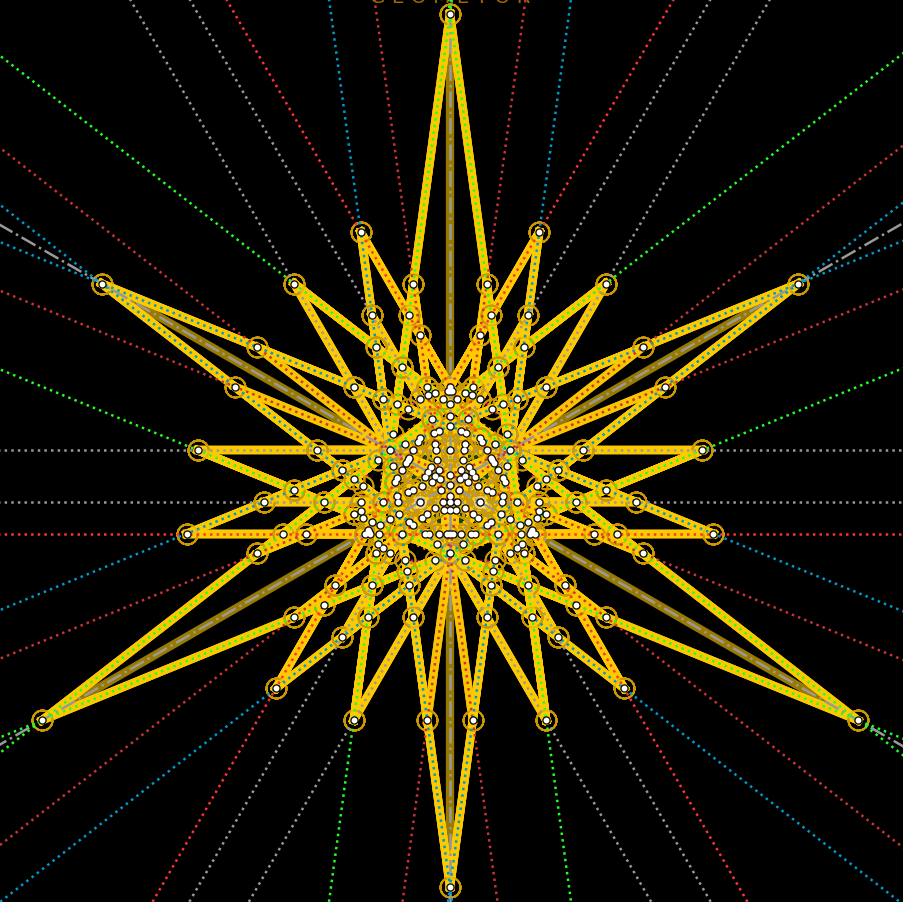
Aquinas’s twin doctrines of abstractio a materia sensibili (q. 85, a. 1, ad 2) and conversio ad phantasmata (q. 84, a. 7) map directly onto the dual architecture pairing geometor.model with geometor.explorer (and, in abstract visual reasoning, geometor.seer with geometor.seer_navigator). geometor.model executes pure mathematical abstraction by stripping away every floating-point pixel artifact or physical imperfection, representing points, lines, and circles in exact algebraic species over materia intelligibilis; yet to comprehend, teach, and heuristically explore those symbolic structures, human reason requires geometor.explorer’s visual SVG diagrams—concrete exemplary phantasms (per modum exemplorum) in which the intellect directly beholds universal proportional harmonies instantiated in a particular construction.