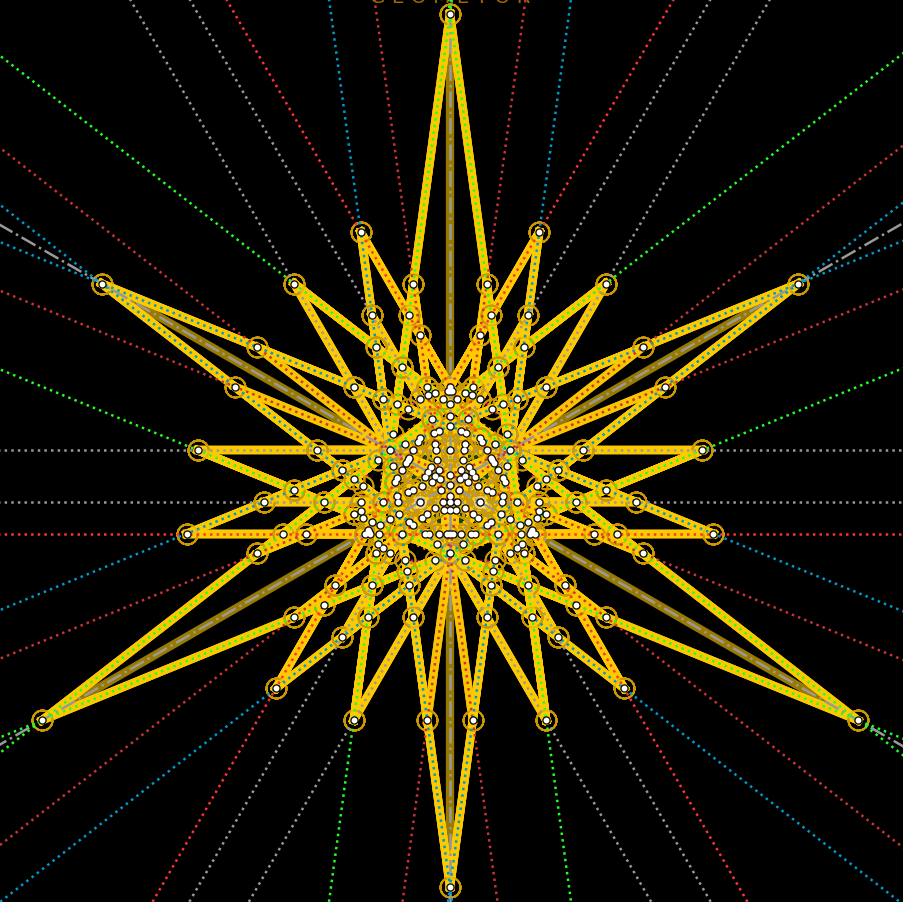
Commentary & Notes — On Action and Passion and the Division of Being into Ten Categories Proportional to Modes of Predicating¶
Aristotelian Sources, Euclidean Counterparts, Hoenen’s Noetics, and GEOMETOR Significance
Aristotelian & Scholastic Foundations¶
Commenting on Physics III.3 (202a13–202b29), Aquinas resolves Aristotle‘s famous aporia on the locus of motion—whether teaching (didaxis) and learning (mathesis), or action (poiesis) and passion (pathesis), are two motions or one—using Aristotle’s own topological analogy of a single road between Thebes and Athens (202b13–14) and a single spatial interval between two points (to metaxy, 202a18–20). Going far beyond a mere paraphrase, Aquinas inserts in nn. 14–17 one of the two great categorial deductions in his entire corpus (parallel to In V Metaphysicorum, lect. 9, n. 890), silently correcting Averroes (In Phys. III, comm. 20–23) and Avicenna on whether motion belongs to a category via ad rem (motus ad formam) or forma fluens. By distinguishing what motion is in rerum natura (an imperfect act reduced to the category of its terminus: quantity, quality, or where) from what reason apprehends in motion as a directed transition from agent to patient (grounding the extrinsic denominations of action and passion), Aquinas preserves both Categories 4 (1b25–2a4) and Physics V.1–2 (225b5–9) within a single analogical metaphysics of being.
Euclidean & Classical Geometric Counterparts¶
Two profound Euclidean insights emerge within Aquinas’s categorial deduction in In III Phys., lect. 5. First, in n. 15 Aquinas explicitly locates geometric figure (figura) in the fourth species of the category of quality (Categories 8, 10a11–24), observing that figure follows upon form yet is founded immediately upon dimensive quantity—specifically in lines and surfaces as quantitative boundaries (sicut color in superficie, et figura in lineis vel in superficiebus). This explains why Euclidean figures possess both metric magnitude (equality of area or length, governed by Common Notions 1–4) and qualitative shape (similarity of rectilinear figures in Elements Book VI Def. 1, governed by angular equality and proportional sides independent of scale). Second, Aquinas’s analysis in nn. 10–12 of the spatial distance (spatium distantium) between two points—identical in abstracto as a metric segment AB = BA, yet distinct in concreto when applied to ordered endpoints from A to B versus from B to A—captures the exact distinction in Euclidean construction between an undirected segment and a directed ray or circle construction (Postulate 3, where one endpoint serves as stationary center and the other determines radial extremity).
Hoenen’s De Noetica Geometriae & Judgment Theory¶
Peter Hoenen S.J. explicitly singles out In III Physicorum, lect. 5 in the Appendix (§ 5, p. 341) of De Noetica Geometriae alongside In V Metaphysicorum, lect. 9 as the master text demonstrating how Aquinas constructs the Aristotelian categories from modes of being (modi essendi) proportional to modes of predicating (modi praedicandi). For Hoenen, this text proves that human intellectual apprehension does not grasp naked static quiddities alone, but abstracts distinct existential and relational modes—inherence (esse in), substantiality (esse per se), and fluent actuality (esse fluens in motion). Moreover, in Chapter IV (§ 2 and § 4.2), Hoenen builds directly on the Thebes-to-Athens / hinc illuc directional analysis of Phys. III.3 and IV.11: while a static line segment AB is one single extension, actuating motion or passage through its endpoints reveals two really distinct, inverse directions (A to B versus B to A), showing that directional order (thesis) and quantitative measure are complementary intelligible aspects of the geometric continuum.
GEOMETOR Constructive & Symbolic Significance¶
Aquinas’s analysis of action as from this (ut ab hoc) and passion as in this (ut in hoc), together with his placement of figure as a form-like quality supervening on quantitative boundaries, resonates directly with constructive geometry as a directed acyclic graph (DAG) in geometor.model. Every compass-and-straightedge step in a GEOMETOR construction—joining two parent points to produce a line, or centering a circle at one point through another to cut an existing locus—embodies a single constructive operation that is simultaneously active with respect to its ancestral parent elements (ut ab hoc) and receptive in instantiating derived child intersections (ut in hoc). Furthermore, Aquinas’s categorial distinction between intrinsic quantitative measure (length, breadth, depth) and qualitative figure grounded on boundaries mirrors the separation between metric coordinate evaluation and projective or proportional invariants studied in geometor.divine and geometor.pappus, where golden sections and harmonic cross-ratios persist across scale and transformation as qualitative structural forms supervening upon continuous extension.