Commentary & Notes — On Discovering Geometric Truth by Dividing Figures in Act (Euclid I.32 and III.31)
Aristotelian Sources, Euclidean Counterparts, Hoenen’s Noetics, and GEOMETOR Significance
Aristotelian & Scholastic Foundations
In Metaphysics Θ.9 (1051a21–33), Aristotle compressed two famous geometric proofs into ten terse, elliptical Greek lines that baffled commentators from Alexander of Aphrodisias to pseudo-Alexander and Averroes. Aquinas’s exposition in Marietti nn. 1888–1894 is a triumph of philosophical and mathematical clarity: situating Θ.9 as the transition from the ontological comparison of act and potency (in priority and goodness) to the veritative treatise of Θ.10, Aquinas explains why geometric discovery (inventio) depends upon actualizing potentiality. Because a continuous magnitude contains infinite potential divisions prior to actual construction, an undivided figure conceals the middle terms required for demonstration; when the geometer actively divides lines and surfaces (facientes aliquid actu cognoscunt), potential relations become actualized objects proportional to the intellect, which is itself act (intellectus actus est, n. 1894).
Euclidean & Classical Geometric Counterparts
Aquinas supplies full, crystal-clear reconstructions of both Euclidean theorems cited by Aristotle! First (Marietti nn. 1889–1890), for the theorem that a triangle’s interior angles equal two right angles (Elements I.32), Aquinas produces base AC of triangle ABC continuously to form an exterior angle at C; invoking Elements I.13 (a straight line standing on a straight line makes two right angles or angles equal to two right angles) alongside the equality of the exterior angle to the two opposite interior angles (proved in Euclid via a parallel through C using I.29 and Postulate 2), the angle-sum theorem becomes immediately visible. Second (Marietti nn. 1891–1893), for Thales’s theorem that every angle inscribed in a semicircle is a right angle (Elements III.31), Aquinas bisects diameter AC at center D and draws radius DB; because DA, DC, and DB are equal radii, triangles DBA and DBC are isosceles (Elements I.5), and by applying the exterior angle property (Elements I.32) to angles BDC and ADB at the center—whose sum equals two right angles (Elements I.13)—their sum is shown to be double the inscribed angle ABC, proving immediately that ABC is one right angle (a famously elegant pre-Euclidean variant of Elements III.31 preserved by Pappus and Eutocius!).
Hoenen’s De Noetica Geometriae & Judgment Theory
No single text in the Thomistic corpus better exemplifies the central thesis of Hoenen‘s De Noetica Geometriae and Bernard Lonergan‘s Verbum: Word and Idea in Aquinas (Ch. 1, opening with the celebrated Euclidean diagram insight!) than In IX Metaphysicorum, lect. 10, nn. 1888–1894 (cited by Hoenen under concordance key aquinas:met:9.10.1894). Look at Aquinas’s repeated phrase in nn. 1890 and 1893: statim manifestum fit videnti dispositionem figurae (‘it becomes immediately manifest to one seeing the disposition of the figure’)! Neither blind sensory staring at an undivided triangle nor purely formal syllogizing without a diagram yields discovery; rather, heuristic imagination actively constructs auxiliary lines (dividendo lineas et superficies), and in that actualized spatial phantasm the agent intellect grasps the necessary formal nexus directly in act prior to formulating the demonstrative syllogism.
GEOMETOR Constructive & Symbolic Significance
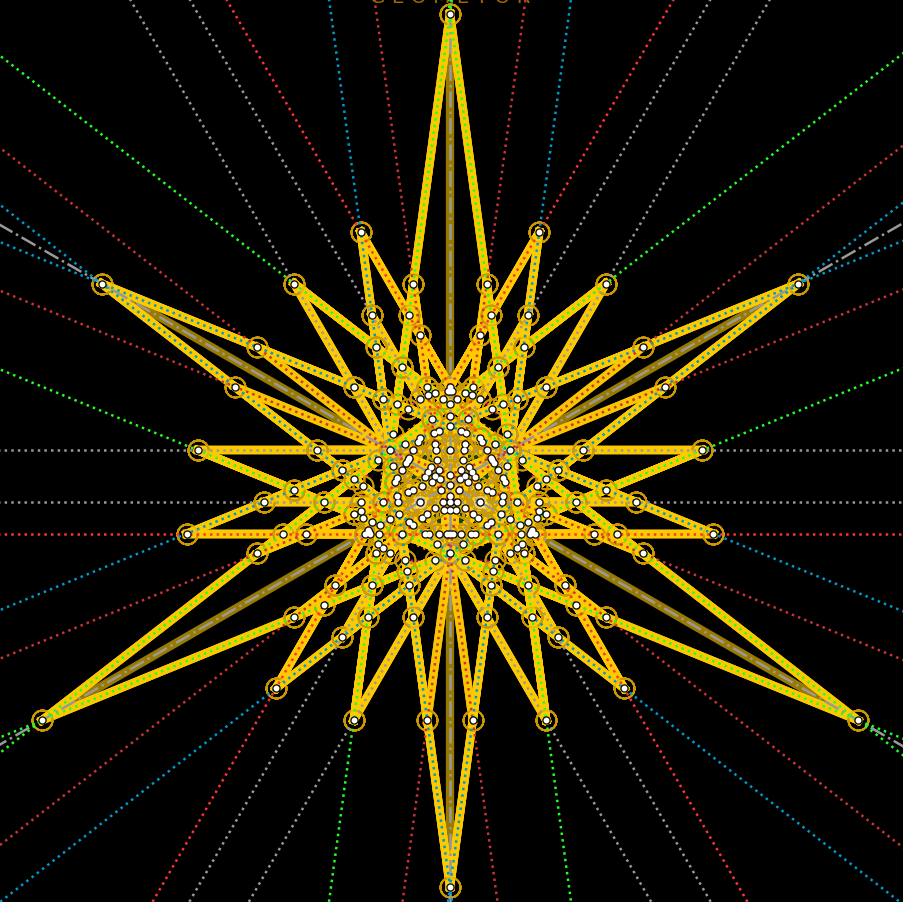
In IX Metaphysicorum, lect. 10 is the philosophical charter of the entire GEOMETOR project. In geometor.model, an initial seed configuration—such as two fundamental points—holds an immense lattice of harmonic ratios, golden sections, and regular polygons purely in potentia; as Aquinas writes in Marietti n. 1888, ‘because in the first drawing of figures divisions of this sort exist in potency, what is sought does not immediately become manifest.’ Every constructive step executed in geometor.model—extending a line through two points or describing a circle—literally performs Aquinas’s divisio reducit in actum quod erat in potentia, computing exact symbolic polynomial intersections that bring latent points into actual existence. Once brought into act, geometor.divine immediately detects golden sections (φ) and harmonic ranges across collinear point-sets, while geometor.explorer renders the actualized dispositio figurae so the geometer sees the invariant structure directly in act.