Commentary & Notes — How the Soul Is in a Way All Things, the Hand the Organ of Organs, and the Intellect the Form of Forms¶
Aristotelian Sources, Euclidean Counterparts, Hoenen’s Noetics, and GEOMETOR Significance
Aristotelian & Scholastic Foundations¶
Commenting on De Anima III.8 (431b20–432a14), Aquinas brings Aristotle‘s treatise on the cognitive powers to its grand architectural synthesis. Aristotle recapitulates his critique of Pre-Socratic materialism from Book I (such as Empedocles’s physical isomorphism, ‘by earth we see earth,’ 404b13), reinterpreting the ancient insight through hylomorphic intentionality: ἡ ψυχὴ τὰ ὄντα πώς ἐστι πάντα (‘the soul is in a way all beings,’ 431b21) because sense receives sensible forms without matter and intellect receives intelligible forms. At 432a1–3 Aristotle crowns this doctrine with the celebrated proportion: ὥστε ἡ ψυχὴ ὥσπερ ἡ χείρ ἐστιν· καὶ γὰρ ἡ χεὶρ ὄργανόν ἐστιν ὀργάνων, καὶ ὁ νοῦς εἶδος εἰδῶν (‘so that the soul is like the hand; for the hand is the organ of organs, and the intellect is the form of forms,’ no. 789), before insisting at 432a3–14 that because no intelligible exists apart from sensible magnitudes, anyone contemplating in act must simultaneously behold a phantasm (ἅμα φάντασμά τι θεωρεῖν, nos. 790–793).
Euclidean & Classical Geometric Counterparts¶
Aquinas’s insistence in nos. 790–791 that even a master possessing habitual geometry cannot contemplate in act without forming a singular phantasm illuminates the classical formal structure of every proposition in Euclid‘s Elements (analyzed by Proclus into protasis, ekthesis, diorismos, kataskeue, apodeixis, and symperasma). Euclid never proves a universal protasis (‘On a given finite straight line to construct an equilateral triangle,’ or ‘In right-angled triangles the square on the hypotenuse equals the squares on the sides’) through imageless verbal syllogisms alone; instead, he immediately performs an ekthesis (‘Let AB be the given finite straight line’) and kataskeue (auxiliary circles and segments), instantiating a singular sensible-imaginative diagram. As Aquinas explains in no. 793, the Euclidean diagram (phantasma) is particular in representation yet contains the universal geometric truth in potency, while the compass and straightedge themselves exemplify manual instruments crafted by the hand as organ of organs (no. 789).
Hoenen’s De Noetica Geometriae & Judgment Theory¶
In De Noetica Geometriae, Chapter I, § 2 (citing De Anima III.8, 432a5–9 and Aquinas, Lecture 13, Pirotta no. 791) and Chapter V (on symbolic logic and logica utens), Hoenen deploys Aquinas’s anti-Avicennian argument to critique modern mathematical logicism and Hilbertian pure formalism. Just as Avicenna imagined that once the intellect has acquired scientific habits it can operate purely among abstract intentions without returning to sensory imagination—a thesis refuted by Aquinas both ontologically and clinically (no. 791)—radical formalists suppose that once axioms are encoded in ‘transcendent terms’ (symbolic letters a, b, c), geometry dispenses with spatial intuition altogether. Hoenen acknowledges (quoting Hadamard on Hilbert) the immense utility of stable symbolic formulas as intellectual instruments, yet proves from Pirotta no. 791 that symbols retain real geometric meaning and truth (which belongs solely to intellectual composition and division, no. 792) only insofar as the mind vitalizes them through ongoing turning to the phantasms.
GEOMETOR Constructive & Symbolic Significance¶
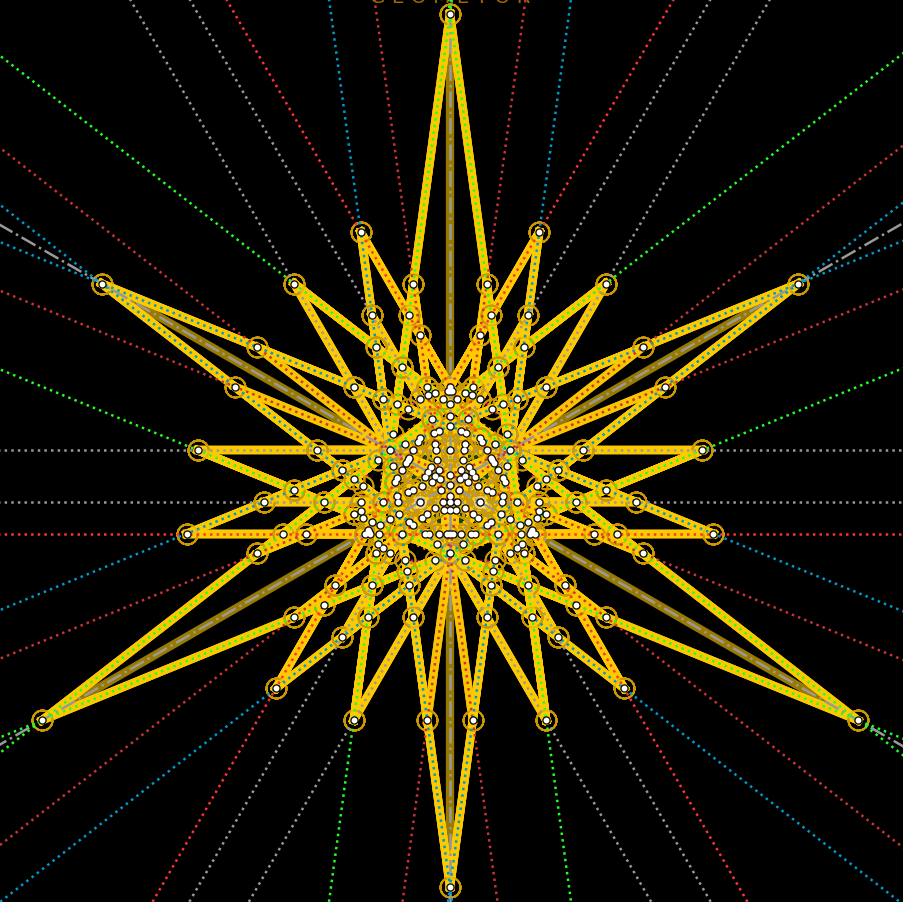
Aquinas’s analogy of the hand as the organ of organs (organum organorum) and the intellect as the form of forms (species specierum, no. 789), paired with the permanent necessity of the phantasm in habitual contemplation (nos. 790–791), articulates the deepest philosophical identity of the GEOMETOR ecosystem. Symbolic computation in geometor.model, automated proportional discovery in geometor.divine, propositional DAG reconstruction in geometor.elements, and interactive visualization in geometor.explorer are intellectual extensions of the organ of organs—universal cognitive instruments crafted by human reason in place of fixed biological instincts. Crucially, GEOMETOR refuses the Avicennian or formalist severance of algebra from vision: geometor.model never replaces the visual phantasm of geometor.explorer, nor is geometric truth reduced to the mere image on the canvas (no. 793); rather, exact symbolic reason and luminous spatial imagination operate in continuous synergy whenever the geometer contemplates in act.