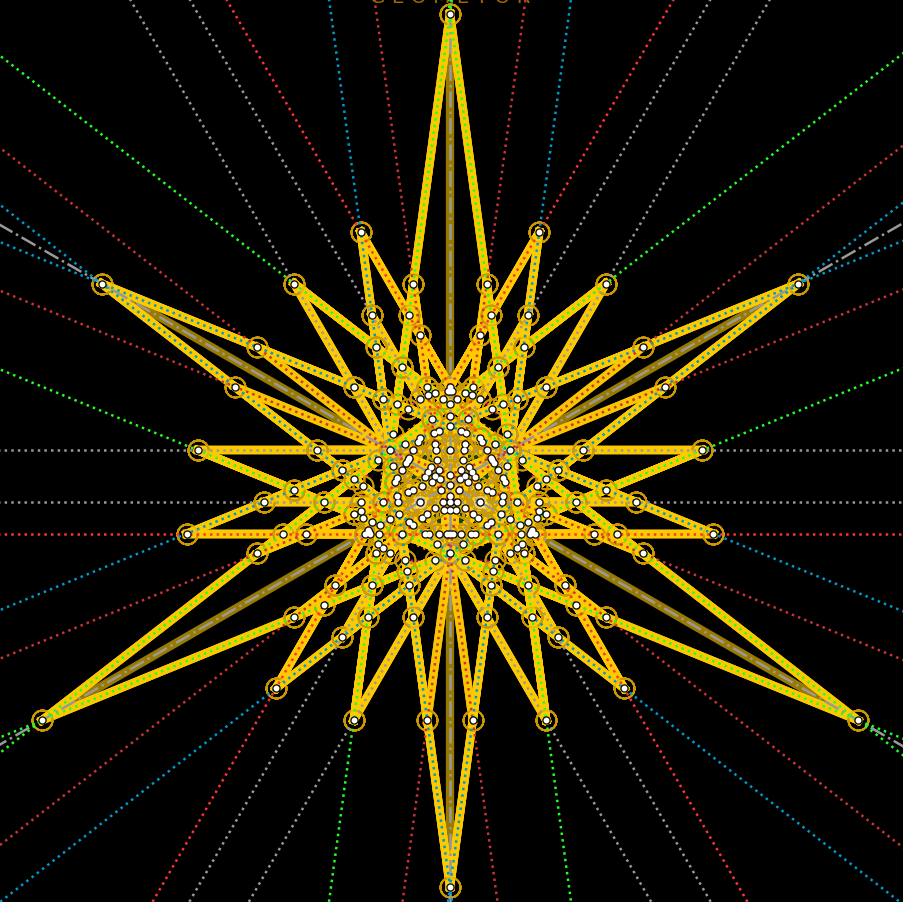
Commentary & Notes — Whether Natural Philosophy Treats of What Exists in Motion and Matter
Aristotelian Sources, Euclidean Counterparts, Hoenen’s Noetics, and GEOMETOR Significance
Aristotelian & Scholastic Foundations
Article 2 rests upon Aristotle‘s anti-Platonic polemic in Metaphysics I.6 (987a32–b10) and VII.7–11 (1033a24–1037a10), together with Physics II.2 and VIII.5–10 and On the Soul III.4 (429b10–22). Whereas Plato inferred from Cratylean sensory flux that universal definitions must refer to separate subsistent Forms, Aristotle distinguished concrete singulars (Socrates, this bronze sphere) from universal composite essences that include common matter (flesh and bones universally) while excluding individual material designation. Aquinas sharpens Aristotle’s Metaphysics VII.10 distinction by forging his signature doctrine of designated matter (materia signata—matter subject to determinate spatial dimensions responsible for hic et nunc local position and individuation) as opposed to undesignated or common matter (materia communis), and by invoking On the Soul III.4 to explain our secondary knowledge of material singulars via intellectual reflexio mediated by the sensitive powers.
Euclidean & Classical Geometric Counterparts
Two striking geometric principles animate Aquinas’s argument in Article 2. First, in co. 2, local motion is identified as the primary motion presupposed by all physical change, and individuation in the mobile continuum is traced to designated dimensions (dimensiones signatae)—anticipating the way a concrete geometric diagram instantiates universal geometric ratios within particular chosen coordinates without restricting the theorem’s universality to that singular placement. Second, in ad 3, Aquinas illustrates how natural philosophy reaches the immaterial First Mover as its extrinsic terminus through the classical Euclidean analogy of the point and the line (Elements I, Defs. 1 and 3: A point is that which has no part, and The extremities of a line are points): just as the endpoint terminates a continuous one-dimensional magnitude and stands in an essential relation to it without itself possessing linear extension, so an unextended principle terminates a causal series of motions without sharing mobile materiality.
Hoenen’s De Noetica Geometriae & Judgment Theory
In La théorie du jugement d’après St Thomas d’Aquin (1946; 2nd ed. 1953) and Chapters II–III of De Noetica Geometriae (1954), Hoenen draws extensively upon Aquinas’s analysis of universal rationes and reflective application (q. 5, a. 2, co. 3 and ad 4) to explain how universal necessary science grasps concrete reality. Hoenen emphasizes that in Thomistic noetics the universal nature is neither a Platonic hypostasis nor a subjective nominalist label, but an objective formal structure (ratio) abstracted from hic et nunc designation in the pre-predicative phantasm. When the intellect judges, it uses this immobile ratio as a formal medium of knowing (ut medio sciendi) and reflects back upon the concrete data presented by the lower cognitive powers, thereby validating both the necessity of pure geometric theorems and their legitimate application to extended physical bodies.
GEOMETOR Constructive & Symbolic Significance
Aquinas’s distinction between singular designated dimensions (hic et nunc coordinates) and universal intelligible rationes, together with his geometric analogy in ad 3 of the indivisible point as the non-homogeneous terminus of a line, directly illuminates symbolic modeling in geometor.model. When a construction begins from two initial anchor points at coordinates (0, 0) and (1, 0), those chosen coordinates play the role of designated dimensions instantiating the construction, yet the algebraic and projective relationships uncovered across the resulting directed acyclic graph express universal per se geometric invariants wholly independent of scale, translation, or rotation. Likewise, in geometor.model, points arise not as tiny physical specks of extension, but as exact zero-dimensional algebraic limits (termini) generated at the intersections of lines and circles.