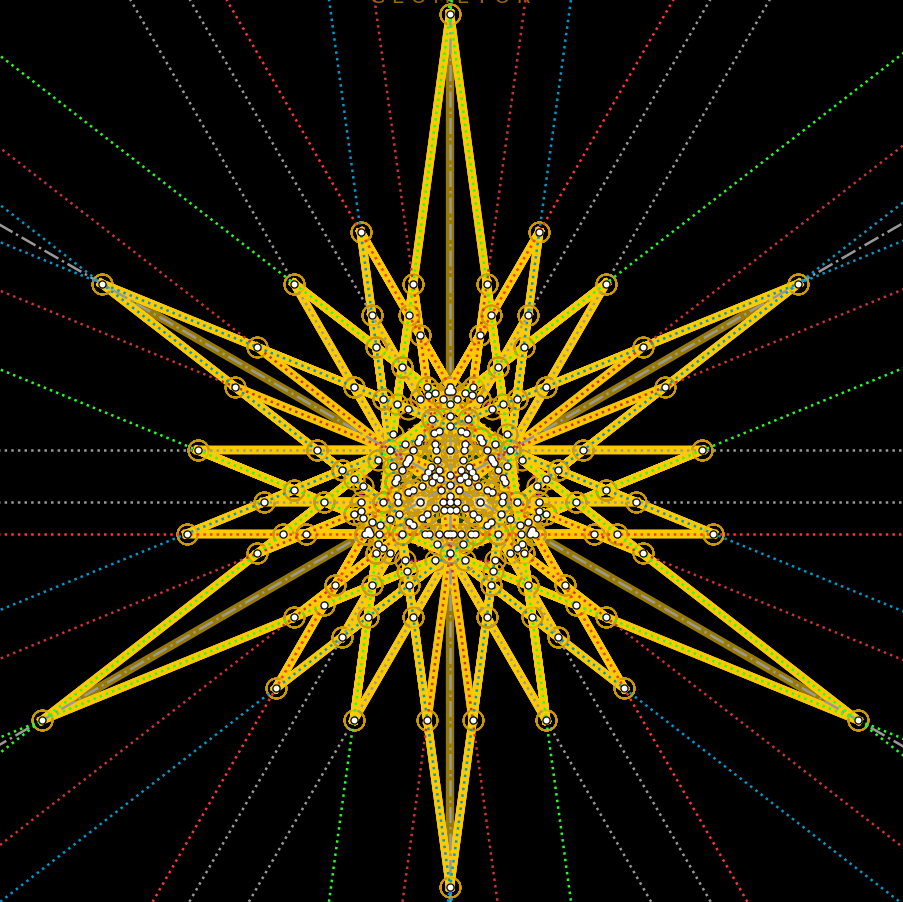
§ 10 & Concluding Remarks: $n$-Manifolds & Continuous Galois Theory — Summary¶
Analytical Synopsis of $n$-Manifolds and the Continuous-Discrete Galois Bridge
§ 10 & Concluding Remarks: $n$-Manifolds, Coordinate-Free Invariants, and Galois Theory¶
$n$-Manifolds (§ 10): Projective invariant theory ($\operatorname{PGL}_{n+1}$), constant-curvature Riemannian/Cayley–Klein manifolds (stabilizing a quadric), and flat Euclidean manifolds (stabilizing adegenerate hyperplane-quadric pair) unify differential and projective geometry in arbitrary dimension.
Coordinate-Free Invariant Formalism: Coordinates are harmless only when the analytical calculus operates exclusively with group invariants (such as algebraic invariants or Hamilton’s quaternions for $\operatorname{SO}_3$).
The Bridge to Book 1 — Continuous vs. Discrete Galois Theory: In his closing manifesto, Klein explicitly parallels continuous transformation groups on manifolds with Évariste Galois’s permutation groups on polynomial roots—linking the Erlangen Program directly to the algebraic constructibility and icosahedral/cyclotomic group theory of Famous Problems!