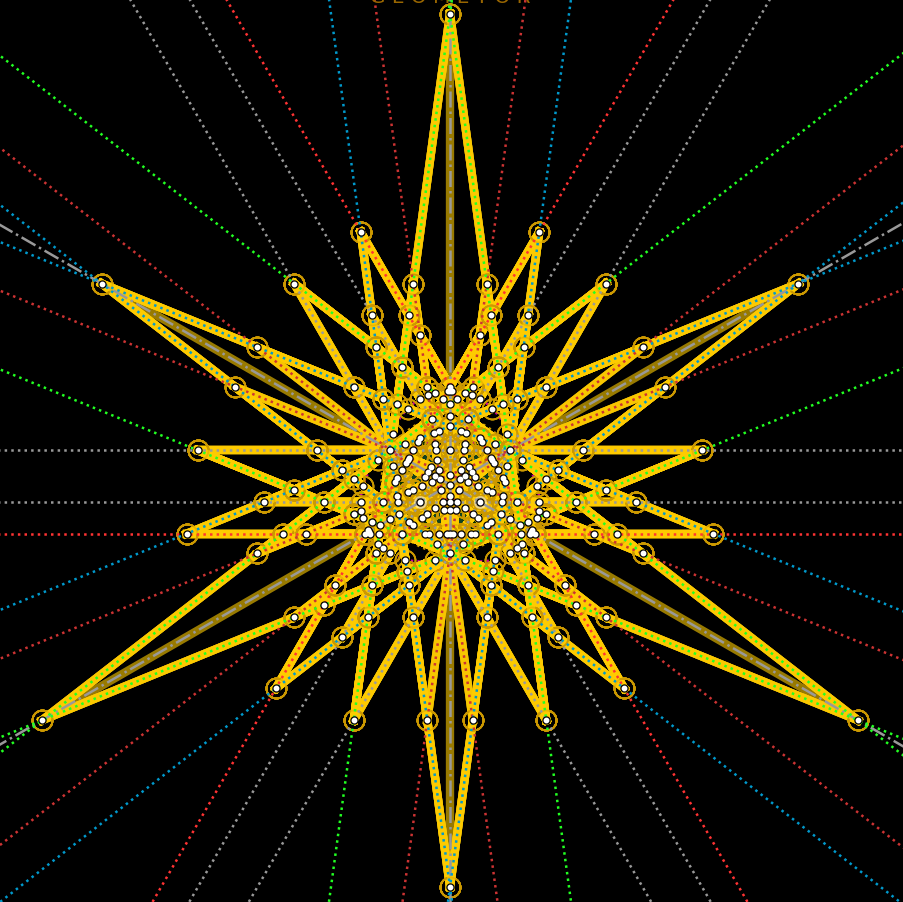
Metrica Book II: Stereometry, Torus, Vaults & Platonic Solids
Προοίμιον καὶ Προτάσεις α΄–κ΄ — Hero of Alexandria (Schöne pp. 90–140)
Table of Contents
Προοίμιον Βιβλίου Β΄ — Εὔδοξος καὶ Ἀρχιμήδης
ΗΡΩΝΟΣ ΜΕΤΡΙΚΩΝ Β. ΠΡΟΟΙΜΙΟΝ (Schöne pp. 90–94; fols. 87r–88r). Ἐν μὲν τῷ πρώτῳ βιβλίῳ τῶν Μετρικῶν ἐδείξαμεν πῶς δεῖ μετρεῖν τάς τε ἐπιπέδους καὶ τὰς μὴ ἐπιπέδους ἐπιφανείας… ἐν δὲ τούτῳ δείξομεν πῶς δεῖ μετρεῖν τὰ στερεὰ σώματα, ἀναφέροντες καὶ ταῦτα ἐπὶ στερεοὺς κύβους… ὧν τὰ κυριώτατα εἰς Εὔδοξον καὶ Ἀρχιμήδην ἀναφέρεται· Εὐδόξου μὲν γὰρ εὕρημα ὅτι πᾶς κύλινδρος τριπλάσιός ἐστι κώνου τοῦ βάσιν μὲν ἔχοντος τὴν αὐτὴν αὐτῷ καὶ ὕψος ἴσον, Ἀρχιμήδους δὲ ὅτι πᾶσα σφαῖρα δύο τρίτα μέρη ἐστὶ κυλίνδρου τοῦ περιλαμβάνοντος αὐτήν.
Book II Prooemium: Eudoxus & Archimedes in Stereometry
Book II, Prooemium (Schöne pp. 90–94; fols. 87r–88r). Having set forth in the First Book the mensuration of planar and curved surfaces, Hero opens the Second Book on solid bodies (στερεὰ σώματα) with a classic historical tribute: before Eudoxus of Cnidus, geometers did not possess rigorous proofs that every cylinder is triple the cone on the same base and of equal height ([XII.10]), nor that every prism is triple the pyramid; and after Eudoxus established those theorems by exhaustion, Archimedes surpassed all predecessors by proving that every sphere is two-thirds of its circumscribing cylinder (Sphere and Cylinder I.34).
Props. II.1–II.10: Cones, Cylinders, Frusta & the Bomiskos Prismatoid
Propositions II.1–II.5 (Cones, Oblique Cylinders, Parallelepipeds, Prisms & Pyramids, Schöne pp. 94–108): Hero computes right and oblique cylinders (\(V = A_{\text{base}} \cdot h\)), cones (\(V = \frac{1}{3} A_{\text{base}} \cdot h\)), hexagonal and polygonal prisms, and pyramids on arbitrary triangular or polygonal bases, obtaining the perpendicular altitude \(h\) from the slant edge and circumradius (or base projection) via [I.47].
Σπεῖρα Διονυσοδώρου (ιγ΄) & Ἐφοδικὸν Ἀρχιμήδους (ιδ΄–ιε΄)
ιγ΄. Ἡ Περὶ τῆς Σπείρας Μέτρησις (Schöne pp. 126–130; fols. 95v–96r):
Props. II.11–II.15: Spheres, Dionysodorus’s Torus & Archimedes’ Method Vaults
Propositions II.11–II.12 (Spheres, Spherical Segments & Vaulted Basins, Schöne pp. 120–126): By Archimedes' Sphere and Cylinder I.34, the sphere is \(\frac{2}{3}\) of the circumscribing cylinder (\(\frac{\pi}{4} d^2 \cdot d\)), giving \(V_{\text{sphere}} = \frac{\pi}{6} d^3 \approx \frac{11}{21} d^3\). For a spherical segment of base radius \(r_b\) and sagitta (height) \(h\) (Prop. II.12), Hero applies Sphere and Cylinder II.2 to derive the intrinsic formula requiring no separate lookup of the full sphere’s radius:
Πέντε Στερεὰ Σχήματα Πλάτωνος καὶ Ἀκανόνιστα Σώματα (ιϛ΄–κ΄)
ιϛ΄–κ΄. Πέντε Στερεὰ Σχήματα Πλάτωνος καὶ Ἀκανόνιστα Σώματα (Schöne pp. 132–140): Ἐπεὶ οὖν τὰ τεταγμένα στερεὰ σώματα μεμετρήκαμεν — συμπεριειλημμένων καὶ τῶν πέντε λεγομένων Πλάτωνος σχημάτων — ὑπολείπεται ἡμῖν καὶ τὰ ἀκανόνιστα στερεὰ σώματα μετρῆσαι διʼ ὕδατος ἐκχύσεως ἢ κηροῦ καὶ πηλοῦ περιπλάσεως.
Props. II.16–II.20: Five Platonic Solids & Irregular Hydrostatic Displacement
Propositions II.16–II.19 — Volumes of the Five Regular Solids (Schöne pp. 132–138; fols. 97r–99r):
Metrica Book II — Analytical Summary & Stereometric Table
Book II advances from two-dimensional surfaces to three-dimensional solid capacities measured in unit cubes:
Metrica Book II — Scholarly Commentary & Method Demonstrations
Proposition II.13 (Schöne 1903, pp. 126–130; fols. 95v–96r) is one of the jewels recovered when Richard Schöne and Hermann Schöne brought the Codex Constantinopolitanus to light in 1896–1903. Prior to 1896, Dionysodorus of Caunus was known primarily through Eutocius's commentary on Archimedes' Sphere and Cylinder II.4 for cutting a sphere in a given ratio via the intersection of a parabola and a rectangular hyperbola.