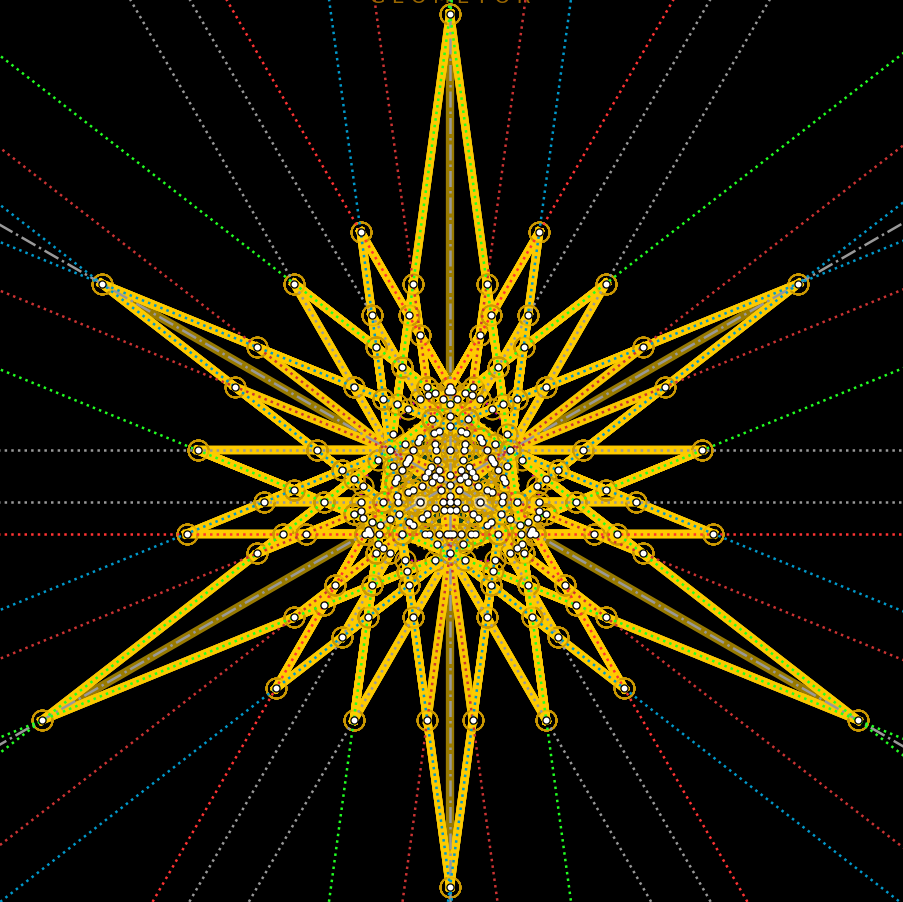
X523
ISOGONAL CONJUGATE OF X110
X523 (ISOGONAL CONJUGATE OF X110) constructed on acute reference triangle \((a, b, c) = (5, 6, 7)\) with unit baseline AB = \(1\).
Constructed Elements
Central Lines: {23, 385}, {230, 231}
Related Centers: X110 (FOCUS OF KIEPERT PARABOLA), X23 (FAR-OUT POINT), X385 (-HIRST INVERSE OF X6), X230 (-CEVA CONJUGATE OF X114), X231 (-CEVA CONJUGATE OF X128)
Alternate Coordinates4 forms
Barycentrics: \(\cot B \cos 2C - \cot C \cos 2B : :\)
Barycentrics: \(S_{B} - S_{C} : :\)
Barycentrics: \(\cot B - \cot C : :\)
Barycentrics: \(\cos 2B - \cos 2C : :\)
X523 lies on the Kiepert parabola.
Incident Central Lines52 lines
{1, 2605}, {2, 1649}, {4, 1552}, {6, 879}, {11, 1090}, {12, 2599}, {23, 385}, {30, 511}, {59, 655}, {66, 2435}, {74, 477}, {75, 876}, {98, 842}, {99, 691}, {100, 1290}, {101, 2690}, {102, 2695}, {103, 2688}, {104, 2687}, {105, 2752}, {106, 2758}, {107, 1304}, {108, 2766}, {109, 2689}, {110, 476}, {111, 2770}, {112, 935}, {125, 2677}, {140, 1116}, {141, 882}, {160, 3164}, {230, 231}, {250, 648}, {253, 2419}, {325, 684}, {396, 3272}, {656, 2457}, {827, 1287}, {878, 3425}, {885, 2346}, {930, 1291}, {1086, 2643}, {1101, 2612}, {1222, 2403}, {1292, 2691}, {1293, 2692}, {1294, 2693}, {1295, 2694}, {1296, 2696}, {1297, 2697}, {2525, 2526}, {2594, 2616}
Functional Relations50 relations
X523 = isotomic conjugate of X99
X523 = Xi-Ceva conjugate of Xj for these (i,j): (1, 11), (2, 115), (4, 125), (99, 2), (100, 442), (107, 4), (108, 429), (110, 5), (112, 427), (254, 136), (264, 338), (476, 30), (685, 1503), (1113, 1312), (1114, 1313)
X523 = cevapoint of polar circle intercepts of Euler line
X523 = Xi-cross conjugate of Xj for these (i,j): (115, 2), (125, 4)
X523 = crosspoint of Xi and Xj for these (i,j): (2, 99), (4, 107), (54, 110), (112, 251)
X523 = crossdifference of every pair of points on line X3X6
X523 = orthopoint of X30
X523 = X30-line conjugate of X511
X523 = crosssum of Xi and Xj for these (i,j): (3, 520), (5, 523), (6, 512), (101, 692), (141, 525), (184, 647), (215, 654), (513, 942), (521, 960), (924, 1147)
X523 = Xi-Hirst inverse of Xj for these (i,j): (6, 1316), (30, 542), (512, 804)
X523 = bicentric difference of PU(i) for these i: 4, 5, 11, 43, 45, 61, 132, 173
X523 = ideal point of PU(i) for these i: 4, 5, 11, 43, 45, 61, 132
X523 = crossdifference of PU(29)
X523 = trilinear pole of PU(40); see note above
X523 = barycentric product of PU(40)
X523 = trilinear product of PU(71)
X523 = perspector of the Kiepert hyperbola
X523 = intersection of the trilinear polars of any 2 points on the Kiepert hyperbola
X523 = intercept of orthic axis and the line at infinity (the trilinear polars of X4 and X2)
X523 = center of parabola {A, B, C,X476,X523}}, which is the locus of trilinear poles of lines passing through X115
X523 = perspector of ABC and the side-triangle of the medial and orthic triangles
X523 = perspector of ABC and the vertex-triangle of the tangential triangles of the medial and Feuerbach triangles
X523 = pole wrt polar circle of the Euler line
X523 = X48-isoconjugate (polar conjugate) of X648
X523 = X2-vertex conjugate of X23
X523 = barycentric cube root of X8029
X523 = perspector of side- and vertex-triangles of circumanticevian triangles of X2 and X4
X523 = Cundy-Parry Psi transform of X14264
X523 = trilinear product of Kiepert hyperbola intercepts of antiorthic axis
Notes
Let A'B'C' be the 1st Brocard triangle. Let A″B″C″ be the 2nd Brocard triangle. Let A* be the trilinear pole of line A'A″, and define B* and C* cyclically. The lines AA*, BB*, CC* are parallel and meet the line at infinity at X523. (Randy Hutson, December 26, 2015)
Let EuaEubEuc be the Feuerbach triangle. Let La be the tangent to conic {A, B, C,Eub,Euc}} at A, and define Lb and Lc cyclically. Let A″ = Lb∩Lc, B″ = Lc∩La, C″ = La∩Lb. The lines EuaA″, EubB″, EucC″ concur in X523; see also X1109.
Let L be the line X115X125; then X523 = trilinear pole of L. The line L is also PU(40), the tangent to Steiner inellipse at X115, the Lemoine axis of the 4th Brocard triangle, the Fermat axis of the 2nd Parry triangle, and the isogonal conjugate of hyperbola {A, B, C,PU(2)}) (Randy Hutson, December 26, 2015)