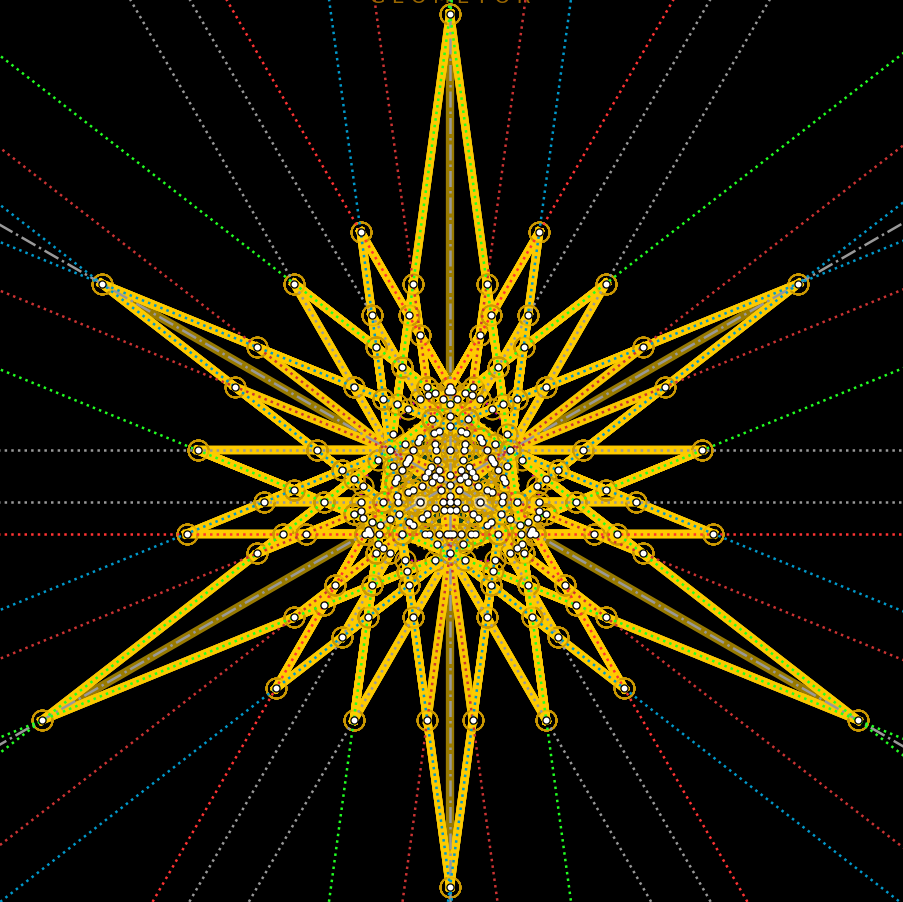
X325
X2-HIRST INVERSE OF X69
X325 (X2-HIRST INVERSE OF X69) constructed on acute reference triangle \((a, b, c) = (5, 6, 7)\) with unit baseline AB = \(1\).
Constructed Elements
Central Lines: {2, 6}, {5, 76}
Related Centers: X2 (CENTROID), X6 (SYMMEDIAN POINT), X5 (NINE-POINT CENTER), X76 (3rd BROCARD POINT)
Alternate Coordinates2 forms
Trilinears: \(bc(b^{4} + c^{4} - a^{2}b^{2} - a^{2}c^{2}) : :\)
Barycentrics: \(b^{4} + c^{4} - a^{2}b^{2} - a^{2}c^{2} : :\)
X325 lies on the Simson quartic Q101.
Incident Central Lines75 lines
{2, 6}, {3, 315}, {4, 1975}, {5, 76}, {11, 350}, {12, 1909}, {20, 6337}, {22, 160}, {23, 3447}, {25, 317}, {30, 99}, {32, 3788}, {39, 626}, {51, 4121}, {74, 2855}, {75, 2886}, {95, 1799}, {98, 2065}, {100, 2856}, {110, 2857}, {111, 2858}, {114, 511}, {115, 538}, {140, 1078}, {147, 1503}, {187, 620}, {194, 5025}, {232, 297}, {250, 340}, {253, 6340}, {264, 305}, {274, 442}, {290, 3978}, {310, 3136}, {311, 1238}, {320, 1447}, {332, 2893}, {339, 1236}, {383, 622}, {441, 2966}, {523, 684}, {532, 6108}, {533, 6109}, {542, 5939}, {621, 1080}, {623, 6115}, {624, 6114}, {631, 3785}, {637, 6289}, {638, 6290}, {639, 3103}, {640, 3102}, {671, 5503}, {672, 4766}, {698, 1916}, {732, 2023}, {740, 5988}, {758, 5977}, {868, 2396}, {892, 1494}, {1235, 1594}, {1329, 6377}, {1368, 6375}, {1444, 4220}, {1506, 3934}, {2071, 5866}, {2482, 3849}, {3233, 6148}, {3734, 5475}, {3814, 6382}, {3829, 4479}, {3847, 4357}, {3932, 4518}, {5149, 5162}, {5965, 6036}
Functional Relations23 relations
X325 = midpoint of Xi and Xj for these (i,j): (99, 316), (147, 5999), (298, 299), (5078, 5979)
X325 = reflection of Xi in Xj for these (i,j): (115, 625), (187, 620), (385, 230), (1513, 114), (2966, 441)
X325 = isogonal conjugate of X1976
X325 = isotomic conjugate of X98
X325 = complement of X385
X325 = anticomplement of X230
X325 = orthoptic-circle-of-Steiner-circumellipe-inverse of X38940
X325 = orthoptic-circle-of-Steiner-inellipe-inverse of X5108
X325 = Xi-cross conjugate of Xj for these (i,j): (114, 2), (511, 297)
X325 = crossdifference of every pair of points on line X32X512
X325 = intersection of trilinear polars of X99, P(37), and U(37)
X325 = crosspoint of X2 and X147 wrt both the excentral and anticomplementary triangles
X325 = trilinear pole of line X2799X3569
X325 = intersection of Simson line of X99 (line X114X325) and trilinear polar of X99 (line X2X6)
X325 = pole wrt polar circle of trilinear polar of X6531 (line X25X669)
X325 = X48-isoconjugate (polar conjugate) of X6531
X325 = polar conjugate of isogonal conjugate of X36212
Notes
Let La be the line through A parallel to the Lemoine axis, and define Lb and Lc cyclically. Let Ma be the reflection of BC in La, and define Mb and Mc cyclically. Let A' = Mb∩Mc, and define B' and C' cyclically. The triangle A'B'C' is inversely similar to, and 3 times the size of, ABC. Let A″B″C″ be the reflection of A'B'C' in the Lemoine axis. The triangle A″B″C″ is homothetic to ABC, with center of homothety X325; see Hyacinthos #16741/16782, Sep 2008. (Randy Hutson, November 30, 2015)