X1594

RIGBY-LALESCU ORTHOPOLE

Traian Lalescu (Trajan Lalesco) proved in “A Class of Remarcable Triangles,” Gazeta Matematica 20 (1915) 213 [in Romanian], that if triangles DEF and D'E'F' are inscribed in a circle and directed arclengths satisfyarc DD' + arc EE' + arc FF' = 0 mod 2π, then the Simson lines of D, E, F with respect to D',E',F' and the Simson lines of D',E',F' with respect to D, E, F concur in the midpoint X of the segment of the orthocenters of DEF and D'E'F'. Daniel Vacaretu considered triangles DEF and D'E'F' associated with left and right isoscelizers and inscribed in the sine-triple-angle circle. He obtained the second set of trilinears shown above for the midpoint X. (See also the bicentric pair PU(61).)
< A B C >: Reference Triangle △ABC [ A B ]: Sideline AB (Base c = 1) [ B C ]: Sideline BC (Side a) [ C A ]: Sideline CA (Side b) { 2, 3 }: Euler Line { 6, 70 }: Central Line L(6, 70) { 128, 136 }: Central Line L(128, 136) { 50, 252 }: Central Line L(50, 252) { 96, 275 }: Central Line L(96, 275) { 125, 389 }: Central Line L(125, 389) A = Vertex A (0.0000, 0.0000) B = Vertex B (1.0000, 0.0000) C = Vertex C (0.6122, 0.5999) X_2 = CENTROID (0.5374, 0.2000) X_3 = CIRCUMCENTER (0.5000, 0.1021) X_4 = ORTHOCENTER (0.6122, 0.3958) X_6 = SYMMEDIAN POINT (LEMOINE POINT, GREBE POINT) (0.6000, 0.2672) X_70 = ISOGONAL CONJUGATE OF X(26) (0.7750, -1.1016) X_128 = -OF-ORTHIC-TRIANGLE (0.3310, 0.3690) X_136 = INTERSECTION OF LINE X(4)X(110) AND X(25)X(132) (0.8024, 0.3155) X_50 = -CEVA CONJUGATE OF X(184) (2.1559, 2.8368) X_252 = ISOGONAL CONJUGATE OF X(143) (0.4565, 0.1253) X_96 = ISOGONAL CONJUGATE OF X(52) (-0.0943, -0.0197) X_275 = CEVAPOINT OF ORTHOCENTER AND SYMMEDIAN POINT (0.6057, 0.3473) X_125 = CENTER OF JERABEK HYPERBOLA (0.6803, 0.0260) X_389 = CENTER OF THE TAYLOR CIRCLE (0.6078, 0.2800) X_1594 = RIGBY-LALESCU ORTHOPOLE (0.5908, 0.3395) A B C X2 X3 X4 X6 X70 X128 X136 X50 X252 X96 X275 X125 X389 X1594 (a, b, c) = (5, 6, 7) | AB = 1

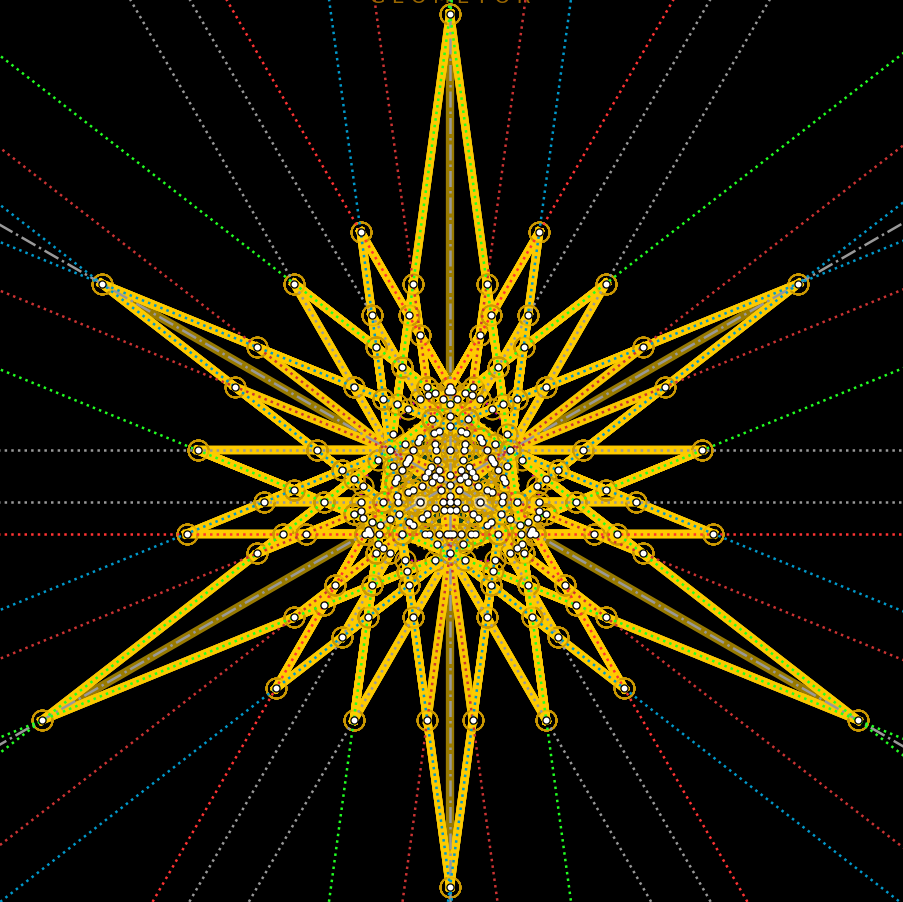
X1594 (RIGBY-LALESCU ORTHOPOLE) constructed on acute reference triangle \((a, b, c) = (5, 6, 7)\) with unit baseline AB = \(1\).

Constructed Elements

Trilinears: \(\sec A + 2 \cos(B - C) : :\)
Search Value (6, 9, 13): \(4.013619010105\)
▸ Alternate Coordinates2 forms
  • Trilinears: \(\cos(2B-C) \cos(A-C) + \cos(2C-B) \cos(A-B) : :\)

  • Trilinears: \((\sec A) (1 - \cos 2B - \cos 2C) : :\)

▸ Incident Central Lines14 lines

{2, 3}, {6, 70}, {50, 252}, {53, 566}, {67, 1173}, {96, 275}, {125, 389}, {128, 136}, {232, 1508}, {264, 847}, {325, 1235}, {933, 1166}, {1209, 1216}, {1225, 1238}

▸ Functional Relations11 relations

Notes

As a point on the Euler line, X1594 has Shinagawa coefficients \((2F, E + 2F)\).

In Episodes in Nineteenth and Twentieth Century Euclidean Geometry,, page 132, Ross Honsberger presents X1594 as the orthopole of the six sides of two triangles and as the point common to six Simson lines. Honsberger calls this orthopole the Rigby Point. (Notes on Lalescu and Honsberger received from D. Vacaretu, 19/16/03)