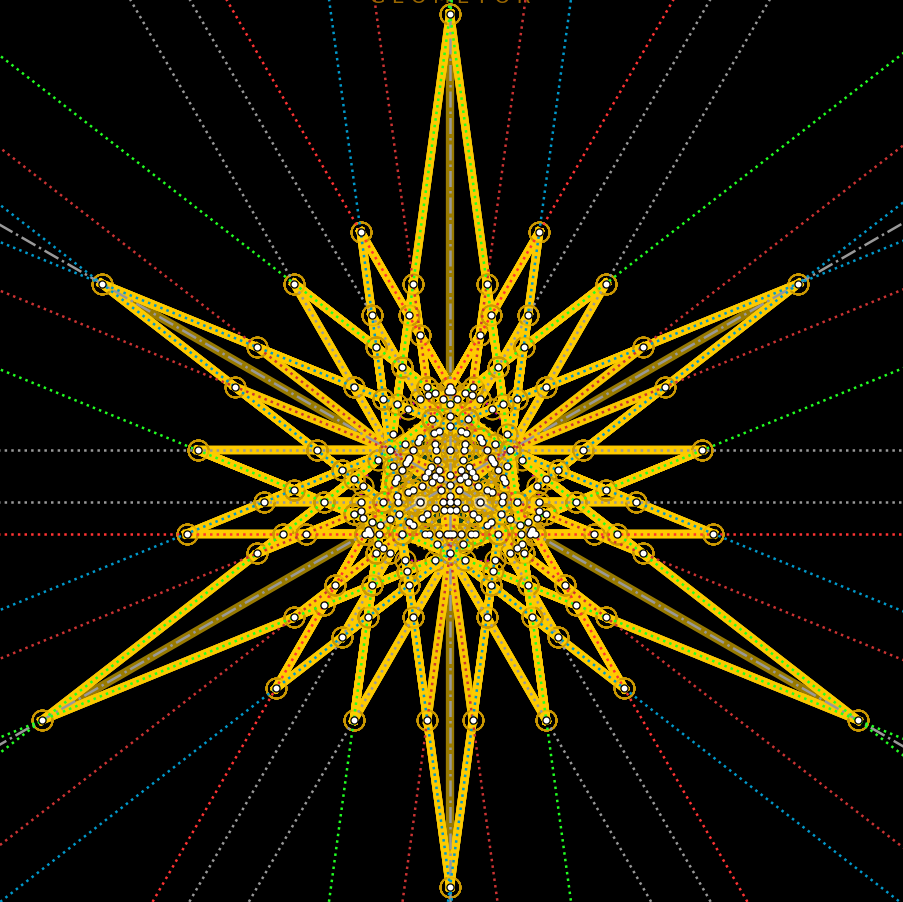
X181
APOLLONIUS POINT
X181 (APOLLONIUS POINT) constructed on acute reference triangle \((a, b, c) = (5, 6, 7)\) with unit baseline AB = \(1\).
Constructed Elements
Central Lines: {10, 12}, {31, 51}
Related Centers: X261 (ISOTOMIC CONJUGATE OF X12), X10 (SPIEKER CENTER), X12 ({X), X31 (2nd POWER POINT), X51 (CENTROID OF ORTHIC TRIANGLE)
Alternate Coordinates2 forms
Trilinears: \(a^{2}\cos^{2}(B/2 - C/2) : b^{2}\cos^{2}(C/2 - A/2) : c^{2}\cos^{2}(A/2 - B/2)\)
Trilinears: \(h(a,b,c) : h(b,c,a) : h(c,a,b)\), where \(h(a,b,c) = [r \cos(A/2) + s \sin(A/2)]^{2}\), s = semiperimeter, r = inradius
Incident Central Lines55 lines
{1, 970}, {6, 197}, {8, 959}, {10, 12}, {11, 2051}, {25, 2175}, {31, 51}, {33, 3022}, {42, 228}, {43, 57}, {44, 375}, {55, 573}, {56, 386}, {58, 1324}, {81, 5061}, {171, 511}, {182, 5329}, {200, 3779}, {213, 2333}, {373, 748}, {389, 3072}, {518, 3687}, {553, 1463}, {575, 5363}, {612, 3688}, {750, 3917}, {756, 2171}, {942, 5530}, {994, 1361}, {1124, 1685}, {1254, 1425}, {1317, 3032}, {1335, 1686}, {1356, 5213}, {1358, 3034}, {1364, 5348}, {1376, 4259}, {1395, 1843}, {1672, 1683}, {1673, 1684}, {1674, 1693}, {1675, 1694}, {1695, 1697}, {2007, 2019}, {2008, 2020}, {2330, 5285}, {2534, 2538}, {2535, 2539}, {3027, 3029}, {3028, 3031}, {3056, 5269}, {3340, 4517}, {3781, 5268}, {3792, 3819}, {4276, 5172}
Functional Relations14 relations
X181 = isogonal conjugate of X261
X181 = complement of X35614
X181 = Xi-Ceva conjugate of Xj for these (i,j): (12, 2197), (59, 4559), (65, 2171), (2171, 1500)
X181 = Xi-cross conjugate of Xj for these (i,j): (872, 1500), (2643, 512)
X181 = crosspoint of Xi and Xj for these (i,j): (42, 1824), (59, 4559), (65, 1400), (1354, 2171)
X181 = crosssum of Xi and Xj for these (i,j): (2, 2975), (11, 4560), (21, 333), (81, 4225), (86, 1444), (1098, 2185)
X181 = crossdifference of X3904 and X3910
X181 = Xi-beth conjugate of Xj for these (i,j): (42, 181), (660, 181), (756, 756)
X181 = X60-isoconjugate of X75
X181 = trilinear product of vertices of extangents triangle
X181 = trilinear product of Xi and Xj for these {I,J}: {1, 181}, {6, 2171}, {7, 872}, {10, 1402}, {12, 31}, {19, 2197}, {25, 201}, {33, 1425}, {34, 3690}, {37, 1400}, {42, 65}, {55, 1254}, {56, 756}, {57, 1500}, {59, 2643}, {71, 1880}, {73, 1824}, {109, 4705}, {115, 2149}, {210, 1042}, {213, 226}, {225, 228}, {227, 2357}, {349, 2205}, {512, 4551}, {594, 604}, {608, 3949}, {651, 4079}, {661, 4559}, {762, 1412}, {798, 4552}, {1020, 3709}, {1089, 1397}, {1110, 1365}, {1214, 2333}, {1334, 1427}, {1395, 3695}, {1409, 1826}, {1415, 4024}, {1426, 2318}, {1441, 1918}, {3063, 4605}, {3124, 4564}, {4017, 4557}
X181 = barycentric product of Xi and Xj for these {I,J}: {1, 2171}, {2, 181}, {4, 2197}, {6, 12}, {7, 1500}, {9, 1254}, {10, 1400}, {19, 201}, {34, 3949}, {37, 65}, {42, 226}, {56, 594}, {57, 756}, {59, 115}, {71, 225}, {72, 1880}, {73, 1826}, {85, 872}, {109, 4024}, {210, 1427}, {213, 1441}, {227, 1903}, {278, 3690}, {281, 1425}, {307, 2333}, {321, 1402}, {349, 1918}, {512, 4552}, {523, 4559}, {604, 1089}, {608, 3695}, {651, 4705}, {661, 4551}, {663, 4605}, {664, 4079}, {762, 1014}, {1018, 4017}, {1020, 4041}, {1042, 2321}, {1091, 2150}, {1109, 2149}, {1214, 1824}, {1252, 1365}, {1262, 4092}, {1334, 3668}, {1404, 4013}, {1411, 4053}, {1415, 4036}, {1426, 3694}, {2222, 2610}, {2643, 4564}, {3124, 4998}, {3709, 4566}
X181 = Xi-isoconjugate of Xj for these (i,j): (1, 261), (2, 2185), (7, 1098), (8, 757), (9, 1509), (21, 86), (27, 1812), (28, 332), (29, 1444), (55, 873), (58, 314), (60, 75), (69, 270), (76, 2150), (81, 333), (99, 3737), (200, 552), (249, 4858), (274, 284), (283, 286), (304, 2189), (310, 2194), (312, 593), (348, 2326), (514, 4612), (645, 1019), (649, 4631), (650, 4610), (662, 4560), (663, 4623), (693, 4636), (763, 2321), (849, 3596), (1014, 1043), (1021, 4573), (1434, 2287), (2170, 4590), (4391, 4556)
Notes
X181 is the external center of similitude (or exsimilicenter) of the incircle and Apollonius circle. The internal center is X1682. (Peter J. C. Moses, 8/22/2003)
X181 is the isogonal conjugate of the isotomic conjugate of X12; also, X181 is the {Xi ,Xj }-harmonic conjugate of Xk for these (i,j,k)): (31,51,3271), (42,1400,1402), (57,1401,1357), (57,1469,1401). (Peter J. C. Moses, 6/20/2014)
A proof of the the concurrence of lines AA',BB',CC' follows.
A = exsimilicenter(incircle, A-excircle)
A' = exsimilicenter(A-excircle, Apollonius circle)
Let J = exsimilicenter(incircle, Apollonius circle).
By Monge’s theorem, the points A, A', J are collinear. In particular, J lies on line AA', and cyclically, J lies on lines BB' and CC'. Therefore, J = X181. (Darij Grinberg, Hyacinthos, 7461, 8/10/03)
Let A' be the inverse-in-excircles-radical-circle of the midpoint of BC, and define B', C' cyclically. Triangle A'B'C' is inscribed in the Apollonius circle and homothetic to the intouch triangle at X181. (Randy Hutson, March 21, 2019)
See also Clark Kimberling, Shiko Iwata, and Hidetosi Fukagawa, Problem 1091 and Solution, Crux Mathematicorum 13 (1987) 128-129; 217-218. [proposed 1985].