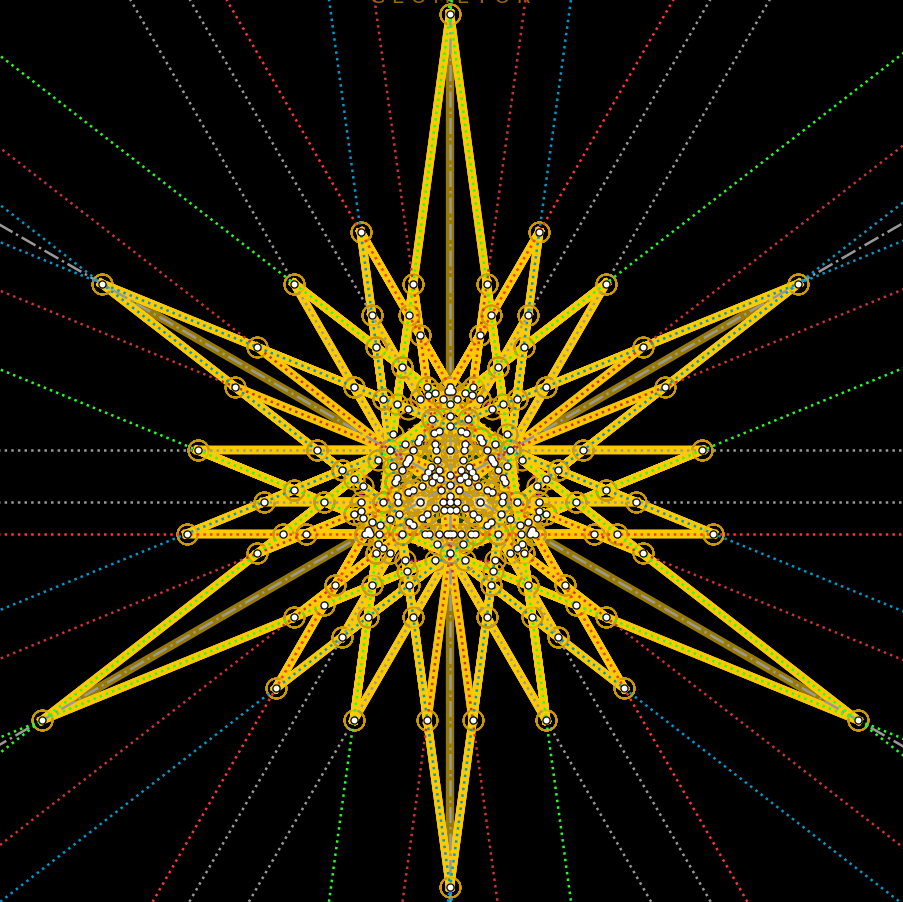
IV. On Manifoldnesses of Any Number of Dimensions¶
A Comparative Review of Recent Researches in Geometry — Note IV (Trans. M. W. Haskell, 1893, pp. 242–249)
That space, regarded as the locus of points, has only three dimensions, does not need to be discussed from the mathematical point of view; but just as little can anybody be prevented from that point of view from claiming that space really has four, or any unlimited number of dimensions, and that we are only able to perceive three. The theory of manifoldnesses, advancing as it does with the course of time more and more into the foreground of modern mathematical research, is by its nature fully independent of any such claim. But a nomenclature has become established in this theory which has indeed been derived from this idea. Instead of the elements of a manifoldness we speak of the points of a higher space, etc. The nomenclature itself has certain advantages, in that it facilitates the interpretation by calling to mind the perceptions of geometry. But it has had the unfortunate result of causing the wide-spread opinion that investigations on manifoldnesses of any number of dimensions are inseparably connected with the above-mentioned idea of the nature of space. Nothing is more unsound than this opinion. The mathematical investigations in question would, it is true, find an immediate application to geometry, if the idea were correct; but their value and purport is absolutely independent of this idea, and depends only on their own mathematical contents.
It is quite another matter when Plücker shows how to regard actual space as a manifoldness of any number of dimensions by introducing as space-element a configuration depending on any number of parameters, a curve, surface, etc. (see § 5 of the text).
The conception in which the element of a manifoldness (of any number of dimensions) is regarded as analogous to the point in space was first developed, I suppose, by Grassmann in his “Ausdehnungslehre” (1844). With him the thought is absolutely free of the above-mentioned idea of the nature of space; this idea goes back to occasional remarks by Gauss, and became more widely known through Riemann's investigations on manifoldnesses (1854/1867), with which it was interwoven.
Both conceptions — Grassmann's as well as Plücker's — have their own peculiar advantages; they can be alternately employed with good results.