Book III
Fundamentals of Plane Geometry Involving Circles
Theory of the Circle
Definitions
III.def.1
Equal circles are those the diameters of which are equal, or the radii of which are equal.
III.def.2
A straight line is said to touch a circle which, meeting the circle and being produced, does not cut the circle.
III.def.3
Circles are said to touch one another which, meeting one another, do not cut one another.
III.def.4
In a circle straight lines are said to be equally distant from the centre when the perpendiculars drawn to them from the centre are equal.
III.def.5
And that straight line is said to be at a greater distance on which the greater perpendicular falls.
III.def.6
A segment of a circle is the figure contained by a straight line and a circumference of a circle.
III.def.7
An angle of a segment is that contained by a straight line and a circumference of a circle.
III.def.8
An angle in a segment is the angle which, when a point is taken on the circumference of the segment and straight lines are joined from it to the extremities of the straight line which is the base of the segment, is contained by the straight lines so joined.
III.def.9
And, when the straight lines containing the angle cut off a circumference, the angle is said to stand upon that circumference.
III.def.10
A sector of a circle is the figure which, when an angle is constructed at the centre of the circle, is contained by the straight lines containing the angle and the circumference cut off by them.
III.def.11
Similar segments of circles are those which admit equal angles, or in which the angles are equal to one another.
Propositions
III.1
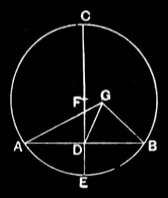
To find the centre of a given circle.
III.2
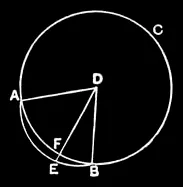
If on the circumference of a circle two points be taken at random, the straight line joining the points will fall within the circle.
III.3
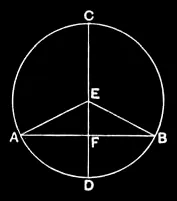
If in a circle a straight line through the centre bisect a straight line not through the centre, it also cuts it at right angles; and if it cut it at right angles, it also bisects it.
III.4
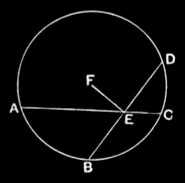
If in a circle two straight lines cut one another which are not through the centre, they do not bisect one another.
III.5
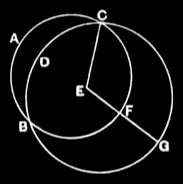
If two circles cut one another, they will not have the same centre.
III.6
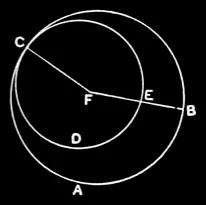
If two circles touch one another, they will not have the same centre.
III.7
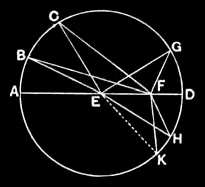
- If on the diameter of a circle a point be taken which is not the centre of the circle, and from the point straight lines fall upon the circle, that will be greatest on which the centre is, the remainder of the same diameter will be least, and of the rest
the nearer to the straight line through the centre is always greater than the more remote, and only two equal straight lines will fall from the point on the circle, one on each side of the least straight line.
III.8
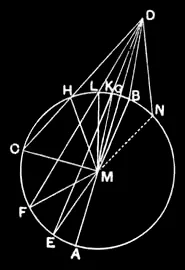
- If a point be taken outside a circle and from the point straight lines be drawn through to the circle, one of which is through the centre and the others are drawn at random, then, of the straight lines which fall on the concave circumference, that through the centre is greatest, while of the rest
the nearer to that through the centre is always greater than the more remote, but, of the straight lines falling on the convex circumference, that between the point and the diameter is least, while of the rest the nearer to the least is always less than the more remote, and only two equal straight lines will fall on the circle from the point, one on each side of the least.
III.9
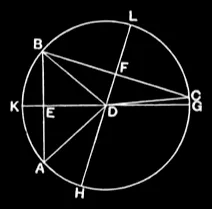
If a point be taken within a circle, and more than two equal straight lines fall from the point on the circle, the point taken is the centre of the circle.
III.10
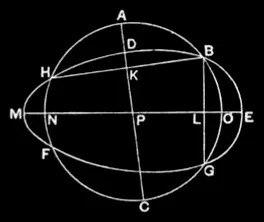
A circle does not cut a circle at more points than two.
III.11
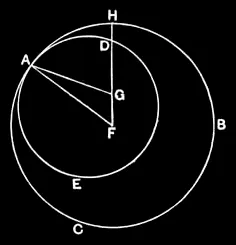
If two circles touch one another internally, and their centres be taken, the straight line joining their centres, if it be also produced, will fall on the point of contact of the circles.
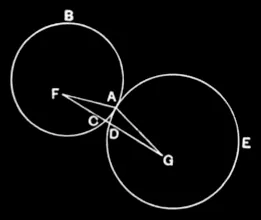
III.12
If two circles touch one another externally, the straight line joining their centres will pass through the point of contact.
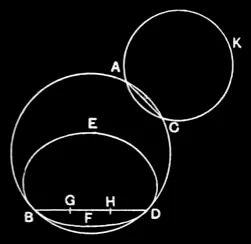
III.13
A circle does not touch a circle at more points than one, whether it touch it internally or externally.
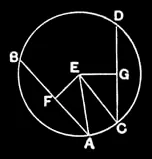
III.14
In a circle equal straight lines are equally distant from the centre, and those which are equally distant from the centre are equal to one another.
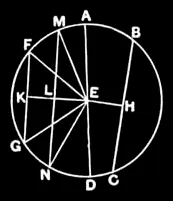
III.15
Of straight lines in a circle the diameter is greatest, and of the rest the nearer to the centre is always greater than the more remote.
III.16
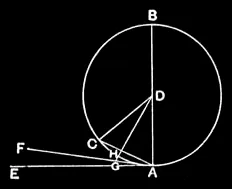
The straight line drawn at right angles to the diameter of a circle from its extremity will fall outside the circle, and into the space between the straight line and the circumference another straight line cannot be interposed; further the angle of the semicircle is greater, and the remaining angle less, than any acute rectilineal angle.
III.17
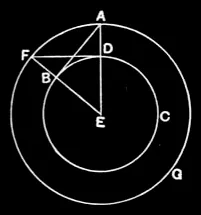
From a given point to draw a straight line touching a given circle.
III.18
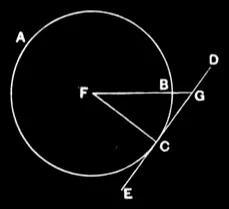
If a straight line touch a circle, and a straight line be joined from the centre to the point of contact, the straight line so joined will be perpendicular to the tangent.
III.19
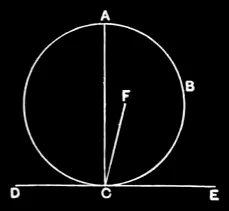
If a straight line touch a circle, and from the point of contact a straight line be drawn at right angles to the tangent, the centre of the circle will be on the straight line so drawn.
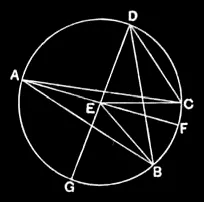
III.20
In a circle the angle at the centre is double of the angle at the circumference, when the angles have the same circumference as base.
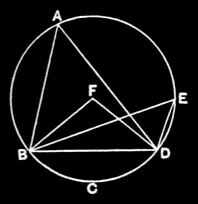
III.21
In a circle the angles in the same segment are equal to one another.
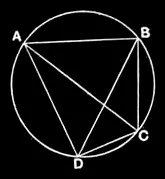
III.22
The opposite angles of quadrilaterals in circles are equal to two right angles.
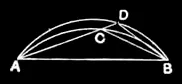
III.23
On the same straight line there cannot be constructed two similar and unequal segments of circles on the same side.
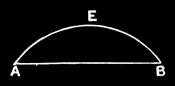
III.24
Similar segments of circles on equal straight lines are equal to one another.

III.25
Given a segment of a circle, to describe the complete circle of which it is a segment.
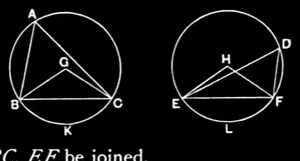
III.26
In equal circles equal angles stand on equal circumferences, whether they stand at the centres or at the circumferences.
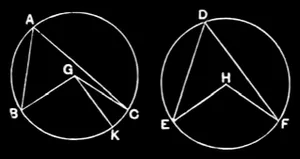
III.27
In equal circles angles standing on equal circumferences are equal to one another, whether they stand at the centres or at the circumferences.
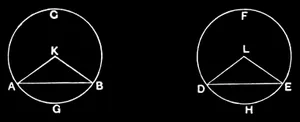
III.28
In equal circles equal straight lines cut off equal circumferences, the greater equal to the greater and the less to the less.
III.29
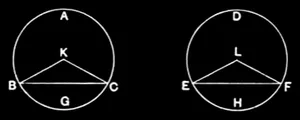
In equal circles equal circumferences are subtended by equal straight lines.
III.30
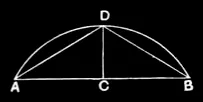
To bisect a given circumference.
III.31
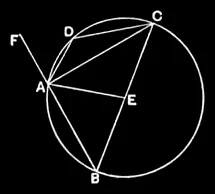
In a circle the angle in the semicircle is right, that in a greater segment less than a right angle, and that in a less segment greater than a right angle; and further the angle of the greater segment is greater than a right angle, and the angle of the less segment less than a right angle.
III.32
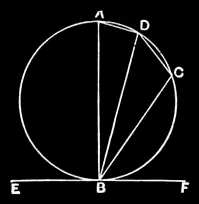
If a straight line touch a circle, and from the point of contact there be drawn across, in the circle, a straight line cutting the circle, the angles which it makes with the tangent will be equal to the angles in the alternate segments of the circle.
III.33
On a given straight line to describe a segment of a circle admitting an angle equal to a given rectilineal angle.
III.34
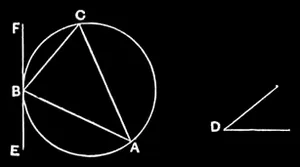
From a given circle to cut off a segment admitting an angle equal to a given rectilineal angle.
III.35
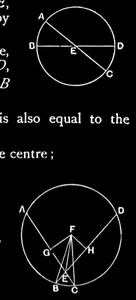
If in a circle two straight lines cut one another, the rectangle contained by the segments of the one is equal to the rectangle contained by the segments of the other.
III.36
If a point be taken outside a circle and from it there fall on the circle two straight lines, and if one of them cut the circle and the other touch it, the rectangle contained by the whole of the straight line which cuts the circle and the straight line intercepted on it outside between the point and the convex circumference will be equal to the square on the tangent.
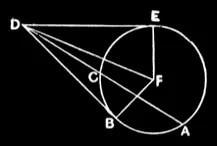
III.37
If a point be taken outside a circle and from the point there fall on the circle two straight lines, if one of them cut the circle, and the other fall on it, and if further the rectangle contained by the whole of the straight line which cuts the circle and the straight line intercepted on it outside between the point and the convex circumference be equal to the square on the straight line which falls on the circle, the straight line which falls on it will touch the circle.