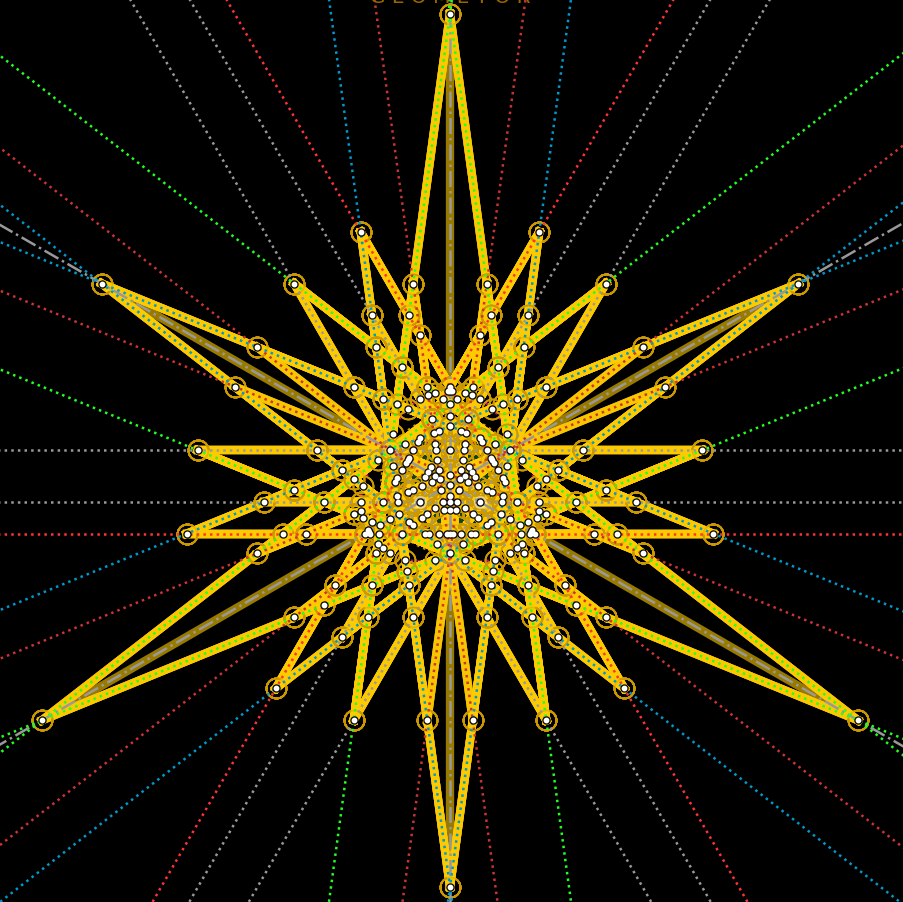
Book IV: Platonic & Archimedean Polyhedral Nets & Perspective
Instruction in Measurement (Nuremberg, 1525) — Albrecht Dürer
Sections
First Printed Planar Fold-Out Nets for Platonic & Archimedean Solids (Figs. 29–43)
In the opening of Book IV, Dürer classifies three families of solid bodies that may be fashioned with compass and straightedge: prismatic columns of uniform cross-section, tapering cones and pyramids, and finally bodies equal on every side in their faces, solid corners, and edges, “which :person:`Euclid <euclid>` calls :term:`corpora regularia <corpora-regularia>`, describing five of them because there can be no more that may be inscribed in a sphere touching it at every vertex” (euclid:elements, plato:timaeus).
The Delian Altar: Doubling the Cube & Cannonball Scaling (Figs. 44–51)
Recounting how the citizens of plague-stricken Athens consulted Apollo’s oracle and were commanded to double his cubical altar, Dürer explains how Plato reduced cube duplication to finding two mean proportionals ($g : c = c : d = d : e \implies c^3 = g^2 e$) between two unequal segments. Declaring that “because this is a most useful art serving all craftsmen, yet kept in great secrecy and concealment by scholars, I wish to bring it into the light of day—for as I believe, it has never until this day been described in the German tongue,” Dürer presents three classical constructions and applies them directly to casting proportional bells and iron cannonballs (püxsen kugeln) of $1, 2, 3, \dots, 100$ pounds:
Cube Sciagraphy & Central Projection Perspective Apparatuses (Figs. 52–63)
Book IV culminates in the geometric synthesis of light, shadow, and central perspective (Perspectiva = Durchsehung):