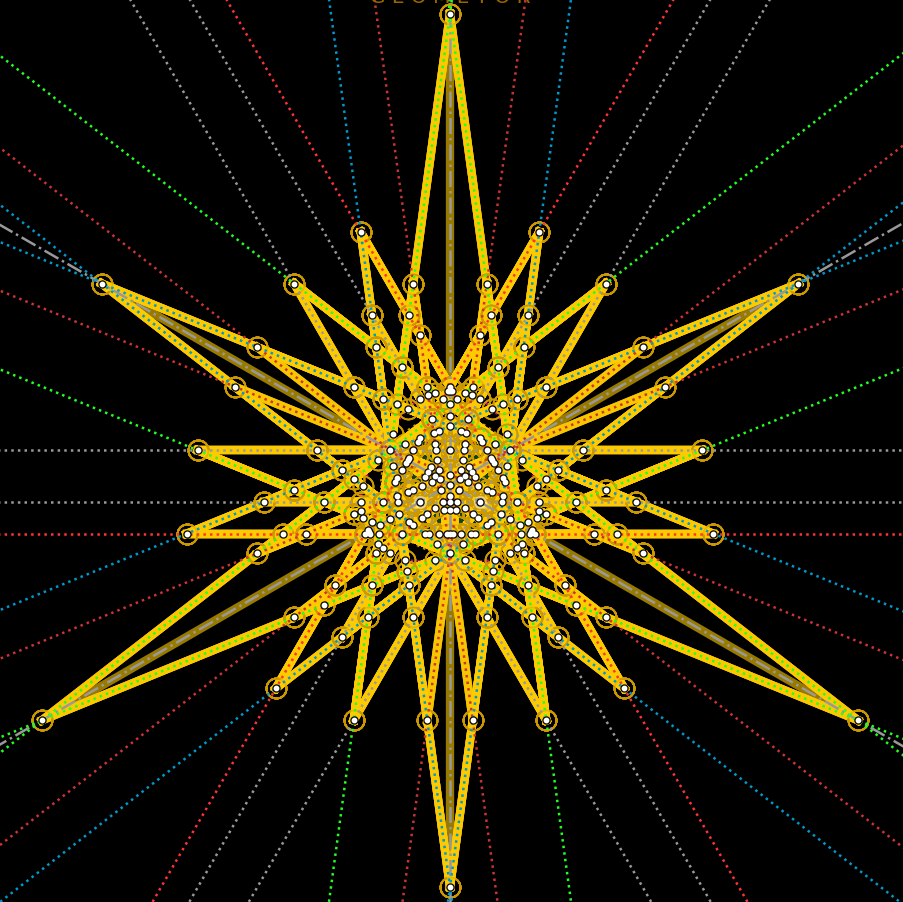
Notes — Combinatorics & Topology of Dürer’s Polyhedral Nets
1. Exact Algebraic & Topological Audit of Dürer’s Polyhedral Nets
Book IV (pp. 142–157) marks a watershed between Luca Pacioli's Divina Proportione (pacioli:1509)—where Leonardo da Vinci rendered polyhedra as perspective wooden frames—and Johannes Kepler's Harmonices Mundi Book II (kepler:1619), which completed the enumeration of all thirteen Archimedean solids.
In geometor.durer (construct_durer_polyhedral_nets()), every
unfolded planar net is modeled as a connected spanning tree of exact regular polygons with unit
edge quadrance $Q = 1$ across three nested number fields:
Cube ($F = 6, E = 12, V = 8$): pure rational lattice $\mathbb{Q}$, $5$ interior fold hinges + $14$ open cut boundary edges ($5 + \frac{14}{2} = 12$ edges in 3D).
Tetrahedron ($4, 6, 4$), Octahedron ($8, 12, 6$), Icosahedron ($20, 30, 12$), and Archimedean Cuboctahedron ($14, 24, 12$): quadratic field $\mathbb{Q}(\sqrt{3})$, verified to have pairwise disjoint face interiors (
non_overlapping_verified = True, zero self-overlap—an early constructive witness to Dürer’s Conjecture on edge-unfolding convex polyhedra!).Regular Dodecahedron ($12, 30, 20$, Fig. 33): cyclotomic golden-ratio field $\mathbb{Q}(\sqrt{5}, \sin 36^\circ) = \mathbb{Q}\!\left(\sqrt{5},\, \frac{\sqrt{10 - 2\sqrt{5}}}{4}\right)$, unfolded into two six-pentagon rosettes joined across a shared hinge ($11$ interior fold hinges + $38$ open cut edges $\implies 11 + \frac{38}{2} = 30$ edges, Euler characteristic $\chi = V - E + F = 20 - 30 + 12 = 2$).
Philological Note on Figure 35 (Truncated Tetrahedron, SLUB N1525 p. 149)
On page 149, introducing the first semi-regular solid (Truncated Tetrahedron, [3.6.6]), Dürer’s 1525 prose inadvertently reads “vier sechs ecketter vnd **drey* dryangletter ebner felder”* (“four hexagonal and three triangular plane faces”), even though he immediately states the true 3D counts (zwelf eck vnnd achtzehen scharpfer seyten: $V = 12, E = 18 \implies F = 2 - 12 + 18 = 8$) and his own woodcut Figure 35 accurately draws four hexagons and four triangles! Joachim Camerarius <camerarius> silently restored quatuor triangulis in the 1532 Latin edition (durer:1532:camerarius), and Dürer’s posthumous 1538 edition (durer:1538) added two further Archimedean truncations (bringing Dürer’s total to nine of Archimedes’s thirteen solids).