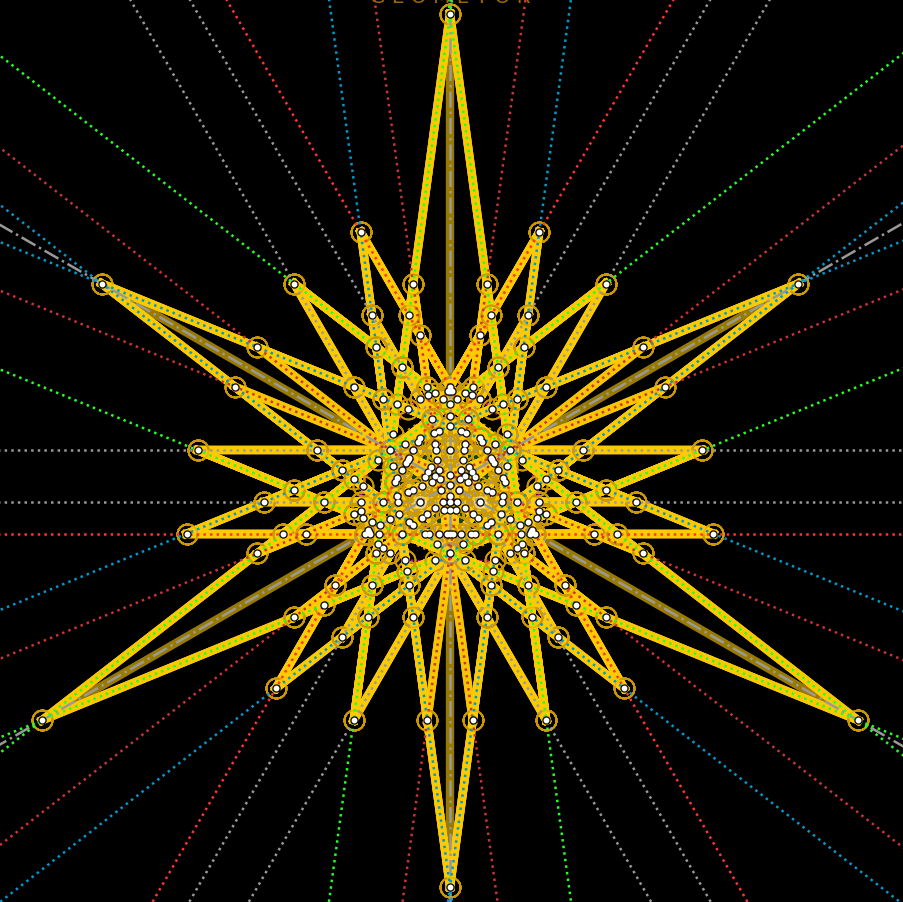
The First Six Books of the Elements of Euclid
In Which Coloured Diagrams and Symbols Are Used Instead of Letters for the Greater Ease of Learners — Oliver Byrne (1847)
firstsixbooksofe00eucl).geometor.model plates.“Segnius irritant animos demissa per aurem, Quam quæ sunt oculis subjecta fidelibus, et quæ Ipse sibi tradit spectator.”
“What finds entrance through the ear strikes the mind less vividly than what is brought before the trusty eyes of the spectator himself.”
—Horace, Ars Poetica 180–182 (quoted by Oliver Byrne, Introduction, p. viii)
Books & Sections
Preliminaries — Introduction, Definitions, Postulates, Axioms & Symbols
Oliver Byrne's 1847 Introduction establishes the manifesto of pointer-free visual deduction: geometric primitives are colored in Chiswick Press vermilion, ultramarine, gamboge, and lampblack so they name themselves directly inside the proof equations without alphabetic vertex labels, followed by Robert Simson's 35 Definitions, 3 Postulates, 12 Axioms, and Byrne’s operator key.
Book I — Congruence, Parallels & The Pythagorean Theorem
Book I ascends from elementary compass-and-straightedge construction (I.1) through triangle congruence (I.4, I.5), vertical angles (I.15), and parallel transport (I.32) to square construction (I.46) and Oliver Byrne's four-color Pythagorean climax (I.47).
Book II — Geometric Algebra & The Golden Section
Book II translates quadratic algebraic identities into direct visual area decompositions—partitioning squares, contained rectangles (×), and gnomons across the binomial square (II.4), difference of squares (II.5), and the Golden Section (II.11).
Book III — Circles, Inscribed Angles & Tangent-Secant Power
Book III investigates the incidence and angular geometry of circles, culminating in three foundational theorems rendered with crystalline economy in Byrne’s four-color notation: central-to-inscribed angle doubling (III.20), Thales’s semicircle theorem (III.31), and the tangent-secant power of an external point (III.36).
Book IV — Inscribed Circles, The Golden Triangle & Regular Pentagon
Book IV unites the triangle congruence of Book I, the golden-section area algebra of Book II (II.11), and the tangent-chord circle theorems of Book III (III.36–III.37) to construct inscribed circles (IV.4), the $36^\circ\text{–}72^\circ\text{–}72^\circ$ Golden Triangle (IV.10), and the regular pentagon (IV.11).
Book V — Color-Coded Symbolic Algebra of Eudoxian Proportions
In Book V, Eudoxus and Euclid generalize ratio and proportion from spatial lines to arbitrary continuous magnitudes of the same kind—lengths, planar areas, polyhedral volumes, or angles. Recognizing that line diagrams obscure this universality, Oliver Byrne abandons spatial figures across pages 153–212 and introduces typed colored magnitude symbols (, , , ).
Book VI — Similar Figures & Extreme and Mean Ratio
Book VI reunites the abstract Eudoxian proportion calculus of Book V with planar figures—developing similarity, parallel proportion, mean proportionals, and the proportional division of a line into extreme and mean ratio (VI.30).
Pointer-Free Visual Pseudocode — 3-Way Rosetta Analysis
Side-by-side compiler and visual-register comparison across Heath's classical alphabetic Euclid (pass-by-reference vertex pointers), Oliver Byrne's 1847 colored glyph equations (pass-by-value visual literals with zero pointer dereferences), and exact geometor.model SymPy algebraic constructions.
Proposition Outline (Books I–VI)
Preliminaries — Introduction, Definitions, Postulates, Axioms & Symbols (pp. vii–xxix) · Summary · Notes
Book I — Congruence, Parallels & The Pythagorean Theorem (pp. 1–50) · Summary · Notes
Prop. I.1 — Equilateral Triangle (p. 1 · G.84)
Prop. I.4 — Side-Angle-Side Congruence (p. 4 · G.90)
Prop. I.5 — Pons Asinorum (p. 5 · G.91)
Prop. I.15 — Equality of Vertical Angles (p. 15 · G.104)
Prop. I.32 — Exterior Angle & Angle Sum of a Triangle (p. 33 · G.125)
Prop. I.46 — Construction of the Square (p. 47 · G.139)
Prop. I.47 — The Pythagorean Theorem (pp. 48–49 · G.140)
Book II — Geometric Algebra & The Golden Section (pp. 51–71) · Summary · Notes
Prop. II.4 — Binomial Square (pp. 56–57 · G.147)
Prop. II.5 — Equal & Unequal Division (p. 58 · G.148)
Prop. II.11 — The Golden Section by Colored Areas (p. 66 · G.154)
Book III — Circles, Inscribed Angles & Tangent-Secant Power (pp. 73–124) · Summary · Notes
Prop. III.20 — Central & Inscribed Angles (p. 102 · G.185)
Prop. III.31 — Angle in a Semicircle (Thales’s Theorem) (p. 115 · G.196)
Prop. III.36 — Tangent-Secant Power of a Point (p. 121 · G.201)
Book IV — Inscribed Circles, The Golden Triangle & Regular Pentagon (pp. 125–151) · Summary · Notes
Prop. IV.4 — Incircle of a Triangle (p. 129 · G.217)
Prop. IV.10 — Isosceles Golden Triangle (pp. 135–136 · G.223)
Prop. IV.11 — Regular Pentagon Inscribed in a Circle (p. 137 · G.224)
Book V — Color-Coded Symbolic Algebra of Eudoxian Proportions (pp. 153–212) · Summary · Notes
Prop. V.11 — Transitivity of Ratios (p. 175 · G.271)
Prop. V.16 — Alternando (p. 181 · G.276)
Prop. V.18 — Componendo (p. 185 · G.278)
Prop. V.22 — Ex Aequali (pp. 193–194 · G.282)
Book VI — Similar Figures & Extreme and Mean Ratio (pp. 213–268) · Summary · Notes
Prop. VI.30 — Extreme & Mean Ratio by Application of Areas (p. 258 · G.328)
Pointer-Free Visual Pseudocode — 3-Way Rosetta Analysis · Summary · Notes