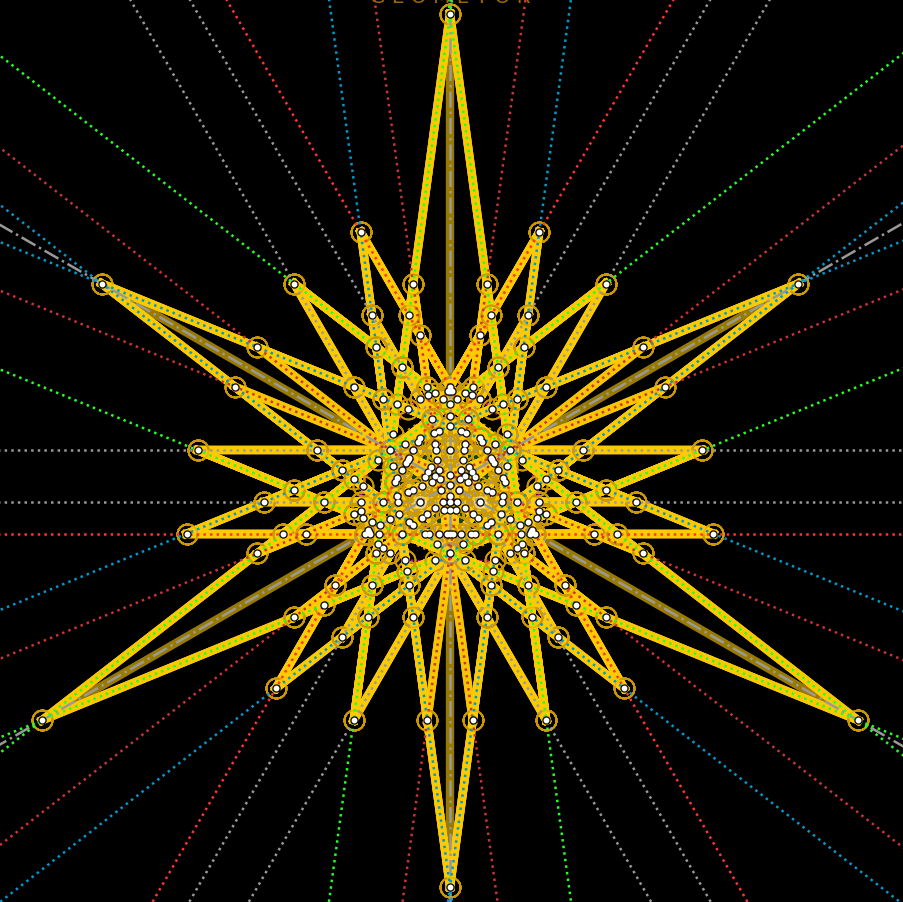
Content of type 'summary'
Book I Summary — Deductive Arc (I.1 → I.47)
Book I ascends in three architectural stages, each illuminated by Oliver Byrne's four-color register design:
Book II Summary — Geometric Algebra Without Variables
Book II of Euclid’s Elements establishes quadratic identities—distributivity (II.1), $(a+b)^2$ (II.4), difference of squares and completing the square (II.5–II.6), the Law of Cosines (II.12–II.13), and quadrature of any rectilinear figure (II.14)—entirely through planar dissection without numerical coordinates or ratio theory:
Book III Summary — Cyclic Angles & Power of a Point
Inscribed & Semicircular Angles (:ref:`III.20 <byrne-iii-20>`, :ref:`III.31 <byrne-iii-31>`): Combining isosceles radius triangles (I.5) with the exterior-angle theorem (I.32) proves that central angles double inscribed angles (III.20) and that every angle inscribed in a semicircle is a right angle (III.31).
Book IV Summary — From the Incircle to the Regular Pentagon
The Incenter & Equal Perpendicular Radii (:ref:`IV.4 <byrne-iv-4>`):
Bisecting two interior angles (I.9) locates the incenter (Kimberling X(1) in geometor/etc), whose three dotted perpendiculars (I.12) are proved equal by AAS congruence (I.26) so the circle touches all three sides (III.16).
Book V Summary — Eudoxian Proportion as Typed Colored Algebra
Redundant Shape + Color Dual Coding: Byrne pairs distinct shapes (circle, square, diamond, shield, pentagon, triangle) with his four colors (red, yellow, blue, black), giving every term of a four- or six-magnitude proportion a unique silhouette even without color cues.
Book VI Summary — Unifying Spatial Form and Eudoxian Ratio
Proportionality Without Commensurability:
Armed with Book V’s general ratio calculus, Book VI proves Thales’s intercept theorem (VI.2), AAA/SAS similarity (VI.4–VI.7), and quadratic area scaling (VI.19–VI.20) without ever assuming rational side ratios.