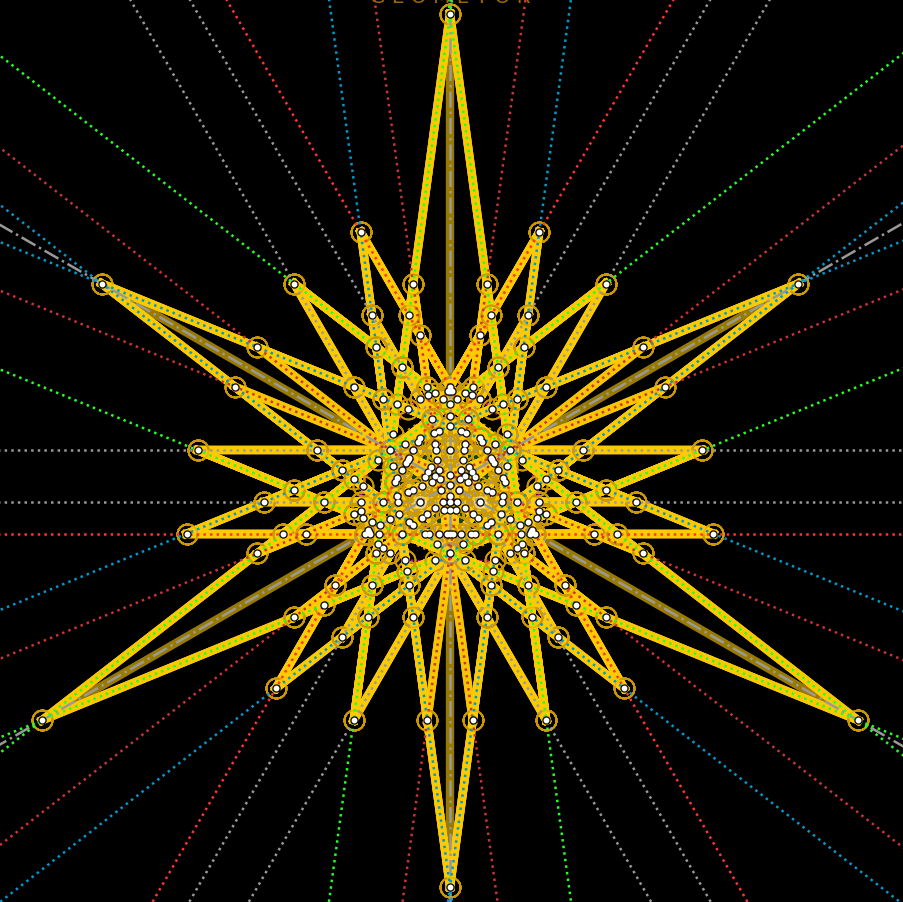
Book II Notes: Exact $\mathbb{Q}(\phi)$ Coordinates & Half-Filled Woodblocks
Typographic & Symbolic Commentary on Book II
Why Byrne Invented Half-Filled Squares in II.4
Inspection of Pickering pp. 56–57 (Leaves 90–91) shows a striking Chiswick Press graphic device: instead of printing the two diagonal sub-squares in solid ink, Byrne fills only the upper-left triangle of each square while outlining the boundary (, ). Because Euclid first proves in II.4 that the two sub-triangles cut by the diagonal are isosceles ([I.6]) before concluding that the four-sided figures are squares, half-filling makes both the constituent triangle and the enclosing square simultaneously legible in a single woodblock impression.
Pre-Proportional Golden Section in $\mathbb{Q}(\phi)$
Book II precedes Eudoxian ratio theory (Book V), so Euclid formulates the Golden Section in II.11 purely as an equality of colored planar regions ( = ), later translated into continuous proportion in VI.30.