Content of type 'section'
Book I: Axiomatic Statics & Postulates 1–7
“I postulate the following (Αἰτούμεθα τάδε):”
On the Sphere and Cylinder I: Assumptions 1–5 & The Tomb Theorem
Part I: The Thirteen Archimedean Semi-Regular Solids (Pappus V.19)
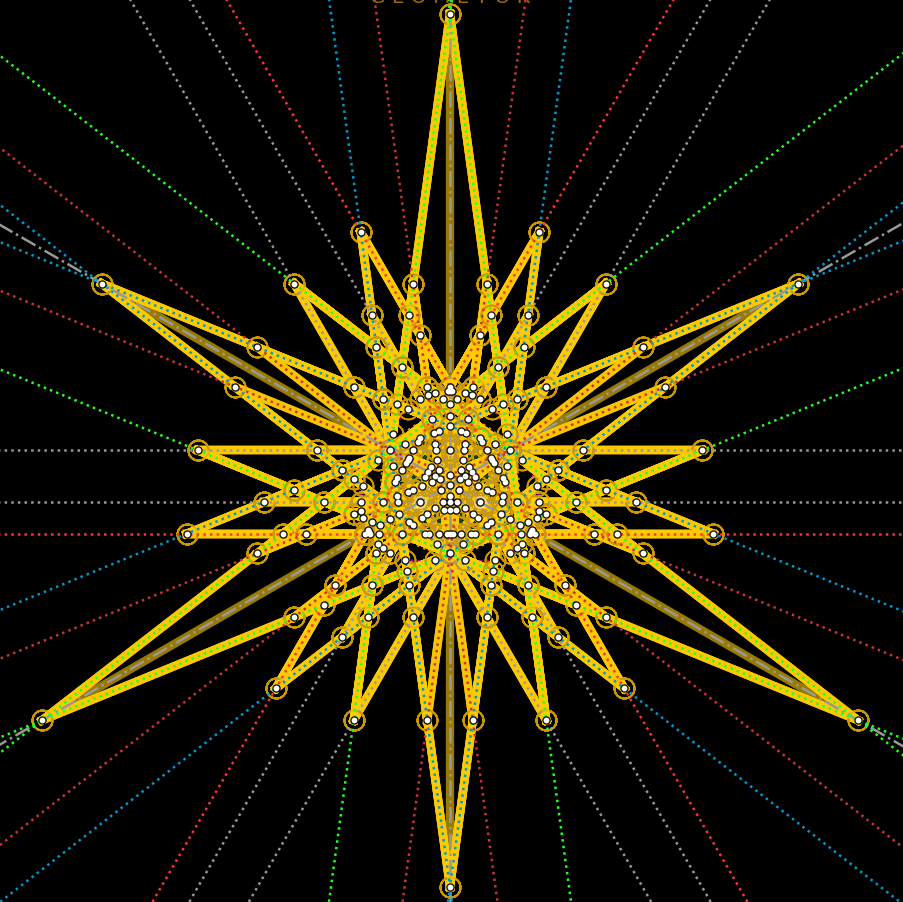
Extending Euclid's five Platonic regular solids (Eucl. XIII. 13–18, euclid:elements), Archimedes discovered and classified the entire finite family of thirteen convex semi-regular polyhedra (Archimedean solids)—bounded by equilateral and equiangular polygons of two or three species meeting in congruent solid angles, excluding the infinite families of prisms and antiprisms. Although Archimedes’ Greek roll was lost in late antiquity, Pappus of Alexandria (pappus:synagoge:v, Synagoge Book V, Prop. 19) preserved the exact polygon counts and ordering of all thirteen solids, later reconstructed in the Renaissance by Luca Pacioli (geometor:pacioli, De Divina Proportione, 1509) and proved complete by Johannes Kepler (Harmonices Mundi Book II, 1619):
Prefatory Epistle to Dositheus & Archimedes’ Lemma
Prefatory Letter to Eratosthenes & Statical Lemmas 1–11
“ARCHIMEDES TO ERATOSTHENES GREETING.
Propositions 1–3: Tangent Circles, Semicircle Tangents & Chord Ratios
Proposition 1 (Homothetic Chords of Tangent Circles): If two circles touch at A, and if CD, EF be parallel diameters in them, then ADF is a straight line (and similarly ACE when tangent externally). Proved by parallel radii and alternate angles (Eucl. I. 29, Eucl. VI. 32).
Book I: Propositions 1–5: Elementary Symmetry of the Balance
Proposition 1: Weights which balance at equal distances are equal (proved by Post. 3 and Post. 1).
On the Sphere and Cylinder II: Spherical Segments & Eutocius’s Cubic Intersection
Book II, Proposition 2 (archimedes:sphere-and-cylinder:ii-2): Every spherical segment of height in a sphere of radius equals the cone having the same base as the segment and altitude , whence .
Part I: Mechanical Exhaustion via the Lever (Propositions 1–17)
Part II: Stomachion (Loculus Archimedius) & The Cattle Problem
The Stomachion (*Στομάχιον*): Recovered from folios of the Constantinople Palimpsest alongside an Arabic witness, the Stomachion dissects a square of side (total area ) via rational midpoints and diagonal intersections into 14 polygonal pieces—11 triangles, 2 quadrilaterals, and 1 pentagon—whose areas are all exact integers:
Book I: Propositions 6 & 7: The Law of the Lever
On Spirals: Kinematic Definition, Subtangent Rectification & Quadrature
Part II: Pure Geometric Exhaustion (Propositions 18–24)
Given a series of areas ABCDdotsZ, of which A is the greatest, and each is equal to four times the next in order, then:
Part III: The Sand-Reckoner (Arenarius)
Book I: Propositions 8–12: Remainders, Parallelograms & Similar Triangles
Proposition 8: If AB be a magnitude whose centre of gravity is C, and AD a part of it whose centre of gravity is F, then the centre of gravity G of the remaining part DE lies on FC produced so that .
On Conoids and Spheroids: Paraboloids, Hyperboloids & Spheroids
In 32 propositions (archimedes:conoids-and-spheroids), Archimedes extends exhaustion by inscribed and circumscribed cylinder-slices (“gnomons” of equal thickness) to affine-scaled quadric surfaces of revolution:
Propositions 3–15: Conoids, Centroids, the Ungula & the Bicylinder
Propositions 3–11 (pp. 21–38): Apply the identical slice-lever engine to discover the volumes of spheroids (Prop. 3), paraboloids (Prop. 4), centroids of paraboloid segments ( along the axis, Prop. 5!), centroids of hemispheres ( from pole to centre, i.e. from the base, Prop. 6!), spherical segments (Props. 7, 9), spheroid segments (Props. 8, 10), and hyperboloid segments & centroids (Prop. 11).
Book I: Propositions 13 & 14: The Triangle Centroid X(2)
Proposition 13. In any triangle, the centre of gravity lies on the straight line joining any angle to the middle point of the opposite side.
Proposition 14. It follows at once that the centre of gravity of any triangle is at the intersection of the lines drawn from any two angles to the middle points of the opposite sides respectively.
Book I: Proposition 15: Centre of Gravity of a Trapezium
Proposition 15. In any trapezium having two sides parallel to one another, the centre of gravity lies on the straight line joining the middle points of the parallel sides, at the point dividing it so that the segment adjacent to the smaller parallel side is to the remaining segment as twice the greater parallel side together with the smaller is to twice the smaller together with the greater:
Book II: Centres of Gravity of Parabolic Segments (Propositions 1–10)
Propositions 9–13: Intersecting Chords & Orthogonal-Chord Quadrance Invariant
If two chords AB, CD in a circle intersect at right angles in a point O, not being the centre, then: