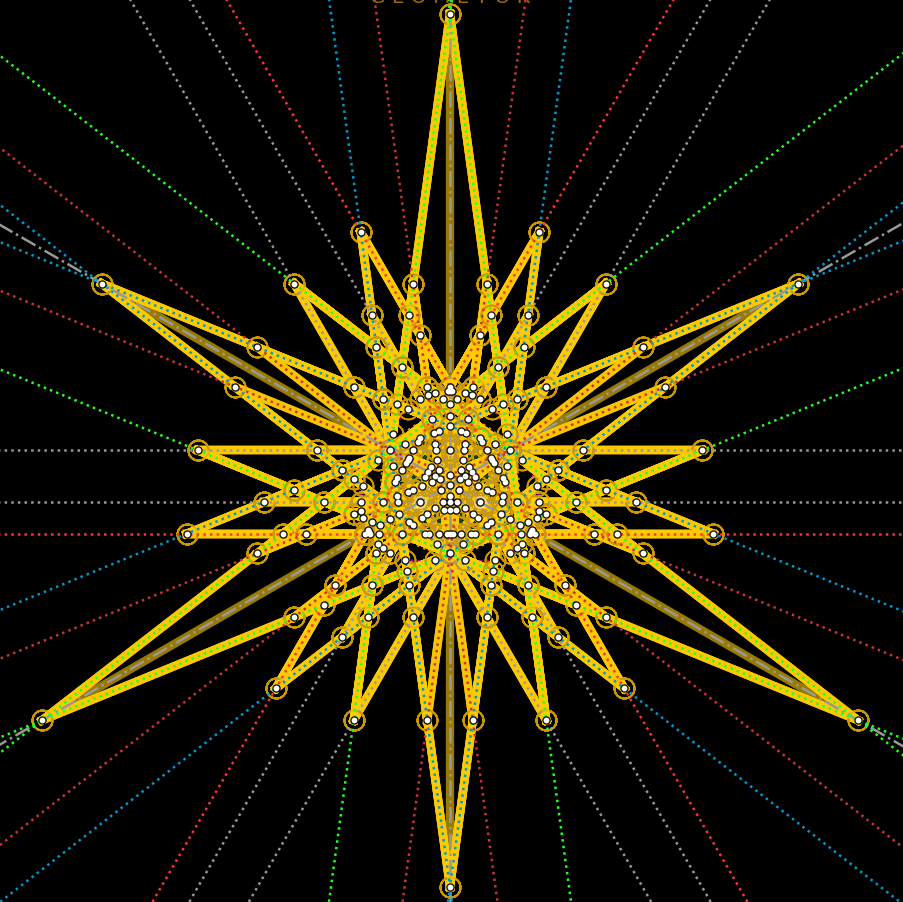
Part III: The Sand-Reckoner (Arenarius)
I. Address to King Gelon & Aristarchus’s Heliocentric Universe
“There are some, king Gelon, who think that the number of the sand is infinite in multitude; and I mean by the sand not only that which exists about Syracuse and the rest of Sicily, but also that which is found in every region whether inhabited or uninhabited. Again there are some who, without regarding it as infinite, yet think that no number has been named which is great enough to exceed its multitude.”
To refute this belief—even for a sphere equal in size to the entire cosmos completely filled with finest poppy-seed sand—Archimedes preserves the priceless sole surviving direct account of :person:`Aristarchus of Samos’s <aristarchus>` heliocentric system (Heath 1897, pp. 221–222):
“Now you are aware that ‘universe’ (κόσμος) is the name given by most astronomers to the sphere whose centre is the centre of the earth and whose radius is equal to the straight line between the centre of the sun and the centre of the earth. This is the common account, as you have heard from astronomers. But Aristarchus of Samos brought out a book consisting of certain hypotheses (ὑποθέσεων γράψας), wherein it appears, as a consequence of the assumptions made, that the universe is many times greater than the ‘universe’ just mentioned. His hypotheses are that the fixed stars and the sun remain unmoved, that the earth revolves about the sun in the circumference of a circle, the sun lying in the middle of the orbit, and that the sphere of the fixed stars, situated about the same centre as the sun, is so great that the circle in which he supposes the earth to revolve bears such a proportion to the distance of the fixed stars as the centre of the sphere bears to its surface.”
Interpreting Aristarchus’s striking point-to-surface phrase mathematically (since a geometric point has no ratio to a surface, Eucl. V. Def. 4!), Archimedes charitably models Aristarchus’s proportion as:
II. Experimental Solar Parallax & Astronomical Bounds
f. Heath (1897), pp. 223–226 · Heiberg II, 248–265 · p. 223Deliberately adopting generous upper bounds at every step so his sand-estimate stays a fortiori unassailable (Earth perimeter stadia, ten times Eratosthenes' measurement; solar diameter greater than the moon’s, citing earlier estimates including that of “Phidias my father”, Φειδία δὲ τοῦ ἁμοῦ πατρός, who made it times the moon’s), Archimedes measures the apparent angular diameter of the rising sun along a sighting rod with a movable cylinder, correcting for the finite aperture of the human pupil, and establishes:
From this chord bound he proves geometrically that the diameter of the traditional cosmos is less than Earth diameters ( stadia), whence the diameter of Aristarchus’s sphere of fixed stars is less than stadia!
III. The Myriad-Octad Number System & Law of Exponents
f. Heath (1897), pp. 227–232 · Heiberg II, 264–291 · p. 227Recalling his earlier treatise Principles (Ἀρχαί) addressed to Zeuxippus, Archimedes constructs his recursive myriad-octad hierarchy on base (a myriad myriads):
First Order: numbers from up to .
Second Order: taking as unit, up to .
*k*-th Order (): up to , culminating at the -th Order in , which closes the First Period!
Second to Myriad-Myriadth Period: taking as the unit of the First Order of the Second Period and continuing through Periods reaches a myriad-myriad units of the myriad-myriadth order of the myriad-myriadth period:
\[P^{10^8} = \left(10^{8 \cdot 10^8}\right)^{10^8} = 10^{8 \cdot 10^{16}}!\]
To multiply across orders without overflowing language, Archimedes proves the Law of Exponents (Heath 1897, p. 229):
IV. Final Cosmic Sand Upper Bounds
Assuming grains of sand in a poppy-seed sphere of diameter finger-breadth and stadium finger-breadths, cubing diameter ratios (Eucl. XII. 18) and applying the Law of Exponents proves:
Traditional Cosmos: Fewer than one thousand units of the seventh order of numbers, i.e. grains of sand!
Aristarchus’s Heliocentric Sphere of Fixed Stars: Fewer than one thousand myriads of units of the eighth order of numbers, i.e. grains of sand!
“I conceive that these things, king Gelon, will appear incredible to the great majority of people who have not studied mathematics, but that to those who are conversant therewith and have given thought to the question of the distances and sizes of the earth and the sun and moon and the whole universe the proof will carry conviction. And it was for this reason that I thought the subject would be not inappropriate for your consideration.”