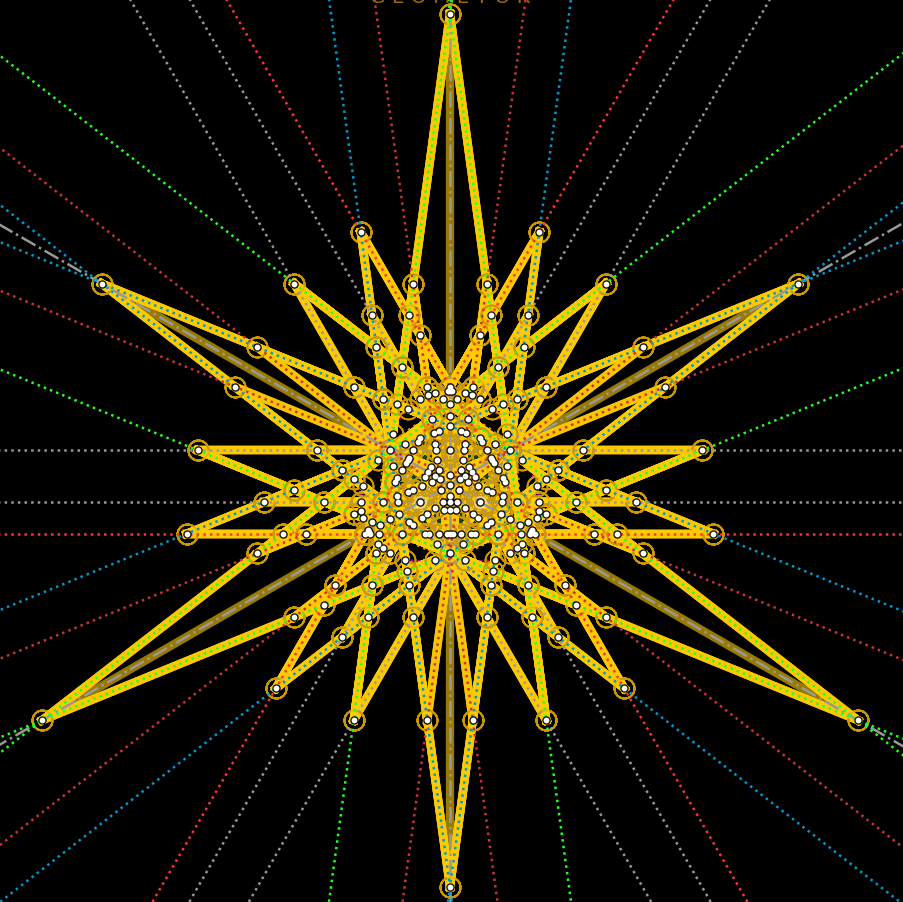
Part I: The Thirteen Archimedean Semi-Regular Solids (Pappus V.19)
Extending Euclid's five Platonic regular solids (Eucl. XIII. 13–18, euclid:elements), Archimedes discovered and classified the entire finite family of thirteen convex semi-regular polyhedra (Archimedean solids)—bounded by equilateral and equiangular polygons of two or three species meeting in congruent solid angles, excluding the infinite families of prisms and antiprisms. Although Archimedes’ Greek roll was lost in late antiquity, Pappus of Alexandria (pappus:synagoge:v, Synagoge Book V, Prop. 19) preserved the exact polygon counts and ordering of all thirteen solids, later reconstructed in the Renaissance by Luca Pacioli (geometor:pacioli, De Divina Proportione, 1509) and proved complete by Johannes Kepler (Harmonices Mundi Book II, 1619):
Complete Register of Pappus V.19 & geometor/pacioli Concordance
# |
Kepler / Modern Name |
Vertex Symbol |
Pappus V.19 Face Census () |
Algebraic Field |
|
|---|---|---|---|---|---|
I |
Truncated Tetrahedron |
|
8 faces: triangles + hexagons |
||
II |
Cuboctahedron (Pacioli ‘heavily abscised cube’) |
|
14 faces: triangles + squares |
/ |
|
III |
Truncated Octahedron |
|
14 faces: squares + hexagons |
||
IV |
Truncated Cube |
|
14 faces: triangles + octagons |
||
V |
Rhombicuboctahedron (Pacioli 26-base body) |
|
26 faces: triangles + squares |
||
VI |
Truncated Cuboctahedron (Great Rhombicuboctahedron) |
|
26 faces: sq. + hex. + oct. |
||
VII |
Snub Cube (chiral) |
|
38 faces: triangles + squares |
Tribonacci cubic |
|
VIII |
Icosidodecahedron (Pacioli abscised icosahedron) |
|
32 faces: triangles + pentagons |
||
IX |
Truncated Icosahedron |
|
32 faces: pentagons + hexagons |
||
X |
Truncated Dodecahedron |
|
32 faces: triangles + decagons |
||
XI |
Rhombicosidodecahedron |
|
62 faces: tri. + sq. + pent. |
||
XII |
Truncated Icosidodecahedron |
|
62 faces: sq. + hex. + dec. |
||
XIII |
Snub Dodecahedron (chiral) |
|
92 faces: triangles + pentagons |
Cubic over |