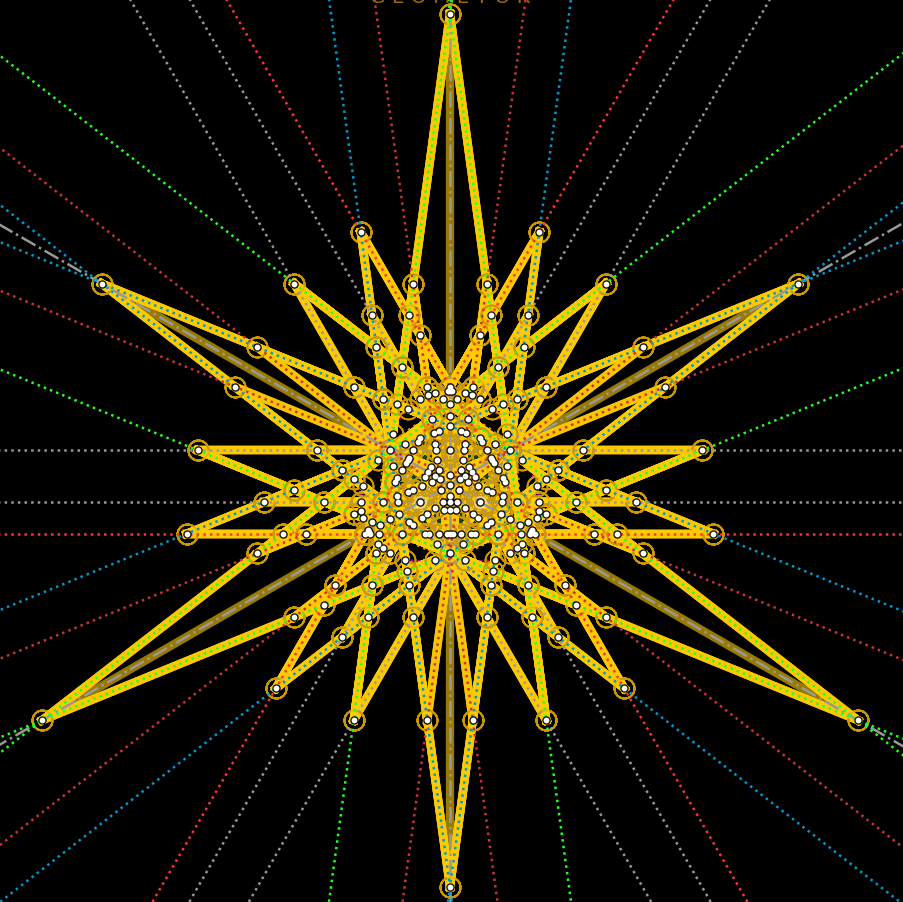
Part II: Stomachion (Loculus Archimedius) & The Cattle Problem
The Stomachion (*Στομάχιον*): Recovered from folios of the Constantinople Palimpsest alongside an Arabic witness, the Stomachion dissects a square of side (total area ) via rational midpoints and diagonal intersections into 14 polygonal pieces—11 triangles, 2 quadrilaterals, and 1 pentagon—whose areas are all exact integers:
\[3,\; 3,\; 6,\; 6,\; 6,\; 9,\; 12,\; 12,\; 12,\; 12,\; 14,\; 14,\; 14,\; 21 \qquad \left(\sum = 144\right),\]investigating the combinatorial multitude of distinct ways ( assemblies, or modulo reflections and rotations) in which commensurable polygonal figures recombine to tile the square.
The Cattle Problem (*Πρόβλημα βοεικόν*) (Heath 1897, pp. 319–326; Heiberg II, 446–455): Addressed in 22 elegiac distichs to Eratosthenes at Alexandria, asking for the number of White, Black, Dappled, and Yellow bulls and cows of the Sun satisfying seven linear ratio constraints plus two Diophantine figurate conditions (White + Black bulls = a square; Yellow + Dappled bulls = a triangular number), reducing to Pell’s equation:
\[t^2 - 4{,}729{,}494\, u^2 = 1,\]whose smallest positive solution yields a herd total of 206,545 decimal digits!