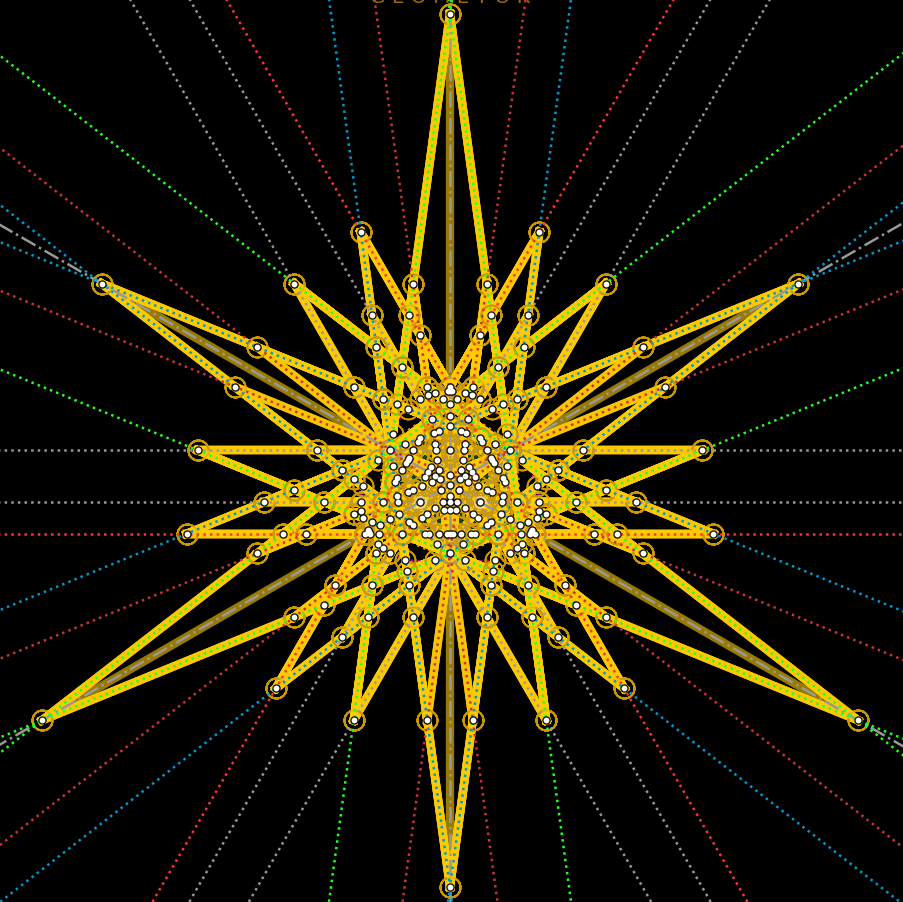
The Sand-Reckoner & Semi-Regular Solids
Τρισκαίδεκα ἡμικανονικὰ στερεά (Pappus V.19) · Στομάχιον · Ψαμμίτης (Arenarius) — Archimedes (heath:1897, pp. xxxvi, 221–232; pappus:synagoge:v; heiberg:1881)
Note
Edition Track (English): Combines the complete ancient record and \(\mathbb{Q}(\phi)\) structural concordance of Archimedes' Thirteen Semi-Regular Polyhedra, the 14-piece Palimpsest Stomachion, and the public-domain text of The Sand-Reckoner (*Arenarius*) from heath:1897 (pp. 221–232), verified against 300 DPI scans of Heath (1897). Switch tracks above for the Summary or Notes.
“There are some, king Gelon, who think that the number of the sand is infinite in multitude… His hypotheses are that the fixed stars and the sun remain unmoved, that the earth revolves about the sun in the circumference of a circle, the sun lying in the middle of the orbit.”
—Archimedes, The Sand-Reckoner
Table of Contents
Part I: The Thirteen Archimedean Semi-Regular Solids (Pappus V.19)
Extending Euclid's five Platonic regular solids (Eucl. XIII. 13–18, euclid:elements), Archimedes discovered and classified the entire finite family of thirteen convex semi-regular polyhedra (Archimedean solids)—bounded by equilateral and equiangular polygons of two or three species meeting in congruent solid angles, excluding the infinite families of prisms and antiprisms. Although Archimedes’ Greek roll was lost in late antiquity, Pappus of Alexandria (pappus:synagoge:v, Synagoge Book V, Prop. 19) preserved the exact polygon counts and ordering of all thirteen solids, later reconstructed in the Renaissance by Luca Pacioli (geometor:pacioli, De Divina Proportione, 1509) and proved complete by Johannes Kepler (Harmonices Mundi Book II, 1619):
Part II: Stomachion (Loculus Archimedius) & The Cattle Problem
The Stomachion (*Στομάχιον*): Recovered from folios of the Constantinople Palimpsest alongside an Arabic witness, the Stomachion dissects a square of side (total area ) via rational midpoints and diagonal intersections into 14 polygonal pieces—11 triangles, 2 quadrilaterals, and 1 pentagon—whose areas are all exact integers:
Part III: The Sand-Reckoner (Arenarius)
Semi-Regular Solids, Stomachion & Sand-Reckoner — Analytical Summary
Scope: Pappus V.19 · Heiberg Vol. II, pp. 242–291, 416–424, 446–455 · Heath (1897), pp. xxxvi, 221–232, 319–326
Semi-Regular Solids, Stomachion & Sand-Reckoner — Philological & Mathematical Notes
In Synagoge V.19 (pappus:synagoge:v), Pappus lists the thirteen solids in increasing order of complexity within the tetrahedral/cubic and icosahedral families (8, 14, 14, 14, 26, 26, 38, 32, 32, 32, 62, 62, 92 faces) and computes their vertex and edge numbers by face-incidence counting (). During the Renaissance, Piero della Francesca and Luca Pacioli (geometor:pacioli, De Divina Proportione, Venice 1509, with woodcuts after Leonardo da Vinci’s corpora vacua skeletal drawings) rediscovered the truncated and elevated (abscisi / elevati) members directly from the five Platonic solids of Euclid Book XIII, before Johannes Kepler (Harmonices Mundi, Linz 1619) restored all thirteen—including the enantiomorphic snub cube and snub dodecahedron—by systematic angular-defect analysis ( at every convex vertex, Eucl. XI. 21).