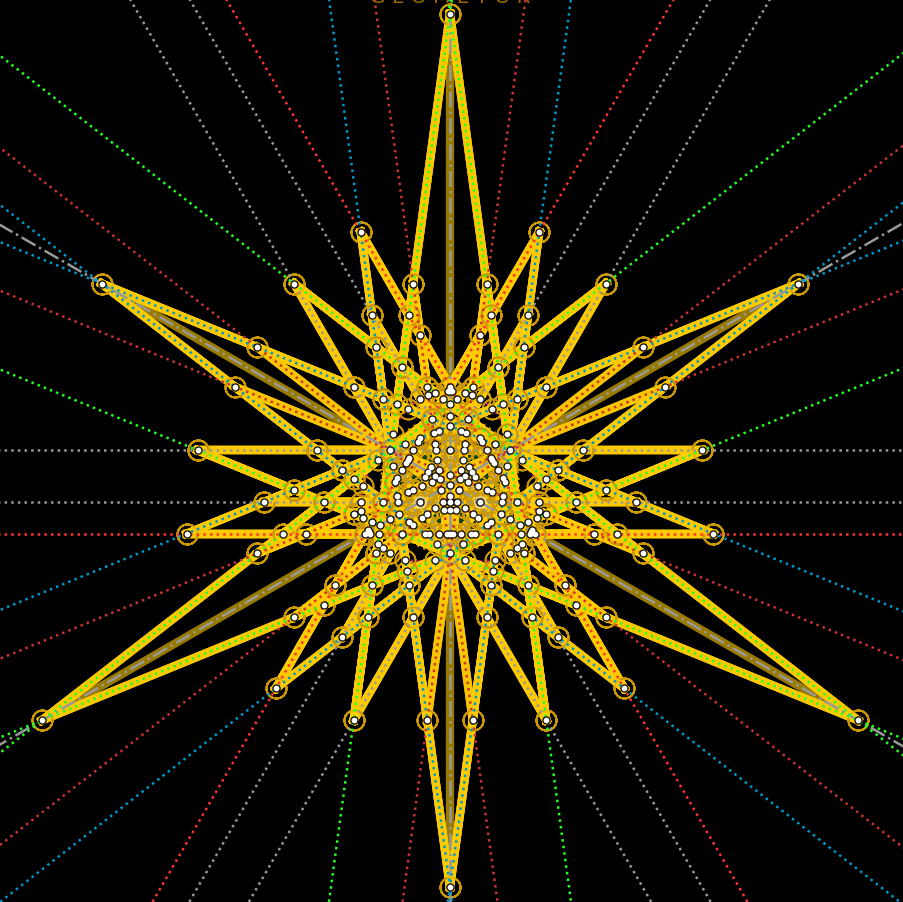
Unit VII: Dynamic Symmetry & Gnomonic Morphology — Jay Hambidge (1919–1920) — Notes & Concordance
Critical Apparatus & GEOMETOR Cross-References — VII. Hambidge: Dynamic Symmetry
Scholarly Commentary & GEOMETOR Concordance (Unit VII)
Exact Algebraic Bridge to wildberger, euclid, divine, and thompson
Greek *Dynamis* = Wildberger’s Quadrance (`geometor/wildberger`): Hambidge’s recovery of Greek dynamis (“square / power” in Plato’s Theaetetus 147d–148b and Euclid Book X Def. 2, euclid:elements) translates with 100% algebraic precision into Rational Trigonometry (geometor/wildberger):
A rectangle of unit height ($Q_{\text{end}} = 1$) and horizontal side $s_n = \sqrt{n}$ has horizontal quadrance $Q_n = n$.
By Pythagoras’s Theorem ($Q_{\text{diag}} = Q_{\text{end}} + Q_n = 1 + n$), swinging the diagonal down to the baseline increments the side quadrance by exact integer steps $Q = 1 \to 2 \to 3 \to 4 \to 5$!
Moreover, for any rectangle of aspect ratio $r$ with main diagonal vector $(r, 1)$ and reciprocal rectangle of width $1/r$ with counter-diagonal vector $(1/r, -1)$, their dot product is:
$$(r, 1) \cdot \left(\frac{1}{r}, -1\right) = 1 - 1 = 0$$
proving algebraically for every ratio $r > 0$ that the diagonal of the reciprocal intersects the diagonal of the whole at exact perpendicular spread $s = 1$ ($90^\circ$)!
Unified Harmonic Identity of the $\sqrt{5}$ and $\phi$ Rectangles (geometor/divine)
Exact $\mathbb{Q}(\sqrt{5})$ Decomposition: Over the golden field $\mathbb{Q}(\phi)$ (geometor/divine), where $\phi = \frac{1+\sqrt{5}}{2}$ and $\phi^{-1} = \phi - 1 = \frac{\sqrt{5}-1}{2}$, Hambidge’s geometric dissections express three fundamental exact identities:
$$\sqrt{5} = 2\phi - 1 = 1 + 2\phi^{-1} = \phi + \phi^{-1}$$
$\sqrt{5} = 1 + 2\phi^{-1}$: a central unit square flanked symmetrically by two vertical reciprocal golden rectangles;
$\sqrt{5} = \phi + \phi^{-1}$: a horizontal whirling-square rectangle ($\phi$) joined to a vertical reciprocal golden rectangle ($\phi^{-1}$);
$2\phi - \sqrt{5} = 1$: two overlapping whirling-square rectangles sharing a central unit square!
Synthesis of Thompson and Hambidge: Reading Thompson (1917) and Hambidge (1919–1920) side by side illuminates two complementary halves of classical morphology: Thompson proves physically and differentially why terminal accretion and apical close-packing generate gnomons, equiangular spirals, and Fibonacci parastichies, while Hambidge shows synthetically and constructively how straightedge and compass unfold those very gnomons into commensurable-in-square harmonic partitions.
Structured Concordance Loci in This Unit
- Root Rectangles (√1–√5), Commensurability in Square, Reciprocal Orthogonality, and Whirling Squares (Companion Concordance: Jay Hambidge (1919–1920), Diagonal Vol. I pp. 1–25 & Greek Vase Chs. I–III (cf. Thompson pp. 509–513, 635–651))
Synthesizes Thompson’s gnomonic shell geometry and Church’s sunflower phyllotaxis with Jay Hambidge’s 1919–1920 Yale geometric canon of root rectangles and whirling squares. Algebraic Invariants:
Q_n = n (n = 1, 2, 3, 4, 5)·√5 = φ + φ⁻¹·1 / φ = φ - 1 = 0.618034...geometor/euclid (Book I, Prop. 47; Book II, Prop. 11; Book X, Def. 2 (δυνάμει σύμμετροι)): Hambidge explicitly grounds Dynamic Symmetry in Euclid X Def. 2: sides 1, √2, √3, 2, √5 are linearly incommensurable yet commensurable in square.
geometor/wildberger (Consecutive Integer Quadrances Q = 1, 2, 3, 4, 5 & Perpendicular Spread s = 1): Unfolding root rectangles via compass diagonals increments side quadrance by 1 at each step (Q_{n+1} = Q_n + 1), while reciprocal diagonals intersect at spread s = 1 (90°).
geometor/divine (√5 Rectangle Decomposition: √5 = φ + 1/φ = 2φ - 1): Demonstrates Hambidge’s core harmonic identity bridging the √5 rectangle to two overlapping whirling-square φ rectangles.
Dynamic Symmetry Parallel: The Diagonal, Vol. I, No. 1 (Nov. 1919), pp. 1–7 (‘Dynamic Symmetry of the Plant’), pp. 18–21 (‘The Elements of Dynamic Symmetry: Root Rectangles & Instruments’)
Dynamic Symmetry Parallel: Dynamic Symmetry: The Greek Vase (1920), Chs. I–III (‘Static and Dynamic Symmetry’, ‘Phyllotaxis and Shells’, ‘Root-Five and Whirling-Square Rectangles’)