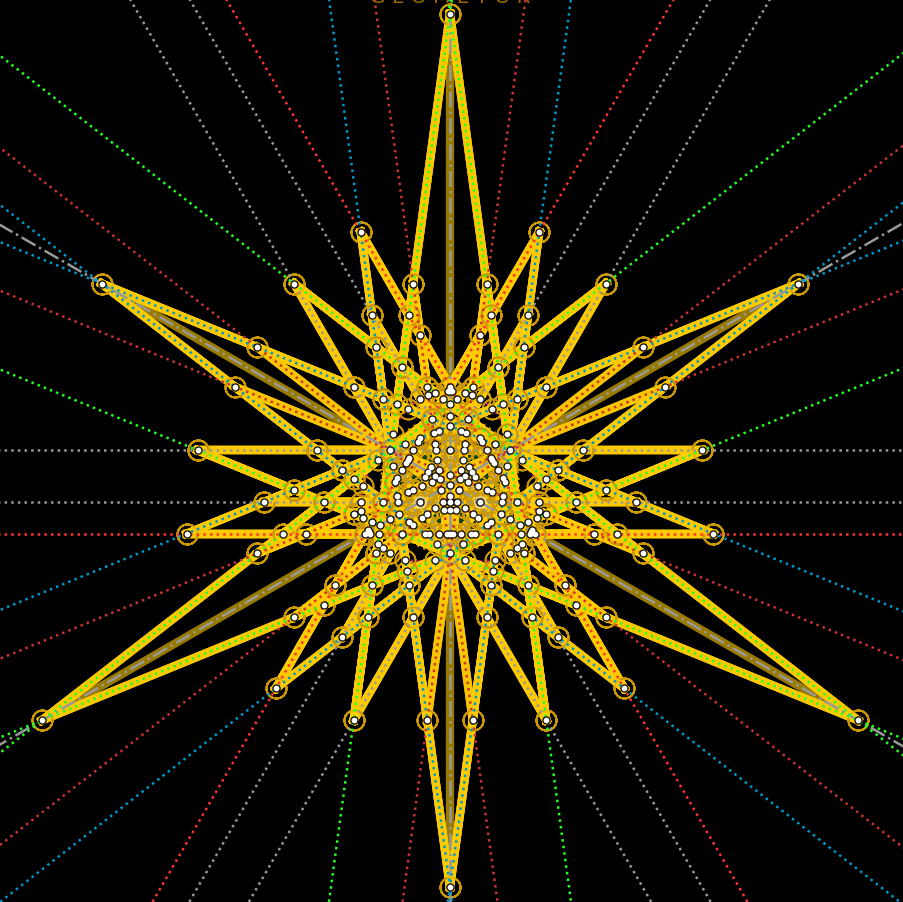
Unit VII: Dynamic Symmetry & Gnomonic Morphology — Jay Hambidge (1919–1920) — Summary
Analytical Synopsis — Yale University Press Public-Domain Companion — The Diagonal (Vol. I, 1919–1920) & Dynamic Symmetry: The Greek Vase (1920)
Overview of Unit VII (Jay Hambidge’s Elements of Dynamic Symmetry, 1919–1920)
Unit VII pairs On Growth and Form (1917) with scan-verified primary lessons from Jay Hambidge's 1919–1920 Yale University Press publications—The Diagonal (hambidge:1920-diagonal, where The Elements of Dynamic Symmetry first appeared serially) and Dynamic Symmetry: The Greek Vase (hambidge:1920-vase):
Static vs. Dynamic Symmetry: Contrasts passive static symmetry (regular polygons, rational grids, crystals, diatoms, and radiolarian polyhedra—Thompson’s Chapters VII–IX) with active dynamic symmetry (shell spirals and botanical phyllotaxis—Thompson’s Chapters XI–XIV).
Botanical Phyllotaxis as Proportional Engine: Draws on A. H. Church's Oxford sunflower capitulum diagrams (church:1904) to connect the Fibonacci summation series ($1, 2, 3, 5, 8, 13, 21, 34, 55, 89, 144\dots$) to the asymptotic golden ratio $\phi = \frac{1 + \sqrt{5}}{2} \approx 1.618034$.
Commensurability in Square (`Euclid Book X`): Highlights the Greek geometric key: although $1, \sqrt{2}, \sqrt{3}, \sqrt{5}$ are linearly incommensurable, they are commensurable in square (dynamei symmetroi, Euclid X Def. 2)—meaning the squares erected on their sides have exact integer area ratios $1 : 2 : 3 : 4 : 5$.
Root-Rectangle Unfolding & Reciprocal Orthogonality: Demonstrates compass unfolding of the $\sqrt{2}, \sqrt{3}, \sqrt{4} = 2, \sqrt{5}$ root rectangles from the unit square, proves that every reciprocal rectangle ($1/\sqrt{n}$) divides its parent $\sqrt{n}$ rectangle into $n$ congruent similar parts with perpendicular diagonals ($90^\circ$), and constructs the whirling-square golden rectangle ($1 : \phi$) inside the $\sqrt{5}$ rectangle ($\sqrt{5} = \phi + \phi^{-1} = 1 + 2\phi^{-1}$).