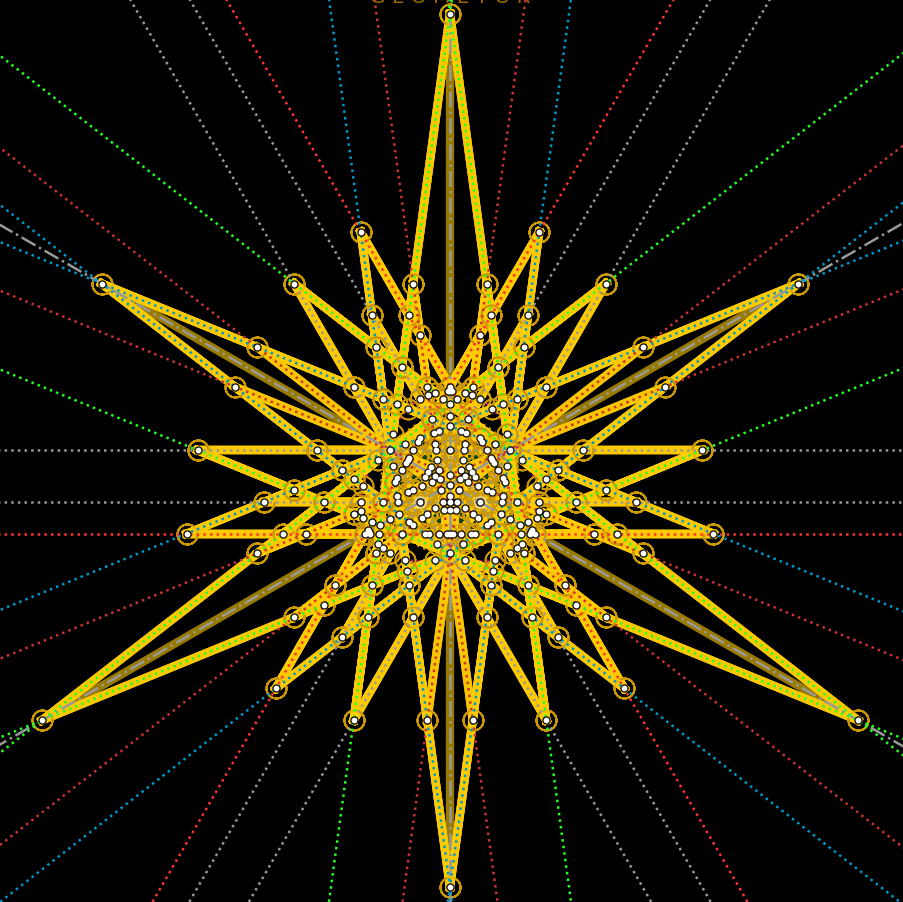
Unit VI: On the Theory of Transformations and Epilogue — Notes & Concordance
Critical Apparatus & GEOMETOR Cross-References — VI. Transformations & Epilogue
Scholarly Commentary & GEOMETOR Concordance (Unit VI)
Projective & Diffeomorphic Geometry (geometor/pappus & geometor/hilbert)
Morphology in the Spirit of Klein’s Erlangen Program: Just as David Hilbert (geometor/hilbert) and Pappus (geometor/pappus) study geometric properties invariant under affine, projective, or birational transformation groups, Thompson defines taxonomic affinity as equivalence under a smooth low-degree homeomorphism $(x, y) \mapsto (x', y')$! Conversely, Thompson stresses a striking topological negative theorem (pp. 724, 774): no continuous transformation can map an invertebrate into a vertebrate or a teleost into a shark without tearing singularities—providing a mathematical criterion for discontinuous bauplan boundaries.
Modern Mathematical Descendants: Chapter XVII (originally read before the Royal Society of Edinburgh in 1915, thompson:1915) directly fathered Julian Huxley’s allometry ($y = b x^k$, 1932), Fred Bookstein’s thin-plate spline morphometrics (biharmonic bending-energy minimization), and Alain Goriely’s modern differential morphoelasticity.
1917 Cambridge Archival Folio Note (Multimodal Scan Verification)
Printed Page 748 Compositor Typo (`Fig. 474` for `Fig. 374`): Direct visual inspection of the 300 DPI page scan of the 1917 First Edition (thompson_transforms-768.png, printed p. 748, second line from bottom) reveals an authentic 1917 Cambridge University Press compositor slip: the text reads “transferred to the oblique coordinates passes into the figure of Sternoptyx (Fig. 474)” (there are only 408 figures in the 1917 edition, and Sternoptyx diaphana is printed immediately above on the same page as Fig. 374.). Faithful to Digital Scriptorium principles, the verbatim 1917 text preserves the historical reading while recording [sic: Fig. 374] here in the critical apparatus.
Epilogue Allusions Identified (pp. 778–779):
“a certain mathematician” (“Conterminous with space and coeval with time is the kingdom of Mathematics…”): James Joseph Sylvester (Presidential Address to Section A of the British Association at Exeter, 1869).
“that old man eloquent, that wise student and pupil of the ant and the bee, who died but yesterday”: the Provençal entomologist Jean-Henri Fabre (1823–1915, died October 1915 while Thompson was completing the 1917 manuscript), quoting Fabre’s Souvenirs entomologiques hymn to Number.
Structured Concordance Loci in This Unit
- Dürer’s Grids, Cartesian Deformation Meshes, and Comparative Phylogeny (Ch. XVII (On the Theory of Transformations) & Epilogue, pp. 719–779)
Culminates On Growth and Form: related species differ not by piecemeal mosaic mutations of isolated parts, but by single global coordinate transformations of the organism as an integral whole. Algebraic Invariants:
(x, y) ↦ (x + y cot ω, y sin ω)·Conformal & coaxial circle familiesgeometor/pappus (Synagoge Book VII (Projective Cross-Ratio & Collineations)): Thompson’s affine shear, perspective/radial, and coaxial circle transformations preserve harmonic and projective invariants across related organic genera.
geometor/hilbert (Grundlagen der Geometrie, Affine & Projective Transformation Groups): Realizes Felix Klein’s and Hilbert’s Erlangen transformation-group viewpoint in comparative anatomy (Argyropelecus → Sternoptyx, Diodon → Orthagoriscus, Eohippus → Equus).
Dynamic Symmetry Parallel: The Diagonal (1919–1920) — Dürer’s human proportion grids contrasted with classical Greek areal modulation