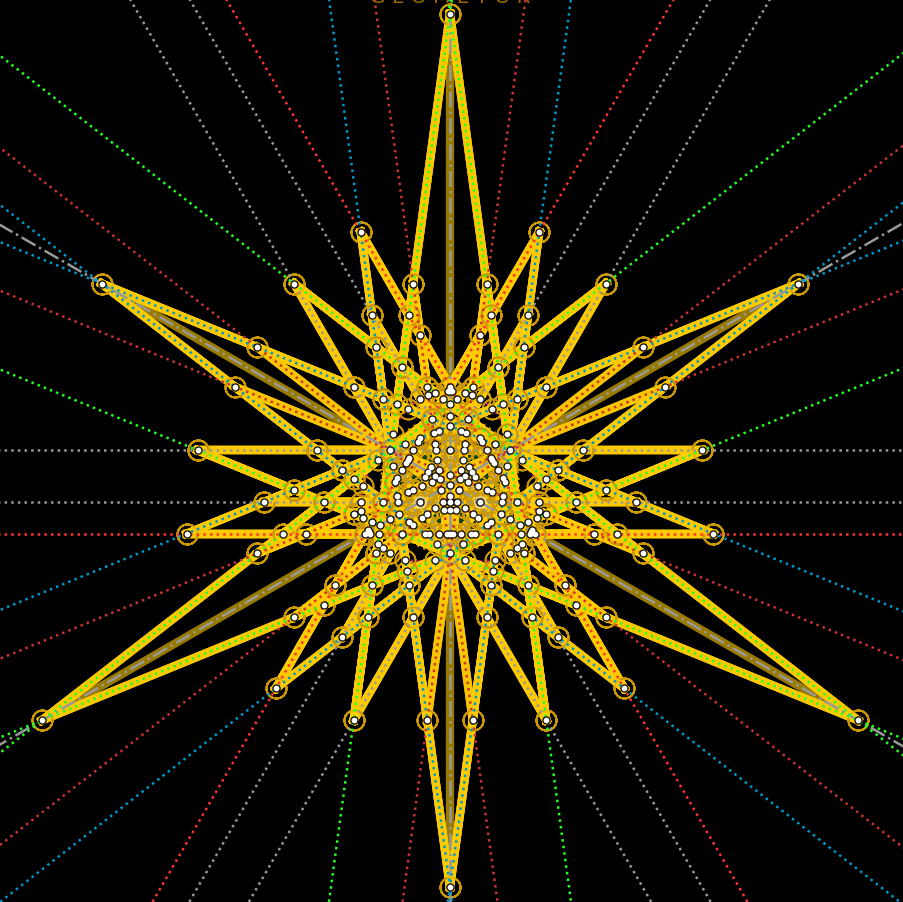
Unit VII: Dynamic Symmetry & Gnomonic Morphology — Jay Hambidge (1919–1920)
Yale University Press Public-Domain Companion — The Diagonal (Vol. I, 1919–1920) & Dynamic Symmetry: The Greek Vase (1920)
I. Static and Dynamic Symmetry in Nature and Greek Art
Jay Hambidge — Dynamic Symmetry: The Greek Vase (Yale University Press, 1920, Foreword) & The Diagonal (Vol. I, No. 1, Nov. 1919, pp. 1–2)
Some twenty years ago, the writer, being impressed by the incoherence of modern design and convinced that there must exist in nature some correlating principle which could give artists a control of areas, undertook a comparative study of the bases of all design, both in nature and in art. This labor resulted in the determination of two types of symmetry or proportion, one of which possessed qualities of activity, the other of passivity. For convenience, the active type was termed dynamic symmetry, the other, static symmetry. It was found that the passive was the type which was employed most naturally by artists, either consciously or unconsciously; in fact, no design which would be recognized as such—unless, indeed, it were dynamic—would be possible without the use, in some degree, of this passive or static type. It is apparent in nature in certain crystal forms, radiolaria, diatoms, flowers and seed pods, and has been used consciously in art at several periods.
The principle of dynamic symmetry is manifest in shell growth and in leaf distribution in plants. A study of the basis of design in art shows that this active symmetry was known to but two peoples, the Egyptians and the Greeks; the latter only having developed its full possibilities for purposes of art. The writer believes that he has now recovered, through study of natural form and shapes in Greek and Egyptian art, this principle for the proportioning of areas.
The synthetic use of these design principles is simple. The Greeks probably used a string held in the two hands. The Harpedonaptae or rope-stretchers of Egypt had no other instrument for orientating and surveying or laying out temple plans. When temple and tomb building began, it became necessary to establish a right angle and lay out a full-sized plan on the ground. The right angle was determined by marking off twelve units on the rope, four of these units forming one side, three the other, and five the hypotenuse of the triangle, a method which has persisted to our day. This was the origin of the historic “cording of the temple.” At some time during the Sixth or Seventh Century B.C. the Greeks obtained from Egypt knowledge of this manner of correlating elements of design. In their hands it was highly perfected as a practical geometry, and for about three hundred years it provided the basic principle of design for the finest art of the Classic period. Euclidean geometry (euclid:elements) gives us the Greek development of the idea in pure mathematics; but the secret of its artistic application completely disappeared. Its recovery has given us dynamic symmetry—a method of establishing the relationship of areas in design-composition.
II. The Dynamic Symmetry of the Plant (Sunflower Phyllotaxis)
Jay Hambidge — The Diagonal (Yale University Press, Vol. I, No. 1, Nov. 1919, pp. 3–7)
It has long been known that a peculiar series of numbers is connected with the phenomenon of the orderly distribution of the leaves of plants. The series is: $1, 2, 3, 5, 8, 13, 21, 34, 55, 89, 144$, etc. This is called a summation series from the fact that each term is composed of the sum of the two preceding terms. For those who may be interested in the subject from the botanical standpoint reference is made to the elaborate work of Professor A. H. Church of Oxford on Phyllotaxis in Relation to Mechanical Laws (church:1904). This series of numbers in reality represents the symmetry of the plant in the sense that the word is used as “analogy,” which is its Greek meaning. From this series we obtain the entire machinery of dynamic symmetry, which applies not only to the architecture of the plant but to the architecture of man.
This summation series of numbers, because of its character, represents a ratio, i.e., it is a geometrical progression. This ratio may be obtained by dividing one term into another, such as $34$ into $55$. The series does not represent the phenomenon exactly, but only so far as it is representable by whole numbers. A much closer representation would be obtained by a substitute series where the cascade ratio is $: 1.618034\dots$ (the golden ratio $\phi = \frac{1 + \sqrt{5}}{2}$).
In the sunflower head used by Professor Church to exhibit the phyllotaxis phenomena, the seed pods are distributed in a rhythmic, intersecting series of curves. Closer inspection shows that these curves are logarithmic or equiangular spirals arrangeable in two intersecting systems winding in opposite directions (parastichies). A normal sunflower disk five or six inches in diameter will exhibit $55$ curves winding in one direction and $89$ crossing them in the other; a smaller head exhibits $34$ and $55$; a very large head $89$ and $144$. Each cross-curve pair consists of two adjacent terms of the summation series, and the seeds themselves expand radially from the center by gnomonic enlargement so that their rhombic packing meshes preserve constant angular form from center to rim.
III. The Root-Five Rectangle and the Rectangle of the Whirling Squares
Jay Hambidge — The Elements of Dynamic Symmetry, Lesson I (The Diagonal, Vol. I, No. 1, Nov. 1919, pp. 15–17)
The basic shape derived from this summation ratio of plant growth and human proportion is a rectangle which has been given the name “root-five” (root-rectangle). It is so called because the relationship between the end and side is as one to the square root of five, $1 : 2.2360\dots$ ($1 : \sqrt{5}$). As a length unit the end cannot be divided into the side of a root-five rectangle, because the square root of five is a never-ending fraction. We naturally think of such a relationship as irrational. The Greeks, however, said that such lines were not irrational in power, because they were commensurable or measurable in square. This is really the great secret of Greek design. In understanding this measurableness of area instead of line the Greek artists had command of an infinity of beautiful shapes which modern artists are unable to use. The relationship between the end and side of a root-five rectangle is a relationship of area and not line, because as lengths one cannot be divided into the other, but the square constructed on the end of a root-five rectangle is exactly one-fifth of the area of the square constructed on the side.
Construction of the Root-Five Rectangle. Draw a unit square $BC$ and bisect one side at $A$. Draw a line from $A$ to an opposite corner $B$ (having length $\frac{\sqrt{5}}{2}$) and use this line as a radius to describe a semicircle cutting the extended baseline at $D$ and $E$. Then $DE$ is twice the length of $AB$, namely $\sqrt{5}$. Complete the rectangle on $DE$: it is composed of the central unit square $CB$ flanked by two reciprocal golden rectangles of width $\frac{\sqrt{5}-1}{2} = 0.6180\dots$ ($\sqrt{5} = 1 + 2 \phi^{-1}$).
The Rectangle of the Whirling Squares. The root-five rectangle produces a great number of other shapes which are measurable in area with themselves and with the parent shape. The principal one of these is that which is called the rectangle of the whirling squares. Draw a unit square $CB$, bisect its base at $A$, draw the diagonal radius $AB$ to an upper corner, and swing $AB$ down to $E$ on the extended baseline. Complete the rectangle $DE$: its ratio is $1 : \frac{1 + \sqrt{5}}{2} = 1 : 1.6180\dots$, equal to the root-five rectangle minus one of its two flanking $0.6180$ rectangles.
The Reciprocal and the Whirling Gnomons. A process connected with the science of plan-making which was thoroughly understood by the Greeks was that of determining the reciprocal of a rectangle. Briefly, the reciprocal of a rectangle is a similar shape, custom-scaled so that the end of the larger rectangle becomes the side of the smaller reciprocal. All Greek constructions for reciprocals depend upon the fundamental theorem that the diagonal of a reciprocal always cuts the diagonal of the major shape at right angles ($90^\circ$).
In a whirling-square rectangle ($1 : \phi$), the reciprocal has area $\frac{1}{\phi} = \phi - 1 = 0.6180\dots$, and the area in excess of the reciprocal is an exact unit square (gnomon). If we draw a diagonal of the whole rectangle and a perpendicular diagonal of its reciprocal, and continue cutting off successive reciprocals inside the remainder, the cut-off squares $1, 2, 3, 4, 5, \dots$ arrange themselves in a spiral whirling to infinity around the intersection pole or “eye” $O$—matching D'Arcy Thompson's gnomonic construction in Chapter XI (Fig. 252). Also, two whirling-square rectangles ($1.6180 + 1.6180 = 3.2360$) overlapping to the extent of a central unit square ($3.2360 - 1 = 2.2360$) reconstitute the parent $\sqrt{5}$ rectangle!
IV. The Root Rectangles ($\sqrt{1}, \sqrt{2}, \sqrt{3}, \sqrt{4}, \sqrt{5}$) and Euclidean Commensurability in Square
Jay Hambidge — The Elements of Dynamic Symmetry, Lesson II (The Diagonal, Vol. I, No. 1, Nov. 1919, pp. 18–21)
The area of a square described on the diagonal of a square is double the area of the smaller square. The rectangle obtained by taking the side of a unit square as end and its diagonal as side has ratio $1 : \sqrt{2}$ ($1 : 1.4142\dots$). The square on the end of this rectangle is one-half the area of the square on the side. The end and side of a root-two rectangle are incommensurable, not measurable one by the other. They are, however, commensurable in square. (See the Greek classification of incommensurables, Euclid, Elements, Book X, Def. 2, euclid:elements.)
For purposes of design the most important element of a rectangle is its diagonal. The area of the square upon the diagonal of any rectangle is equal to the areas of a square upon its end and a square upon its side. This important fact is the 47th proposition of the first book of Euclid and has been picturesquely described by Kepler as “a measure of gold.”
By swinging the diagonal of the $\sqrt{2}$ rectangle down to the baseline with a compass, we obtain the $\sqrt{3}$ rectangle ($1 : 1.7320\dots$), whose diagonal in turn yields $\sqrt{4} = 2$ (composed of two unit squares), and the diagonal of the $1 : 2$ rectangle yields the $\sqrt{5}$ rectangle ($1 : 2.2360\dots$).
The element of the rectangle second in importance to the diagonal is the diagonal of a reciprocal. The reciprocal of a rectangle is obtained by dividing the side into the end ($1 / \sqrt{n}$):
The reciprocal of a $\sqrt{2}$ rectangle has ratio $1 / \sqrt{2} = 0.7071\dots$ and divides the parent $\sqrt{2}$ rectangle into two equal similar $\sqrt{2}$ rectangles.
The reciprocal of a $\sqrt{3}$ rectangle has ratio $1 / \sqrt{3} = 0.5773\dots$ and divides the parent $\sqrt{3}$ rectangle into three equal similar $\sqrt{3}$ rectangles.
The reciprocal of a $\sqrt{4}$ ($1 : 2$) rectangle has ratio $1 / 2 = 0.5000$ and divides the parent rectangle into four equal $1 : 2$ rectangles.
The reciprocal of a $\sqrt{5}$ rectangle has ratio $1 / \sqrt{5} = 0.4472\dots$ and divides the parent $\sqrt{5}$ rectangle into five equal similar $\sqrt{5}$ rectangles.
Three simple classical constructions establish the reciprocal of any dynamic rectangle: (1) applying a unit square on the end of the rectangle so its inner side cuts the main diagonal at $D$, determining the reciprocal end; (2) erecting a perpendicular $BC$ to the main diagonal $AB$ at vertex $B$; or (3) describing a semicircle on the end of the rectangle cutting the main diagonal at $C$ (Euclid III.31), from which the line through $C$ from the opposite end corner traces the diagonal of the reciprocal.
This strange power of modulation possessed by dynamic symmetry is shown in the symmetry of the plant. Professor Church, in describing the phyllotaxis of the sunflower, speaks of the change in cross-curve numbers from the flowers lowest on the stalk to those highest and mentions the pairs $(13, 21)$, $(21, 34)$, $(34, 55)$, $(55, 89)$; these combinations all produce the same ratio, and modulate seamlessly within the root-five and whirling-square system.