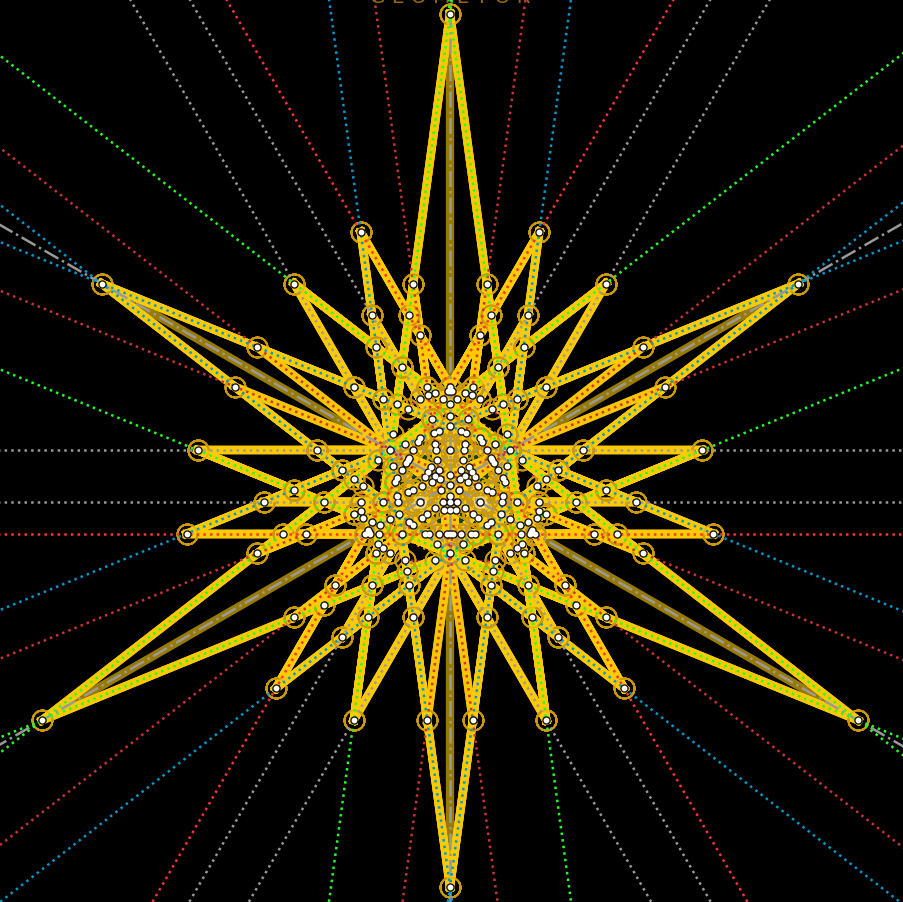
Summary: Proposition 131 · Harmonic Conjugates
Exact Symbolic Audit & geometor.pappus Verification
1. The Fourth Harmonic Conjugate
Given three distinct collinear points $A, B, C$, their fourth harmonic conjugate $D$ satisfies:
\[\operatorname{CR}(A, B; C, D) = \frac{(A - C)(B - D)}{(A - D)(B - C)} = -1.\]
Solving for $D$ gives the exact rational formula:
\[D = \frac{2AB - C(A + B)}{2C - (A + B)}.\]
2. Straightedge Construction & 81 Harmonic Tetrads
Implemented in
geometor.pappus.construct_harmonic_fourth(): constructs the point $D$ using an auxiliary complete quadrilateral by ruler alone, with zero measurement of angles or distances.In the full 9-point, 9-line Pappus–Steiner configuration, the cross-joins and diagonals create exactly 81 collinear harmonic ranges across the complete network of intersection points.