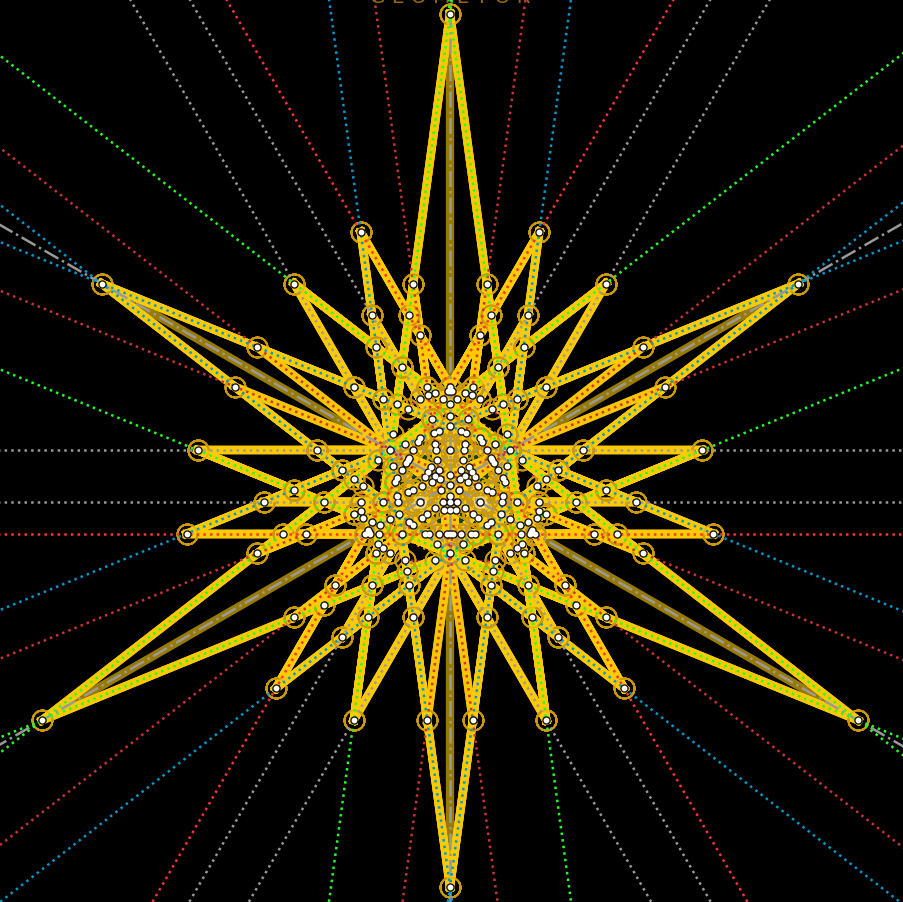
Proposition 131: Complete-Quadrilateral Harmonic Conjugates

Synagoge Book VII, Proposition 131 (Hultsch II, pp. 874–876, Lemma V to Euclid’s Porisms) · Critical English Edition

In Proposition 131, Pappus applies cross-ratio invariance to the geometry of the complete quadrilateral, demonstrating that opposite sides and diagonals cut any transversal line across the figure in harmonic division ($\operatorname{CR} = -1$).

Emergent Harmonic Ranges in the Pappus–Steiner Configuration [ A0 B0 ]: -x - y + 1 = 0 [ A0 B1 ]: x - 1 = 0 [ A0 B2 ]: -3*x + 3*y + 3 = 0 [ A1 B0 ]: -x - 2*y + 2 = 0 [ A1 B1 ]: -3*x/2 - y + 3 = 0 [ A1 B2 ]: -3*x + 2*y + 6 = 0 [ A2 B0 ]: -x - 3*y + 3 = 0 [ A2 B1 ]: -3*x/2 - 2*y + 9/2 = 0 [ A2 B2 ]: -3*x + y + 9 = 0 [ A0 A2 ]: y = 0 [ B0 B2 ]: -2*x + 4*y - 4 = 0 [ M0110 M1221 ]: y - 1/2 = 0 [ M0210 M1122 ]: 4*x/3 + 4*y/3 - 20/9 = 0 [ M0011 M1220 ]: -36*x/11 - 20*y/11 + 84/11 = 0 [ M0211 M1022 ]: 36*x/35 + 44*y/35 - 12/5 = 0 [ M0012 M1120 ]: -36*x/35 + 4*y/35 + 12/7 = 0 [ M0112 M1021 ]: y + 3/2 = 0 [ S1 S2 ]: 2*x + 13*y/9 - 25/6 = 0 X1 = (5/3, 0) X2 = (7/3, 0) X3 = (25/12, 0) X4 = (-1, 1/2) X5 = (4/9, 11/9) X6 = (32/23, 39/23) X7 = (20/29, 39/29) X8 = (32/17, 33/17) X10 = (1/2, 1/2) X12 = (1, 12/5) X13 = (1, 12/11) X14 = (7/4, 3/4) X15 = (-1/2, -3/2) X16 = (101/62, 39/62) X17 = (32/13, -3/13) X18 = (32/19, 3/19) X19 = (49/23, -3/46) X20 = (5/3, 1/2) X21 = (3, -3/2) X22 = (28/15, -1/5) X23 = (36/17, 3/17) X24 = (51/25, 3/50) X25 = (15/8, 3/8) X27 = (147/82, 33/82) X28 = (-7/3, 4) X29 = (23/13, 12/13) X30 = (19/6, 1/2) X31 = (11/4, -3/4) X32 = (103/38, -33/38) X33 = (7/6, 1/2) X34 = (37/18, 1/2) X35 = (-4/3, 3) X36 = (16/9, 1) X37 = (25/6, -3/2) X38 = (3/2, -3/2) A0 = (1, 0) A1 = (2, 0) A2 = (3, 0) B0 = (0, 1) B1 = (1, 3/2) B2 = (4, 3) O = (-2, 0) M0110 = (1, 1/2) M1221 = (7/3, 1/2) M0220 = (3/2, 1/2) M0210 = (4/3, 1/3) M1122 = (8/3, -1) M0120 = (1, 2/3) M1220 = (24/11, 3/11) M0221 = (13/7, 6/7) M0211 = (8/5, 3/5) M1022 = (20/7, -3/7) M0012 = (8/5, -3/5) M1120 = (12/7, 3/7) M0112 = (1, -3/2) M1021 = (5, -3/2) M0022 = (5/2, -3/2) S1 = (31/18, 1/2) S2 = (19/6, -3/2) A0 A1 A2 B0 B1 B2 O S+ S−

Proposition 131 (Harmonic Division on a Complete Quadrilateral): Given three collinear points $A, B, C$, to find the fourth point $D$ on their line such that $(A, B; C, D)$ is divided harmonically—that is:

\[\frac{AC}{CB} = \frac{AD}{DB} \quad \Longleftrightarrow \quad \operatorname{CR}(A, B; C, D) = -1.\]
step Construction (Straightedge Alone): Take any point $P$ not on line $AB$, and draw rays $PA, PB, PC$. From any point $Q$ on $PB$, draw a line through $C$ meeting $PA$ at $R$. Let $AQ$ and $BR$ intersect at $S$. The join $PS$ meets line $AB$ at the fourth harmonic point $D$.
step Demonstration: The four vertices $P, Q, R, S$ form a complete quadrilateral whose three pairs of opposite sides are $(PQ, RS)$, $(PR, QS)$, and $(PS, QR)$. Central projection from $P$ onto $QR$ followed by projection from $A$ back onto line $AB$ preserves the cross-ratio. By Pappus’s lemma, the resulting involution forces the harmonic cross-ratio $\operatorname{CR}(A, B; C, D) = -1$, completely independent of the choice of auxiliary points $P$ and $Q$.