Part II, Chapter I — Critical & Symbolic Notes
Cantor’s 1874 vs. 1891 Proofs, Golden Section at Height $N = 4$, and Foundational Impact
Historical & Sister-Corpus Notes
Klein’s Synthesis of Cantor 1874 and Halle 1891: In Cantor's original 1874 paper (Crelle's Journal, Vol. 77, pp. 258–262), the uncountability of every interval $[\alpha, \beta]$ was proved by nested intervals $[a_\nu, b_\nu]$ skipping sequence elements, whereas his 1891 Halle note introduced the pure diagonal argument on binary sequences without mentioning algebraic numbers. Klein’s 1895 Göttingen lecture is the historic text that fused Cantor’s 1874 algebraic-height enumeration with the 1891 decimal diagonal construction (explicitly excluding trailing $9$’s to ensure decimal uniqueness)—creating the canonical exposition taught in mathematics ever since!
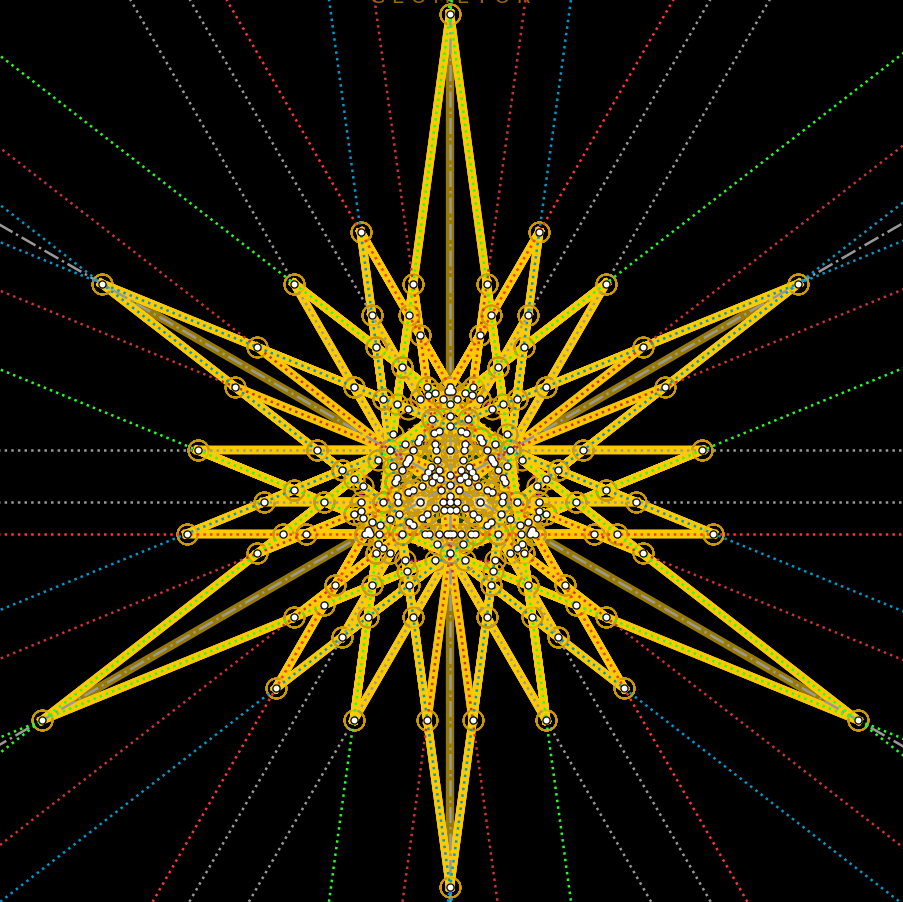
Golden Ratio and Root-Two at Height $N = 4$ (`geometor/divine` & `geometor/fundamentals`): Notice that the very first irrational numbers to appear in Cantor’s height hierarchy occur at $N = 4$ ($n = 2$, $|a_0| + |a_1| + |a_2| = 3$), consisting of precisely two families: the diagonal of the unit square $\pm\sqrt{2}, \pm\frac{1}{\sqrt{2}}$ ($\omega^2 - 2 = 0$, $2\omega^2 - 1 = 0$) and the golden section $\phi = \frac{1 + \sqrt{5}}{2}$ with its conjugates $\frac{\pm 1 \pm \sqrt{5}}{2}$ ($\omega^2 \mp \omega - 1 = 0$)!
Continuum & Foundations (`geometor/hilbert`, `geometor/bertrand-russell`, `geometor/hoenen`): Klein’s contrast between countable algebraic point-fields (such as Hilbert’s constructible pythagorean/quadratic fields $\Omega$ in Grundlagen der Geometrie, 1899) and the full Dedekind–Cantor continuum informs both Bertrand Russell's analysis of continuity (1897) and P. H. J. Hoenen's epistemological critique of geometric intelligibility vs. arithmetic set constructions (1954).