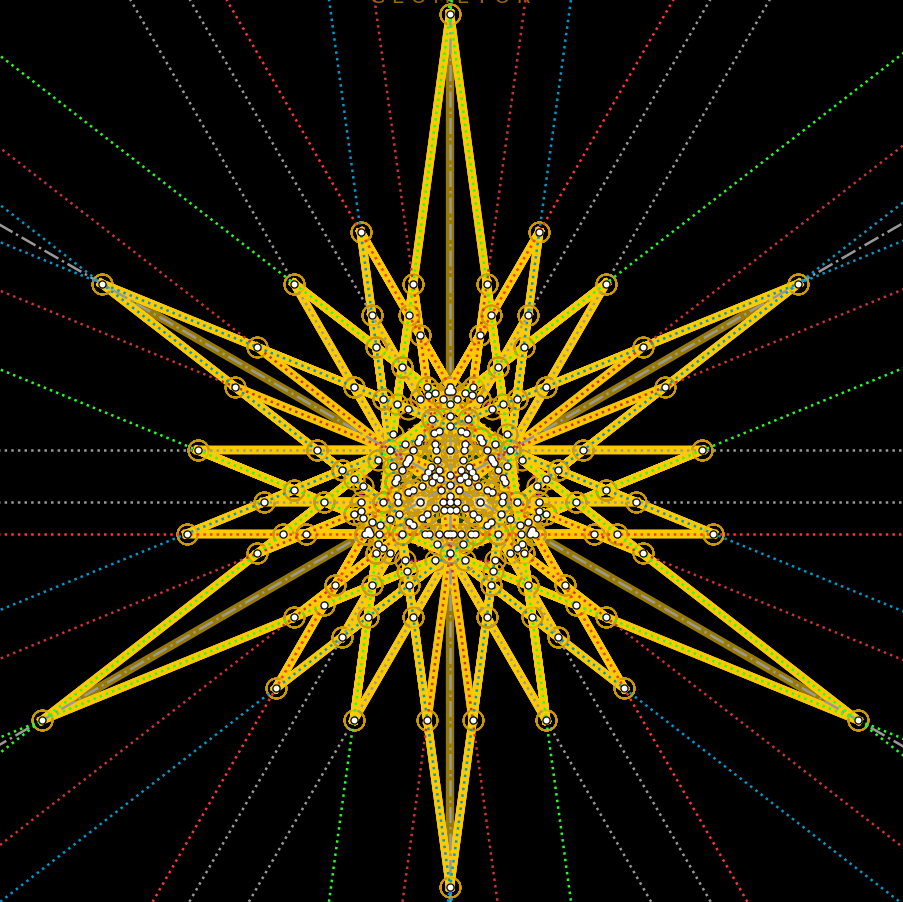
§ 5. Choice of Space-Element & Hesse’s Principle — Summary¶
Dimensionality as Relative to the Space-Element & Dedekind Bodies
§ 5. Arbitrariness of the Space-Element and Transitive Group-Bodies (Körper)¶
Dimension Is Relative to the Space-Element: Taking points ($\infty^3$), lines ($\infty^4$, Plücker), planes ($\infty^3$), or general quadrics ($\infty^9$) as the primary space-element changes the dimension of space at will, while preserving the mathematical substance of the geometry so long as the underlying transformation group remains unchanged.
Hesse’s Principle & Plücker’s Line Quadric: Pairing points on a conic identifies binary form theory with Cayley–Klein planar metric geometry; similarly, Plücker’s $6$ homogeneous line coordinates satisfying $p_{01} p_{23} + p_{02} p_{31} + p_{03} p_{12} = 0$ identify $3$-dimensional projective geometry ($\operatorname{PGL}_4 \rtimes \mathbb{Z}_2$) with $5$-dimensional projective metric geometry relative to the Klein quadric in $\mathbb{P}^5$.
Group-Bodies (*Körper*): Borrowing Dedekind’s algebraic term Körper, Klein defines a geometric body as a single transitive orbit $G \cdot x_0$ (requiring in 1893 that the stabilizer contain no normal subgroup of $G$). Coherent coordinate representation demands that chosen space-elements form a single Körper (homogeneous space) or decompose cleanly into Körper.