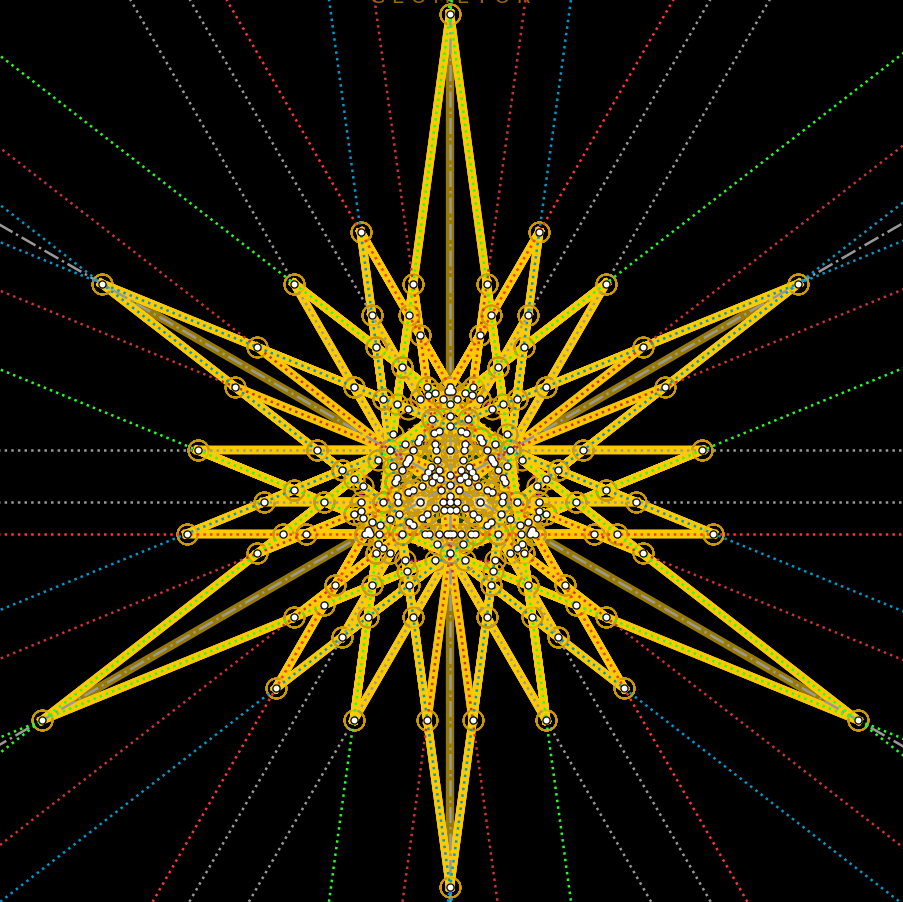
§ 5: Choice of Space-Element & Plücker Quadric — Critical & Symbolic Notes¶
Plücker’s Line Geometry, the Klein Quadric in $\mathbb{P}^5$, and Dedekind Bodies
The Plücker–Klein Quadric in $\mathbb{P}^5$¶
$\operatorname{PGL}_4(\mathbb{C}) \rtimes \mathbb{Z}_2 \;\cong\; \operatorname{PO}_6(\mathbb{C})$ (The Plücker–Klein Quadric): Representing a line joining $X = (x_0 : x_1 : x_2 : x_3)$ and $Y = (y_0 : y_1 : y_2 : y_3)$ in $\mathbb{P}^3$ by its six $2 \times 2$ Plücker determinants $p_{ij} = x_i y_j - x_j y_i$ embeds the Grassmannian $\operatorname{Gr}(2, 4)$ as the smooth $4$-dimensional quadric
\[\Omega_{\text{Plücker}}(p) \;=\; p_{01} p_{23} + p_{02} p_{31} + p_{03} p_{12} \;=\; 0 \quad \subset \mathbb{P}^5,\]where spatial collineations and dualities correspond to the two connected components of orthogonal transformations preserving $\Omega_{\text{Plücker}} = 0$.
Footnote 23 (1893 Addition on Normal Subgroups and Faithful Orbits): In § 5, Klein defines a Körper (“body,” modern homogeneous space $G / H$) as the orbit of a geometric element under $G$. In 1893, Klein added Footnote 23 pointing out that if the stabilizer $H = \operatorname{Stab}_G(x_0)$ contains a nontrivial self-conjugate (normal) subgroup $N \triangleleft G$, then $N$ acts trivially on every element $g \cdot x_0$ of the orbit ($N \subset g H g^{-1}$), so the orbit represents only the quotient group $G / N$ rather than $G$ faithfully. For instance, points at infinity fail to represent translations inside the affine or Euclidean group because translations act trivially on the plane at infinity!
Cross-Corpus Links in GEOMETOR¶
Bertrand Russell on Dimension & Space-Elements (`geometor/bertrand-russell`): In An Essay on the Foundations of Geometry (1897), Russell directly engages Klein’s § 5 thesis that dimensionality is relative to the chosen space-element (Raumelement).