Section 2: Bee Honeycombs & Discovery of the Two Rhombic Polyhedra¶
Original GEOMETOR English translation from Johannes Kepler’s Strena seu de Nive Sexangula, §§4–9 (Frankfurt am Main: Tampach, 1611; Frisch VII, pp. 718–722).
Let us examine familiar natural architectures where regular geometry arises from material necessity. Bees build hexagonal wax prisms (Pappus, Synagoge V) so that every wall is shared by two neighboring chambers without empty interstices. Yet inspect the bottoms (fundi) of a two-layered honeycomb! Each six-sided tube terminates not in a flat floor, but in an obtuse three-plane pyramidal keel composed of three congruent rhombi, meeting three-by-three against the staggered cells of the opposite layer.
Moved by this observation, I set my mind to inquiring via geometry whether there might exist any solid body—analogous to the five Platonic solids and Archimedes's thirteen solids, though missed by antiquity—bounded exclusively by congruent rhombi. And I discovered two:
The first, akin to the Cube and Octahedron, is enclosed by twelve congruent rhombi (Rhombic Dodecahedron, ABCD), having fourteen vertices—eight obtuse trihedral corners matching the cube and six acute four-edged corners matching the octahedron—and twenty-four edges, with long diagonal AC to short diagonal BD in exact ratio $\sqrt{2} : 1$ and dihedral angle $120^\circ$.
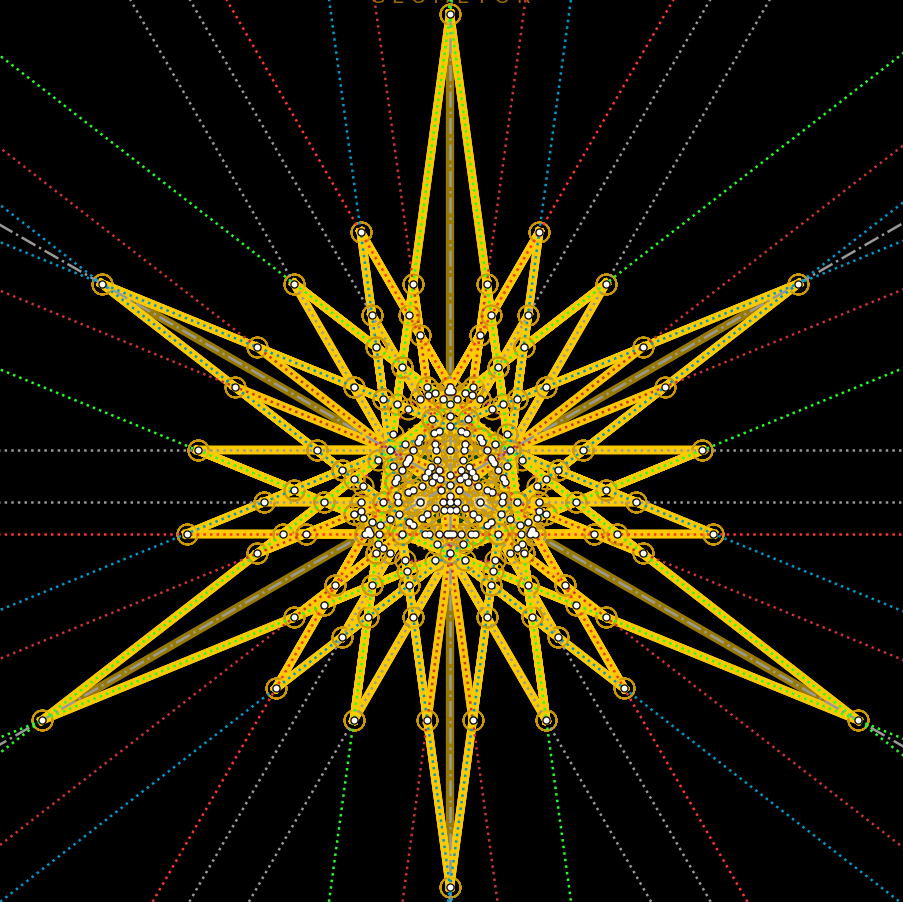
The second, akin to the Dodecahedron and Icosahedron, is enclosed by thirty congruent golden rhombi (Rhombic Triacontahedron), having thirty-two vertices and sixty edges, whose diagonals stand in the exact Divine Section $\phi : 1$.
Above all, the first of these two bodies shares with the Cube a most remarkable property which the second lacks: just as plane hexagons and squares cover a flat surface without leaving any gap, twelve-faced rhombic dodecahedra pack together in three-dimensional space to fill solid volume completely without a single void (impletrix loci solidi), three $120^\circ$ dihedral edges meeting seamlessly along every line ($3 \times 120^\circ = 360^\circ$)!