Section 3: Pomegranate Seeds & the Sphere Close-Packing Conjecture¶
Original GEOMETOR English translation from Johannes Kepler’s Strena seu de Nive Sexangula, §§10–14 (Frankfurt am Main: Tampach, 1611; Frisch VII, pp. 722–726).
Turn next to the pomegranate (malum granatum), whose angular crimson kernels are packed tightly inside a tough rind. Why are those seeds faceted into rhomboidal planes? Not from any formal soul counting faces, declare I, but from material compression of round globules!
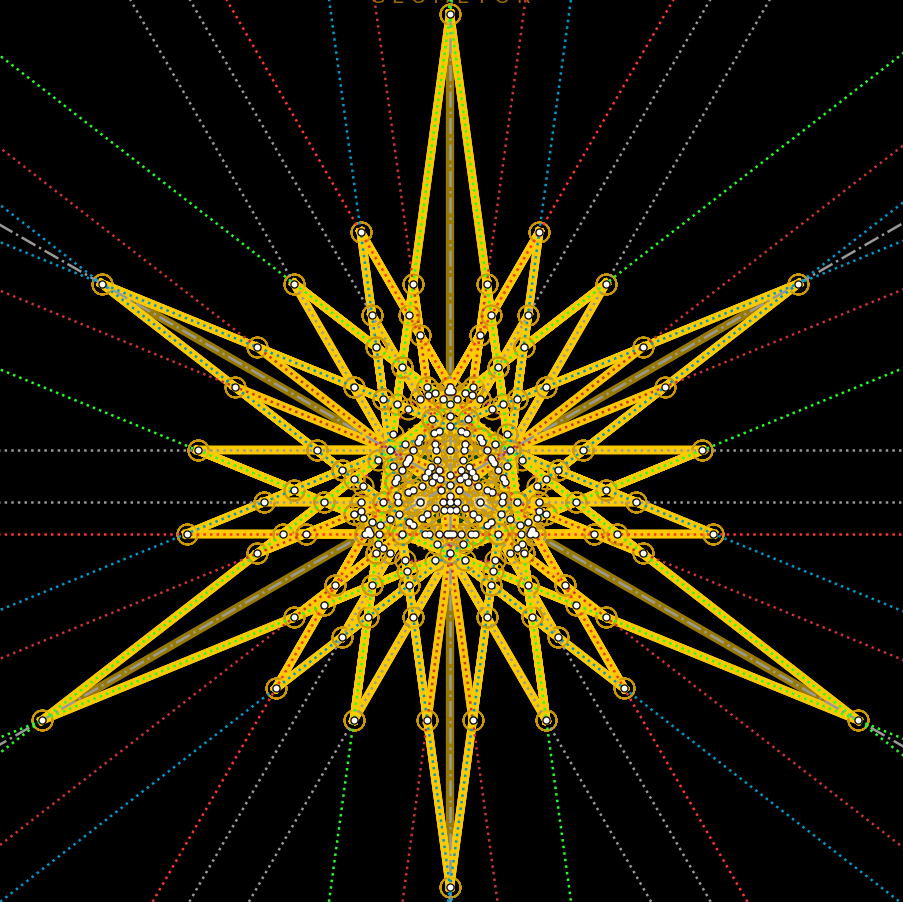
Suppose you gather equal round pellets on a single horizontal plane and press them together until they touch one another mutually: they coalesce either in quadrangular order (where four neighbors touch one central pellet at $90^\circ$) or in triangular order (as in the rosette figure above, where six pellets P0–P5 surround one central pellet O along hexagon HEX with equal center-to-center quadrances $Q = 4R^2$). Now stack such layers in three dimensions:
Stacking square layers directly atop square layers yields simple cubic order, where each sphere is touched by six neighbors ($\eta_{\text{cubic}} = \frac{\pi}{6} \approx 52.36\%$).
Seating each sphere of a square layer into the hollow pit of four spheres below—or equivalently seating each sphere of a triangular-hexagonal layer into the hollow of three spheres below—yields pyramidal close-packing, where every interior sphere is kissed simultaneously by twelve neighbors (six in its own horizontal plane, three above, and three below)!
“The fitting together will become the **tightest possible*, so that in no other arrangement whatsoever could more globules be packed into the same vessel”* (Coaptatio fiet arctissima, ut nullo praeterea ordine plures globuli in idem vas compingi queant — the Kepler Conjecture, $\eta_{\text{FCC}} = \frac{\pi}{3\sqrt{2}} \approx 74.048\%$).
And if uniform swelling or external pressure squeezes these twelve-kissed spheres until all interstitial voids vanish, each sphere deforms into an exact Rhombic Dodecahedron!