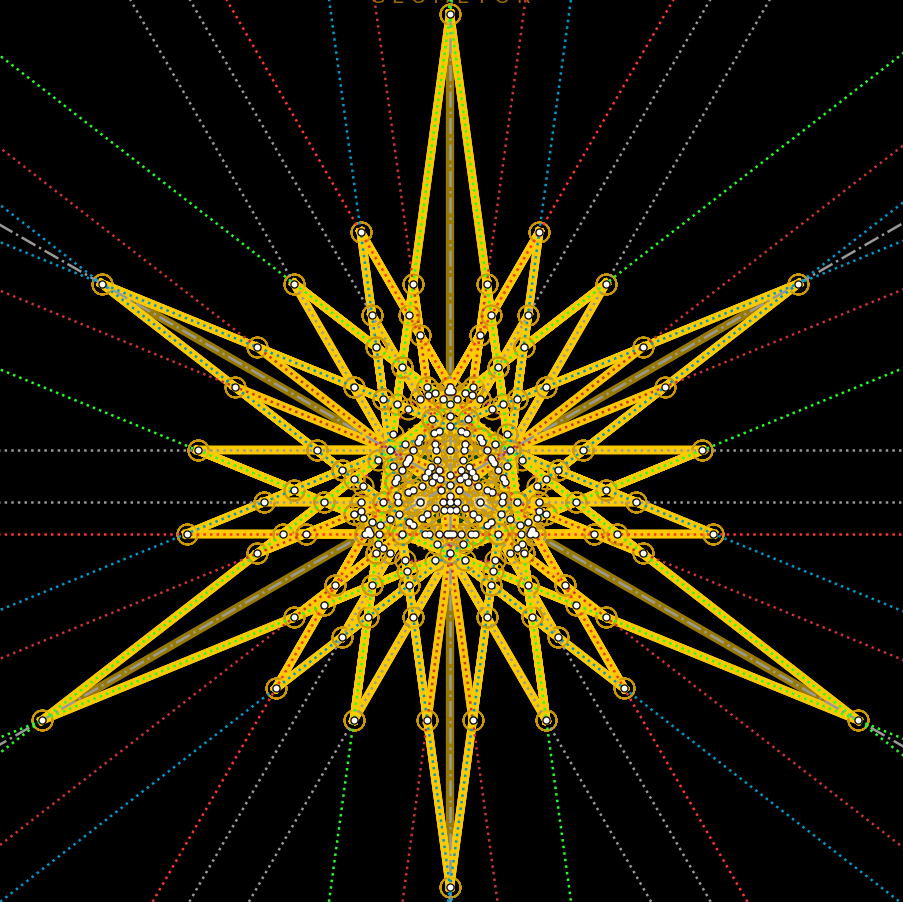
Chapters XII–XIII: Historical & Mathematical Commentary
Exact Algebraic Proof of Polar-Duality Sphere Equality
Why do the Dodecahedron ($\{5, 3\}$, 12 pentagonal faces, 20 vertices) and Icosahedron ($\{3, 5\}$, 20 triangular faces, 12 vertices) possess the exact same insphere-to-circumsphere ratio? Let any regular polyhedron $\{p, q\}$ have edge half-angle $\alpha$, face-center-to-edge-midpoint angle $\beta$, and vertex-to-face-center angle $\gamma$ on the unit sphere. In the right spherical triangle formed by a vertex $V$, an adjacent edge midpoint $E$, and a face center $F$:
$$\frac{r_{\text{in}}}{R_{\text{out}}} = \cos\gamma = \cot\frac{\pi}{p}\,\cot\frac{\pi}{q}.$$
Swapping $p \leftrightarrow q$ leaves the product $\cot(\pi/p)\cot(\pi/q)$ strictly invariant! In geometor.kepler.mysterium_spheres.derive_platonic_sphere_ratios, we verify this without trigonometry directly over $\mathbb{Q}(\phi)$:
For the Dodecahedron on $Q_{\text{out}} = 3$, the pentagonal face in plane $x + \phi z = \phi + 1$ has centroid $G = \frac{1}{5}(\phi + 2,\, 0,\, 3\phi + 1)$ with $Q_{\text{in}} = \frac{4\phi + 3}{5}$, giving $\frac{Q_{\text{in}}}{Q_{\text{out}}} = \frac{4\phi + 3}{15} = \frac{5 + 2\sqrt{5}}{15}$.
For the Icosahedron on $Q_{\text{out}} = \phi + 2$, the triangular face $(0, 1, \phi), (0, -1, \phi), (\phi, 0, 1)$ has centroid $G' = \frac{1}{3}(\phi,\, 0,\, 2\phi + 1)$ with $Q_{\text{in}} = \frac{3\phi + 2}{3}$. Multiplying numerator and denominator of $\frac{3\phi + 2}{3(\phi + 2)}$ by $(3 - \phi)$—using $(\phi + 2)(3 - \phi) = 5$ and $\phi^2 = \phi + 1$—reduces identically to $\frac{4\phi + 3}{15}$!