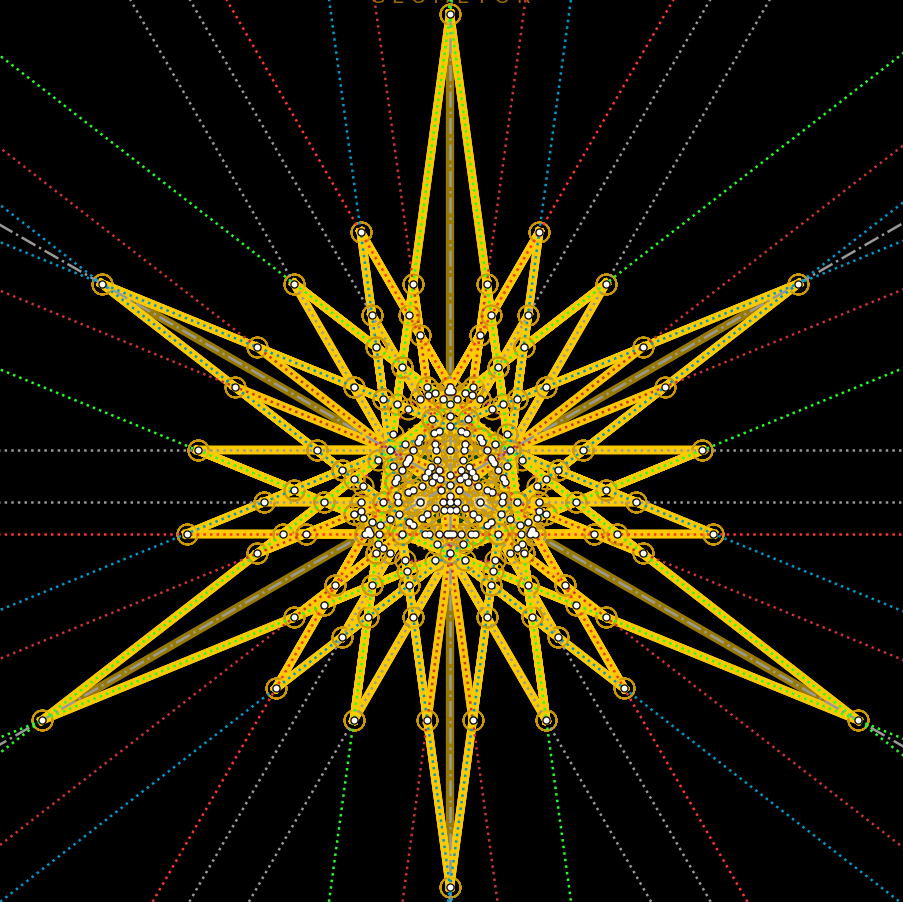
Chapters XII–XIII: The Two Treasures of Geometry & Polar Duality
Original GEOMETOR English translation from Johannes Kepler’s Mysterium Cosmographicum, Capita XII–XIII (Tübingen, 1596; Frankfurt, 1621; Frisch I, pp. 138–143).
Geometry possesses two great treasures: the one is the ratio of the hypotenuse to the legs in a right-angled triangle ([I.47]), and the other is the straight line cut in extreme and mean ratio—the Divine Section ([II.11], [VI.30]). The first you may rightly compare to a measure of gold (massa auri); the second we may call a precious jewel (gemma). For from the first flows the construction of the Cube, the Tetrahedron (Pyramis), and the Octahedron; whereas from the second—self-propagating and ineffable—flows the construction of the Dodecahedron and the Icosahedron (Pacioli 1509).
When each regular solid is inscribed in a unit outer sphere ($R_{\text{out}} = 1$, $Q_{\text{out}} = 1$) so that its vertices touch the outer planet’s inner boundary while an inner sphere ($r_{\text{in}}$, $Q_{\text{in}} = r_{\text{in}}^2$) touches the centers of its faces, exact Euclidean demonstration yields three distinct quadrance ratios, because polar-dual solids share identical insphere-to-circumsphere proportions:
Cube & Octahedron ($\{4, 3\}$ and $\{3, 4\}$):
$$\frac{r_{\text{in}}}{R_{\text{out}}} = \frac{1}{\sqrt{3}} = \frac{\sqrt{3}}{3} \approx 0.57735, \qquad \frac{Q_{\text{in}}}{Q_{\text{out}}} = \frac{1}{3}.$$
Tetrahedron ($\{3, 3\}$, self-dual):
$$\frac{r_{\text{in}}}{R_{\text{out}}} = \frac{1}{3} \approx 0.33333, \qquad \frac{Q_{\text{in}}}{Q_{\text{out}}} = \frac{1}{9}.$$
Dodecahedron & Icosahedron ($\{5, 3\}$ and $\{3, 5\}$ over $\mathbb{Q}(\phi)$):
$$\frac{r_{\text{in}}}{R_{\text{out}}} = \sqrt{\frac{5 + 2\sqrt{5}}{15}} = \sqrt{\frac{4\phi + 3}{15}} \approx 0.79465, \qquad \frac{Q_{\text{in}}}{Q_{\text{out}}} = \frac{5 + 2\sqrt{5}}{15}.$$