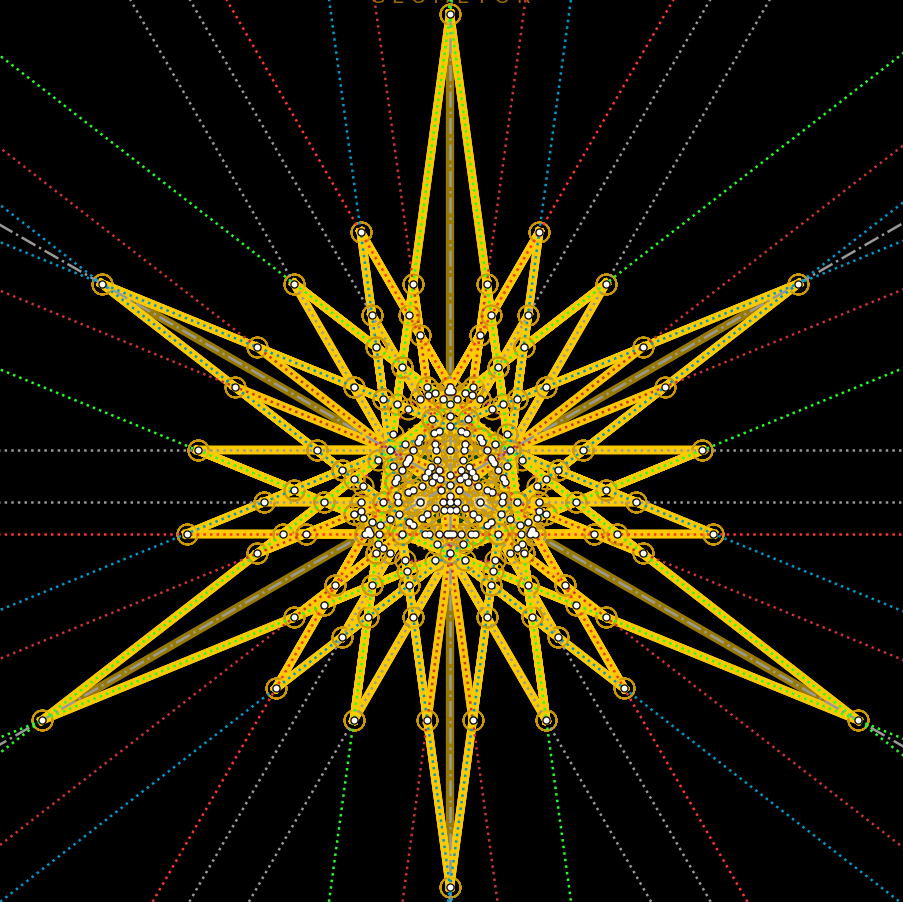
Chapter XIV: Earth as Measuring Orb (Circulus mensor omnium)
Original GEOMETOR English translation from Johannes Kepler’s Mysterium Cosmographicum, Caput XIV (Tübingen, 1596; Frankfurt, 1621; Frisch I, pp. 144–147).
The five solids divide naturally into two noble ranks: three primary solids (primaria)—the Cube, Tetrahedron, and Dodecahedron, each having distinct polygonal faces (square, triangle, pentagon) and simple three-edge trihedral vertices—and two secondary solids (secundaria)—the Icosahedron and Octahedron, borrowing the triangular face and meeting four or five to a vertex around an axis. Fittingly, the dwelling place of contemplative humanity—the orb of Earth (cTERin)—was placed as a boundary wall between these two classes as the measuring circle of all:
“Earth is the Circle that measures all things: circumscribe about it a **Dodecahedron* (DODEC); the circle comprehending this will be Mars (cMARin). About Mars circumscribe a Tetrahedron; the circle comprehending this will be Jupiter (cJUP). About Jupiter circumscribe a Cube (CUBUS); the circle comprehending this will be Saturn (cSAT). Now inscribe within Earth an Icosahedron; the circle inscribed in it will be Venus (cVEN). Within Venus inscribe an Octahedron; the circle inscribed in it will be Mercury (cMER). There you have the reason for the number of the planets!”*
In his 1621 Author’s Notes (Notae Authoris, Frankfurt, 1621), Kepler triumphantly observes that the small residual discrepancies between thin polyhedral spheres and Tycho Brahe's observations do not refute the five regular bodies, but rather correspond to the orbital eccentricities governed by harmonic consonances in Harmonices Mundi Book V (1619).