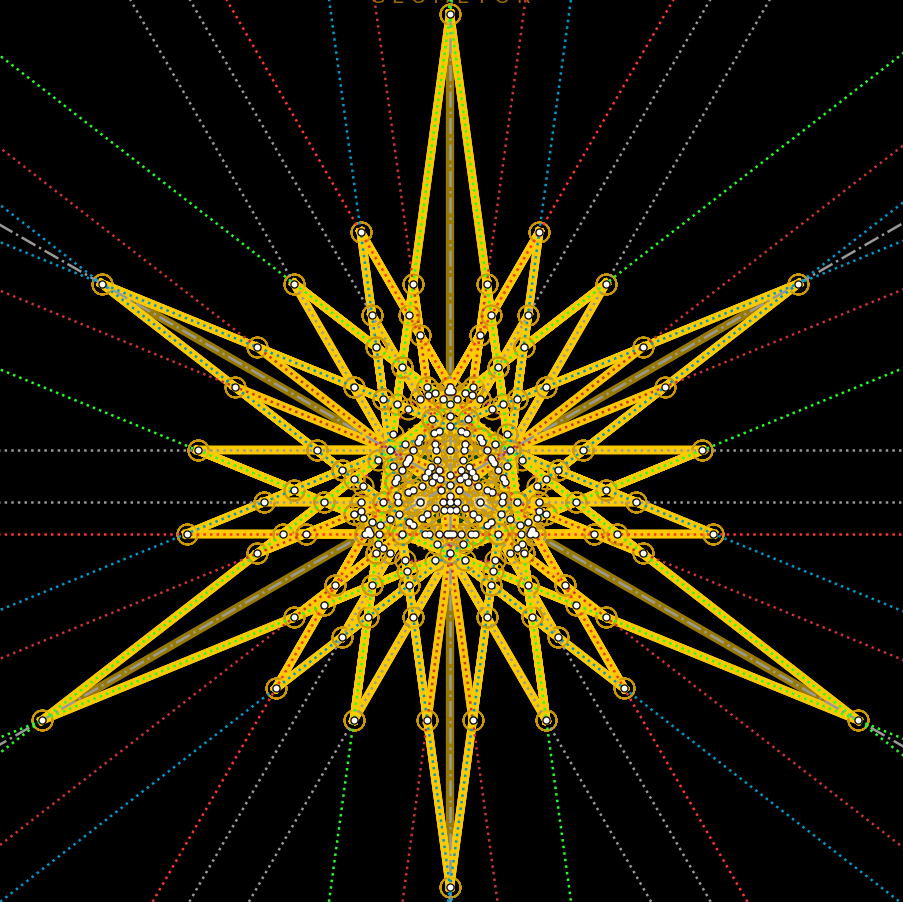
Figura Aa: Historical & Mathematical Commentary
From Kepler’s Figure Aa (1619) to Penrose Tilings (1974) & Quasicrystals
In Harmonices Mundi Book II (pp. 59–61, engraved Figura Aa), after noting that 5.5.10 fails as a uniform tiling, Kepler refused to abandon fivefold symmetry. Allowing decagons, fused twin-pentagons, regular pentagons, and star pentagrams $\{5/2\}$, he drew an extraordinary patch with concentric fivefold inflation symmetry and remarked cryptically that “if you truly wish to continue it outward, certain irregularities must be mixed in, with two decagons joined together…”
In 1974, Sir Roger Penrose (1974) proved that Kepler’s exact Aa prototiles—a regular pentagon, a five-pointed star, a three-pointed “boat” (partial star), and a “diamond” rhomb, together with decagons—tile the entire infinite Euclidean plane aperiodically through golden-ratio deflation ($\phi : 1$)! Eight years later (1982), Dan Shechtman observed sharp tenfold electron-diffraction Bragg peaks in rapidly cooled Al–Mn alloys—physical icosahedral quasicrystals built on the three-dimensional cousin of Kepler’s Figure Aa, the Golden Rhombic Triacontahedron!