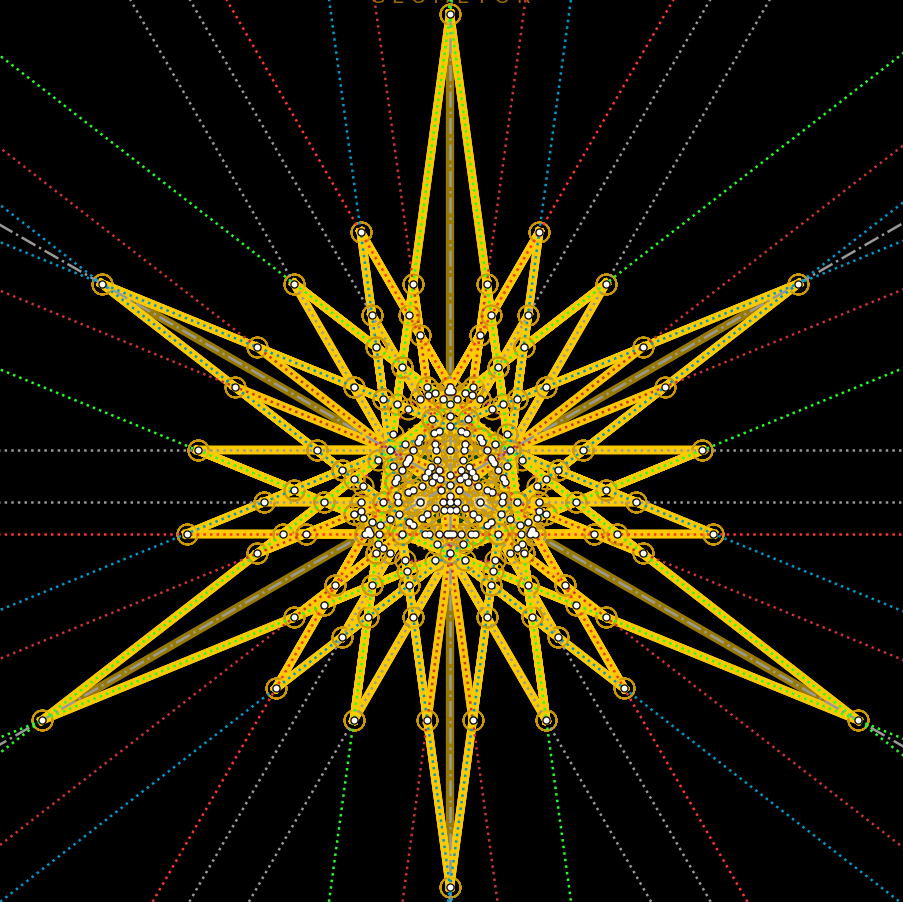
Pentagonal & Star-Pentagram Congruence (Figure Aa)
Original GEOMETOR English translation from Johannes Kepler’s Harmonices Mundi Liber II, pp. 59–61 (Linz: Tampach/Plancus, 1619; Frisch V, pp. 138–140).
Although regular pentagons ($108^\circ$) and regular decagons ($144^\circ$) cannot form a uniform vertex-transitive tiling of convex polygons alone, if we admit the five-pointed star (stella quinquangula, $\{5/2\}$, tip angle $36^\circ$, re-entrant pocket $72^\circ$), marvelous fivefold flower-like congruences blossom across the plane! Around a central decagon DEC0 (D0 in the left panel below), five regular pentagons and five star pentagrams interlock seamlessly because:
$$144^\circ + 108^\circ + 108^\circ = 360^\circ, \qquad 144^\circ + 144^\circ + 72^\circ = 360^\circ, \qquad 3 \times 108^\circ + 36^\circ = 360^\circ,$$
generating radiating rings of decagons, stars, and twin-pentagon monsters that expand outward indefinitely according to a hidden law of the Divine Section!