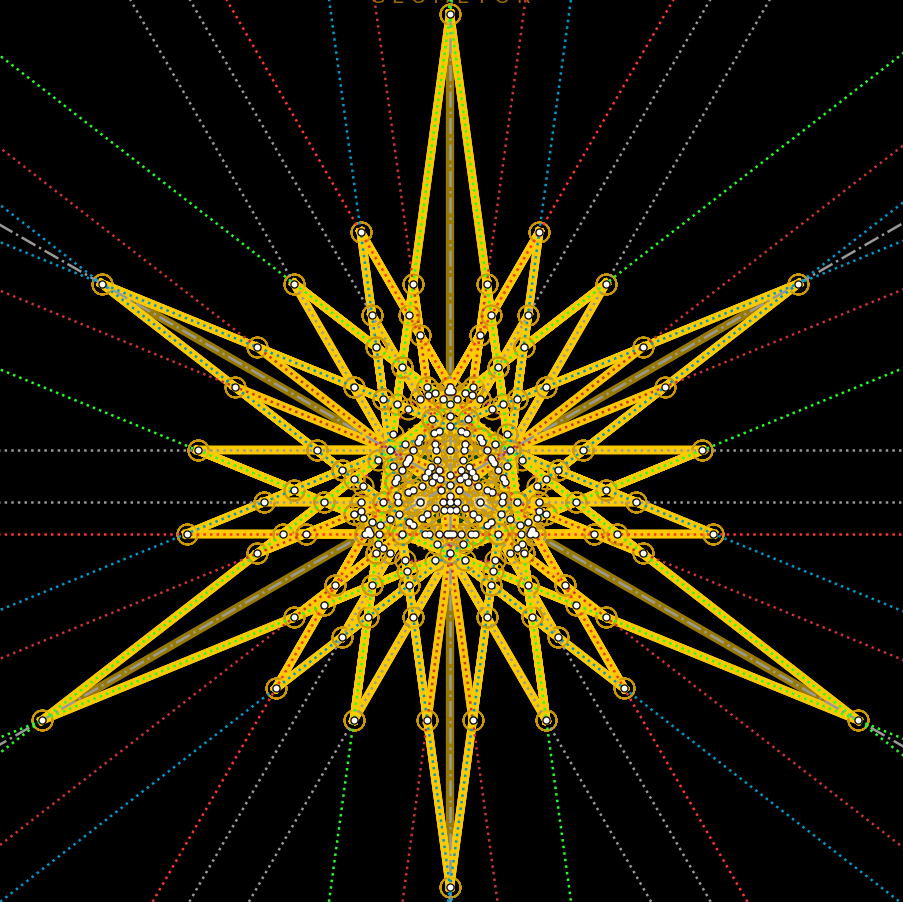
Propositions XXV–XXVIII: Star Solids, Rhombic Solids & 13 Archimedeans
Original GEOMETOR English translation from Johannes Kepler’s Harmonices Mundi Liber II, Propositiones XXV–XXVIII (Linz: Tampach/Plancus, 1619, pp. 62–66; Frisch V, pp. 140–144).
In three-dimensional solid congruence, Kepler completes the inventory of symmetric polyhedra across four families:
The Five Convex Platonic Solids (corpora quinque regularia): Cube, Tetrahedron, Dodecahedron, Icosahedron, Octahedron.
Two Regular Non-Convex Star Polyhedra (corpora stellata): Admitting twelve regular pentagrams $\{5/2\}$ as faces produces two utterly regular augmented star solids—the thorny echinus or Small Stellated Dodecahedron ($\{5/2, 5\}$, twelve 5-pointed vertices) and the Great Stellated Dodecahedron ($\{5/2, 3\}$, twenty trihedral vertices)!
Two Isohedral Rhombic Zonohedra: The 12-faced Rhombic Dodecahedron ($\sqrt{2}:1$) and the 30-faced Golden Rhombic Triacontahedron (PQRS in the right panel above, long diagonal PRgold to short diagonal QSgold in ratio $\phi : 1$).
The Thirteen Convex Archimedean Semi-Regular Solids (corpora semiregularia Archimedis, Prop. XXVIII): Cleanly setting aside the two infinite families of regular prisms and antiprisms, Kepler reconstructs, names, and proves the completeness of all thirteen semi-regular convex solids recorded by Pappus (Synagoge V.19): Truncated Tetrahedron, Cuboctahedron, Truncated Cube, Truncated Octahedron, Rhombicuboctahedron, Great Rhombicuboctahedron (Truncated Cuboctahedron), Snub Cube (Cubus simus), Icosidodecahedron, Truncated Dodecahedron, Truncated Icosahedron, Rhombicosidodecahedron, Great Rhombicosidodecahedron (Truncated Icosidodecahedron), and Snub Dodecahedron (Dodecaedron simum).