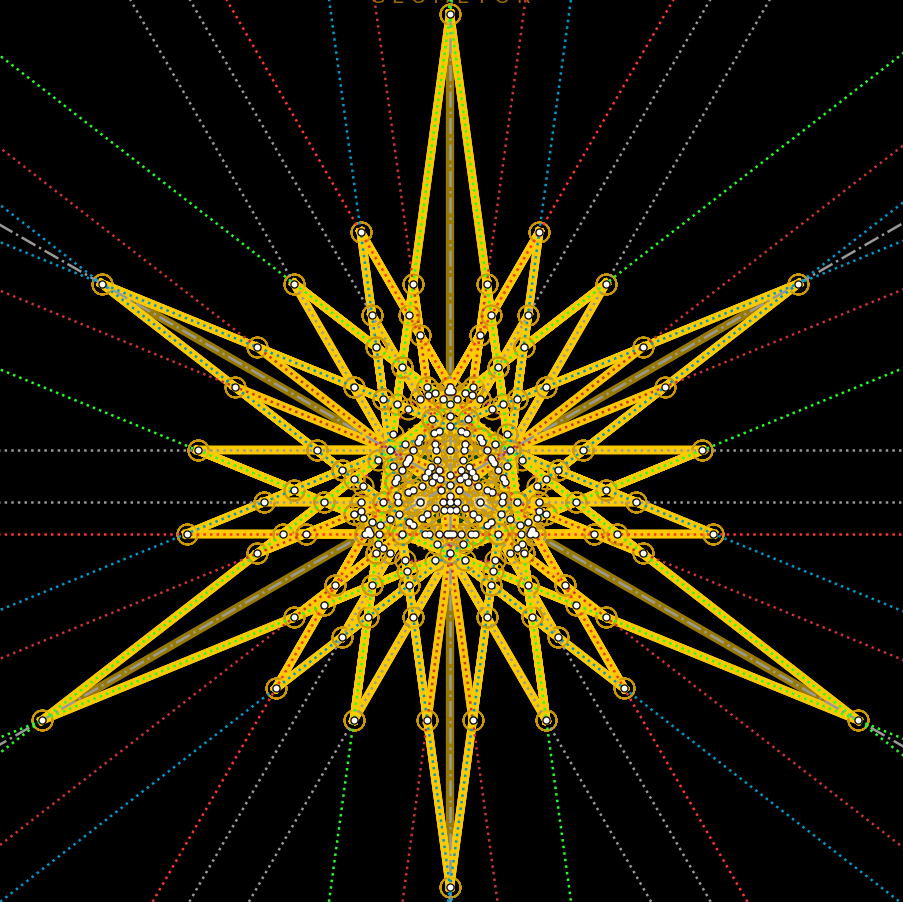
Definitions I–XXV: Historical & Mathematical Commentary¶
Gauss (1801), the 17-gon, and Wantzel (1837)¶
Kepler’s two central mathematical claims in Book I fared extraordinarily well under nineteenth-century algebra:
Exclusion of $n = 7, 9, 11, 13$: Completely vindicated by Pierre Laurent Wantzel (1837), who proved that straightedge-and-compass constructions reach solely algebraic numbers whose minimal polynomial over $\mathbb{Q}$ has degree $2^k$ (and lies in a $2$-tower of normal closures). Since $\deg(2\cos(2\pi/7)) = 3$, $\deg(2\cos(2\pi/9)) = 3$, and $\deg(2\cos(2\pi/11)) = 5$, none is constructible.
What about $n = 17$? Having seen degree $\frac{p-1}{2}$ fail for $p = 7$ (degree $3$), $p = 11$ (degree $5$), and $p = 13$ (degree $6$, containing an odd factor $3$), Kepler naturally assumed all primes $p > 5$ were non-constructible. On March 30, 1796, nineteen-year-old Carl Friedrich Gauss (1801, §365) discovered that for $p = 17$, $\frac{p-1}{2} = 8 = 2^3$ decomposes into a pure chain of three nested quadratic equations because $17 = 2^{2^2} + 1$ is a Fermat prime! Even so, for musical acoustics $17$-fold division lies far beyond primary consonance, leaving Kepler’s geometric demarcation of $\{2, 3, 5\}$ intact across the small integers.