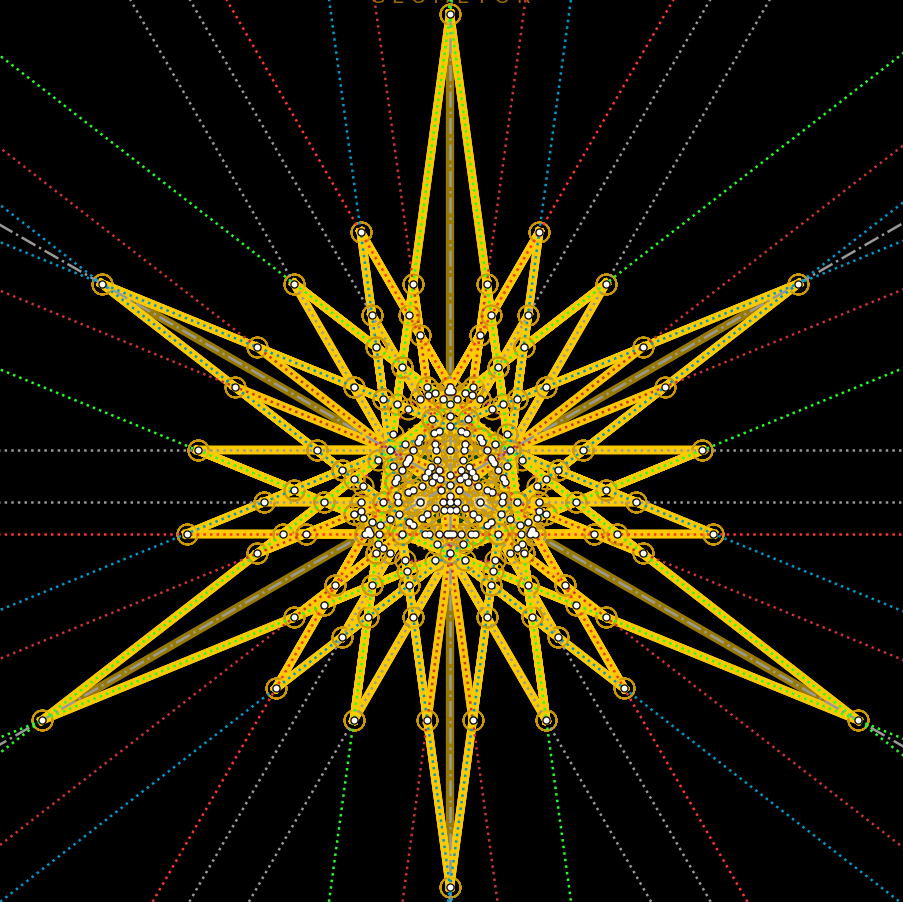
Definitions I–XXV: The Eight Degrees of Geometric Scibilitas
Original GEOMETOR English translation from Johannes Kepler’s Harmonices Mundi Liber I, Definitiones VII–XXV (Linz, 1619, pp. 3–14; Frisch V, pp. 78–92).
Definition VII (*To Know in Geometry*): To know (scire) in geometric matters is to measure by a known measure; and in our problem of inscribing figures in a circle, that canonical known measure is the diameter of the circle ($D = 2R$).
Definition VIII (*Knowable / Demonstrable*): A line or chord is called knowable (scibilis, Greek γνώριμον) when it is either directly measurable by the diameter itself, or at least derived through a definite and geometrical chain of squares and square-roots descending from the diameter.
From the diameter $D = 2R$, geometric knowability descends across eight ordered degrees:
Degree I (*Identity*): Equality with the diameter itself ($s_2 = D = 2R$).
Degree II (*Expressible in Length*): Rational commensurability in length (effabilis longitudine), exemplified by the Regular Hexagon whose side equals the radius ($s_6 = R = \frac{1}{2}D$, [IV.15]).
Degree III (*Expressible in Square Only*): Incommensurability in length paired with exact rational quadrance (effabilis potentiâ tantùm), exemplified by the Square ($s_4^2 = 2R^2 = \frac{1}{2}D^2$, [IV.6]) and the Equilateral Triangle ($s_3^2 = 3R^2 = \frac{3}{4}D^2$, [XIII.12]).
Degree IV (*Medial / Mese*): Geometric mean of two lines commensurable in square only (mese, Euclid X.21), governing areas of the Regular Octagon and Regular Dodecagon.
Degrees V & VI (*Binomial & Apotome*): Sum and difference $a \pm \sqrt{b}$ of lines commensurable in square only (binominis & apotome). Here shines forth the Regular Decagon (OG), whose side $s_{10} = \frac{\sqrt{5}-1}{2}R = \frac{R}{\phi}$ is an Apotome cut by the Divine Section ([XIII.9])!
Degrees VII & VIII (*Major / Mizon & Minor / Elasson*): Compound nested quadratic radicals $\sqrt{a \pm \sqrt{b}}$ (mizon & elasson, Euclid X.39, X.76). In the left panel below, the Regular Pentagon (PENT5) has side AG equal to an Elasson (Minor) line $s_5 = \frac{R}{2}\sqrt{10 - 2\sqrt{5}}$ ([XIII.10]), while the five-pointed star chord (stella quinquangula) is its conjugate Mizon (Major) line $d_5 = \frac{R}{2}\sqrt{10 + 2\sqrt{5}}$, followed by the Pentadecagon ($n = 15$, [IV.16]) and iterated bisections ($n = 8, 12, 16, 20, 24\dots$).