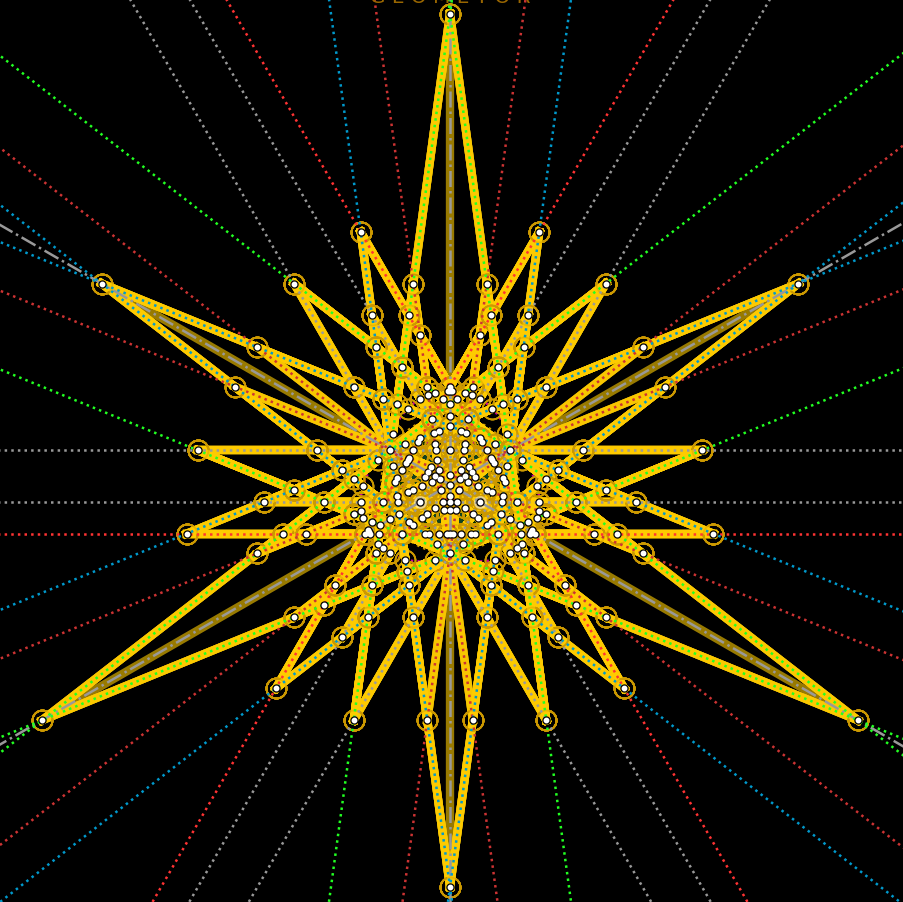
Definitiones §58: The Universal Gnomon & Golden Self-Similarity¶
Definition 58 — Universal Gnomon (*Καθόλου Γνώμων*, Heiberg §58 / Hultsch p. 21 §59):
“Primarily, in a parallelogrammic area, a :term:`gnomon <gnomon>` is any one of the parallelograms about the diameter together with the two complements (:just:`II.def.2`). **Universally, however, a gnomon is anything whatever which, when added to anything—whether number or figure—makes the whole similar to that to which it has been added* (καθόλου δὲ γνώμων ἐστὶ πᾶν ὃ προσλαβὸν ὁτιοῦν, ἀριθμὸν ἢ σχῆμα, ποιεῖ τὸ ὅλον ὅμοιον ᾧ προσείληφεν).”*
This single sentence generalizes Euclid’s parallelogram gnomon into the universal law of scale-invariant morphogenesis across arithmetic (polygonal numbers), geometry, and botanical phyllotaxis. Its supreme planar realization is the Golden Rectangle over \(\mathbb{Q}(\phi)\) (\(\phi = \frac{1 + \sqrt{5}}{2}\)):
Construct the unit square gnomon ABCD (\(AB = BC = 1\)), bisect AB at M, and swing compass circle (MC) of radius \(MC = \frac{\sqrt{5}}{2}\) onto AB extended to E ([II.11]), giving AE \(= \frac{1}{2} + \frac{\sqrt{5}}{2} = \phi\) and BE \(= \phi - 1 = \frac{1}{\phi}\).
Erect the perpendicular at E to complete the whole rectangle AEFD. Adjoining the unit square gnomon ABCD to the seed rectangle BEFC (sides \(1\) and \(\phi - 1\)) produces a whole rectangle AEFD (sides \(\phi\) and \(1\)) strictly similar to the seed:
\[\frac{AE}{AD} = \frac{\phi}{1} = \frac{1}{\phi - 1} = \frac{BC}{BE}, \qquad \frac{Q(A, E)}{Q(A, D)} = \frac{Q(B, C)}{Q(B, E)} = \phi^2 = \frac{3 + \sqrt{5}}{2}.\]Swinging circle (EB) inside BEFC cuts off a second square gnomon \(BEGH\) (G, H), leaving residual rectangle \(HGFC\) with the exact same aspect quadrance \(\phi^2\) ad infinitum, while circle (MC) also meets AB at the conjugate point E1 (\(x = -\phi^{-1}\)), forming a golden projective range \((E_1, A; B, E)\)!