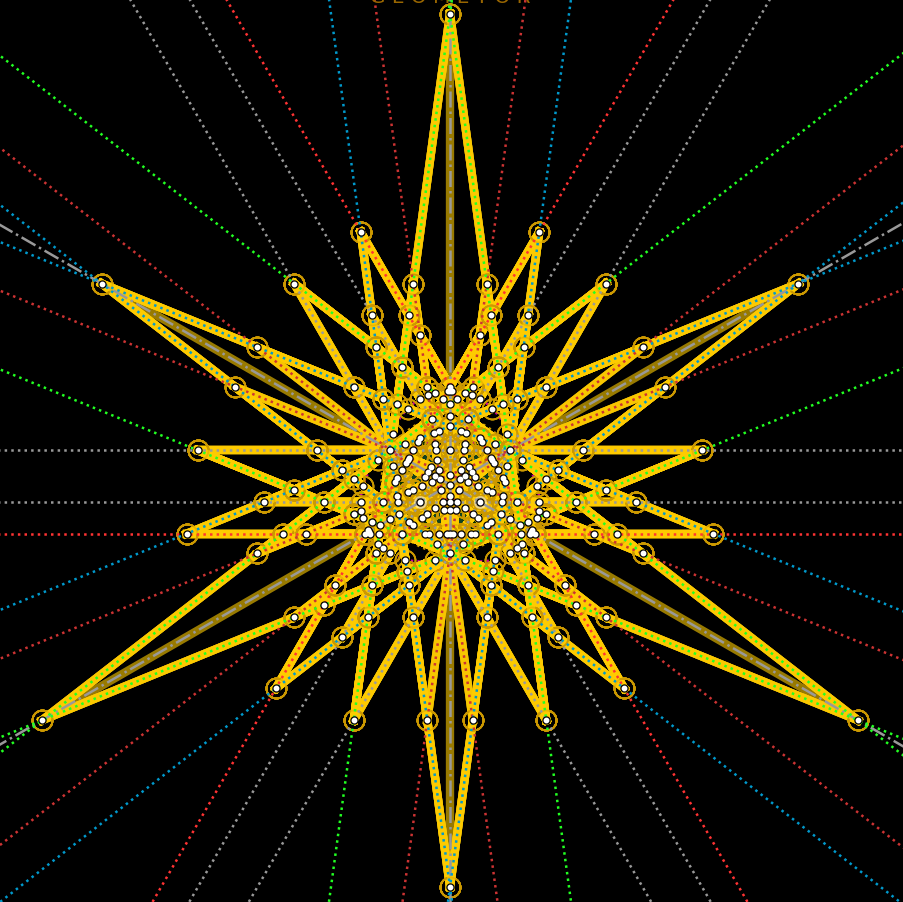
Scholarly Notes — Definitiones & Proclus Commentary
Hero’s Definition 58 & D’Arcy Wentworth Thompson’s On Growth and Form
Hero’s Definition 58 («καθόλου δὲ γνώμων ἐστὶ πᾶν ὃ προσλαβὸν ὁτιοῦν, ἀριθμὸν ἢ σχῆμα, ποιεῖ τὸ ὅλον ὅμοιον ᾧ προσείληφεν») inspired one of the most celebrated chapters of modern mathematical biology: Chapter XI (“The Equiangular Spiral”) of D’Arcy Wentworth Thompson’s On Growth and Form (1917 / 1942). Whereas Euclid restricted the gnomon to L-shaped parallelogram increments ([II.def.2]), Hero recognized that self-similar accretion unites:
Arithmetic Gnomons: Adding the odd number \(2n + 1\) to the square \(n^2\) produces the next square \((n + 1)^2\).
Planar Golden Gnomons: Adding a square of side \(1\) to a rectangle of aspect \(1 : (\phi - 1)\) produces a similar rectangle of aspect \(\phi : 1\) (and in isosceles golden triangles of \(36^\circ\text{-}72^\circ\text{-}72^\circ\) and \(108^\circ\text{-}36^\circ\text{-}36^\circ\), adjoining one gnomon triangle produces the next larger similar triangle!).
Logarithmic Spirals & Nautilus Shells: Continuous gnomonic accretion around a pole generates the equiangular spiral \(r = a e^{b\theta}\) without ever altering the organism’s shape. See Universal Golden Gnomon & Dioptra Mountain Tunnel and the
geometor/divineandgeometor/phyllotaxisrepositories.
Proclus’s Testimonies to Hero’s Direct Proofs & Axiomatic Reforms
In his Commentary on the First Book of Euclid's Elements (Friedlein pp. 196, 305–307, 340–344), Proclus records that Hero eliminated indirect proofs by contradiction in favor of direct constructive demonstrations, and established that all ten algebraic identities of Elements Book II follow directly from II.1 without separate geometrical figures.