VII.33
Given as many numbers as we please, to find the least of those which have the same ratio with them.
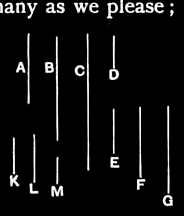
Let A, B, C be the given numbers, as many as we please; thus it is required to find the least of those which have the same ratio with A, B, C.
A, B, C are either prime to one another or not.
Now, if A, B, C are prime to one another, they are the least of those which have the same ratio with them. [VII.21]
But, if not, let D the greatest common measure of A, B, C be taken, [VII.3] and, as many times as D measures the numbers A, B, C respectively, so many units let there be in the numbers E, F, G respectively.
Therefore the numbers E, F, G measure the numbers A, B, C respectively according to the units in D. [VII.16]
Therefore E, F, G measure A, B, C the same number of times; therefore E, F, G are in the same ratio with A, B, C. [VII.def.20]
I say next that they are the least that are in that ratio.
For, if E, F, G are not the least of those which have the same ratio with A, B, C, there will be numbers less than E, F, G which are in the same ratio with A, B, C.
Let them be H, K, L; therefore H measures A the same number of times that the numbers K, L measure the numbers B, C respectively.
Now, as many times as H measures A, so many units let there be in M; therefore the numbers K, L also measure the numbers B, C respectively according to the units in M.
And, since H measures A according to the units in M, therefore M also measures A according to the units in H. [VII.16]
For the same reason M also measures the numbers B, C according to the units in the numbers K, L respectively;
Therefore M measures A, B, C.
Now, since H measures A according to the units in M, therefore H by multiplying M has made A. [VII.def.15]
For the same reason also E by multiplying D has made A.
Therefore the product of E, D is equal to the product of H, M.
Therefore, as E is to H, so is M to D. [VII.19]
But E is greater than H; therefore M is also greater than D.
And it measures A, B, C: which is impossible, for by hypothesis D is the greatest common measure of A, B, C.
Therefore there cannot be any numbers less than E, F, G which are in the same ratio with A, B, C.
Therefore E, F, G are the least of those which have the same ratio with A, B, C. Q. E. D. literally (as usual) each of the numbers E, F, G measures each of the numbers A, B, C.